 MineArchive
Balgonie Colliery
| Location | Thornton, near Markinch, Fife — 56.1756, -3.1230 (exact) |
|---|---|
| Commodities | Coal, Brick Clay, Mudstone |
| Type | Coal |
| Worked | 1883–1885–1960 |
| Maximum depth | 147 metres (482 feet), No. 1 shaft; the No. 2 shaft was 119 metres |
| Operators | Charles Babington Balfour (1883–?, landowner) Balgonie Colliery Co. Ltd (1914–1947, owner) National Coal Board (1947–1960, owner) |
Overview
Balgonie Colliery, also called the Julian Pit after its owner's initials, was sunk on the Balgonie estate near Thornton Junction in Fife between 1883 and 1885 for Charles Babington Balfour. Its two shafts reached 147 and 119 metres. It raised manufacturing and steam coal, with clay in 1896 and blaes — the Scots word for the shale and mudstone between the seams — through the 1900s and 1910s, and had a brickworks of its own whose bricks are still visible built into a nearby bridge parapet. It employed 338 people in 1894 and peaked at 490 in 1952, closing in 1960.
History
Sinking on the Balgonie estate near Thornton Junction went on through 1883 to 1885. The property belonged to Charles Babington Balfour, and the pit took the name Julian C.B.B. — the pit name and the owner's initials — as well as Balgonie. A report of 1886 gives the shaft then sunk as 80½ fathoms, or 483 feet; the two shafts finished at 147 and 119 metres. The Lists of Mines return coal from Balgonie as early as 1855 and 338 people in 1894, raising manufacturing and steam coal. Clay is returned alongside the coal in 1896 and blaes — the Scots word for the shale and mudstone between the seams — in 1905, 1910 and 1915, both of them the products of a colliery working more than the coal seam. Employment rose to 484 in 1910 and 585 in 1920. The Balgonie Colliery Co. Ltd was incorporated in 1914 as a private company to take over the colliery and the brickwork business at Markinch. The brickworks had a drying-shed floor designed by the architect James Ross Gillespie in 1902; it had either closed or been sold by 1947, since it did not pass to the National Coal Board with the colliery. Under the Board the colliery raised 140,000 tons in 1947, and its workforce averaged 448 with a peak of 490 in 1952.
Geology
Balgonie worked the Fife coalfield near Thornton, taking clay and blaes — shale and mudstone — from the same ground as the coal. Both appear in the Lists of Mines as products alongside the manufacturing and steam coal, the clay feeding the colliery's own brickworks.
Geological setting: Sedimentary Beds and Seams (well documented example)
Workings
Two shafts, the No. 1 sunk to 147 metres and the No. 2 to 119 metres; a report of 1886 gives the shaft then being sunk as 80½ fathoms or 483 feet. A brickworks stood on the colliery, worked by the same company and taken over with it when the Balgonie Colliery Co. Ltd was incorporated in 1914.
Closure
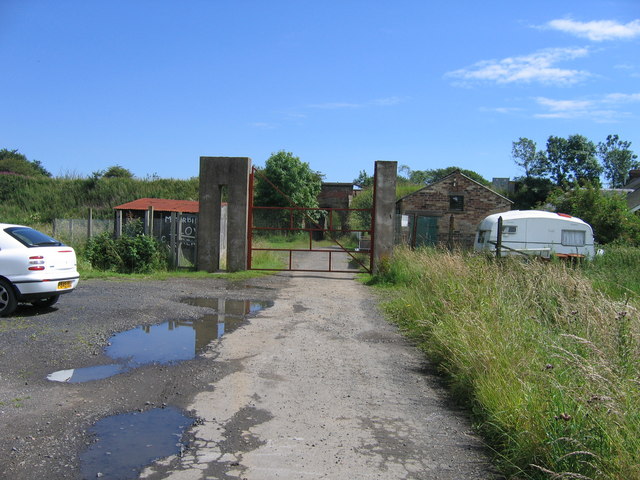
Balgonie closed and was abandoned in 1960, eight years after its peak workforce of 490. Road and rail access to the colliery ran side by side west of the Edinburgh to Dundee main line, and the entrance survives with tall concrete posts set across it.
What remains
The colliery has gone. Its entrance survives beside the Edinburgh to Dundee line, blocked with tall concrete posts, and Balgonie bricks from the colliery's own works can be seen built into the parapet of a nearby bridge over the Lochty Burn.
The colliery entrance beside the Edinburgh to Dundee line, blocked with tall concrete posts, and Balgonie bricks built into the parapet of a nearby bridge over the Lochty Burn.
Related mines
- Thornton Colliery — Both Balgonie estate collieries at Thornton; Balgonie was sunk in 1883-85, after Thornton's engine pit was abandoned.
Nearby mines
- Earlseat Colliery — 0.9 miles (1.5 km) SE
- Thornton Colliery — 1.1 miles (1.8 km) SW
- Rothes Colliery — 1.7 miles (2.7 km) SW
- Dysart Colliery — 1.8 miles (2.9 km) S
- Randolph Colliery — 1.8 miles (2.9 km) S
Straight-line distance, within 9 miles (15 km). Show on the map.
Recorded claims
Individual factual claims, each attached to the source(s) that support it below. Where sources disagree, both are kept.
- Balgonie Colliery, also known as the Julian Pit, had sinking and production commence in 1883-5; the pit name Julian C.B.B. combines the pit name with the initials of the owner, Charles Babington Balfour. 1
- The colliery had two shafts, the No. 1 sunk to 147 metres and the No. 2 to 119 metres; a report of 1886 gives the shaft then being sunk on the Balgonie estate as 80½ fathoms, or 483 feet. 1
- The average workforce was 448 and the peak 490, reached in 1952; the colliery closed and was abandoned in 1960. 1
- The Lists of Mines return manufacturing and steam coal from 1894, clay alongside it in 1896, and blaes in 1905, 1910 and 1915; the colliery raised 140,000 tons in 1947. 2
- The Balgonie Colliery Co. Ltd was incorporated in 1914 as a private company to take over the colliery and brickwork business at Markinch; the brickworks had closed or been sold by 1947, since it did not pass to the National Coal Board. 1
- The colliery brickworks made common bricks under the trade name Balgonie, listed as such in a directory of British clay products and manufacturers for 1961-62; the entire output came for years from a Hoffmann kiln, with two Newcastle kilns added by 1905. Common brick rather than refractory firebrick is why the clay is recorded here as brick clay. 1
- The BGS mine-plans catalogue holds a Mining Remediation Authority abandonment plan titled 'Balgonie' (catalogue S390, Dysart Main, dated 1962). 3
Photographs & further reading
The colliery and its brickworks together: the Julian Pit name, the 1883-5 sinking, both shaft depths, the workforce figures and the 1960 closure.
View sourceOwners, output and employment for each Lists of Mines year from 1855 to 1954, showing the clay and blaes raised alongside the coal.
View sourceSources
- (secondary) Balgonie Colliery Brickworks, Markinch — Scotland's Brick and Tile Manufacturing Industry
- (primary) Durham Mining Museum: Balgonie Colliery — Durham Mining Museum, from the Lists of Mines
- (primary) BGS / Mining Remediation Authority mine plans: BALGONIE — British Geological Survey / Mining Remediation Authority
- (observational) Entrance to Balgonie Colliery (photographed 2008) — Geograph Britain and Ireland, A-M-Jervis
- (secondary) Coaltown of Balgonie: historical perspective — The Gazetteer for Scotland
Record created: 10 September 2026 · Last researched: 10 September 2026