 MineArchive
Mudstone
| Also known as | Mudrock, Heavy clay |
|---|---|
| Category | Commodities |
| Commodity page | Mudstone → |
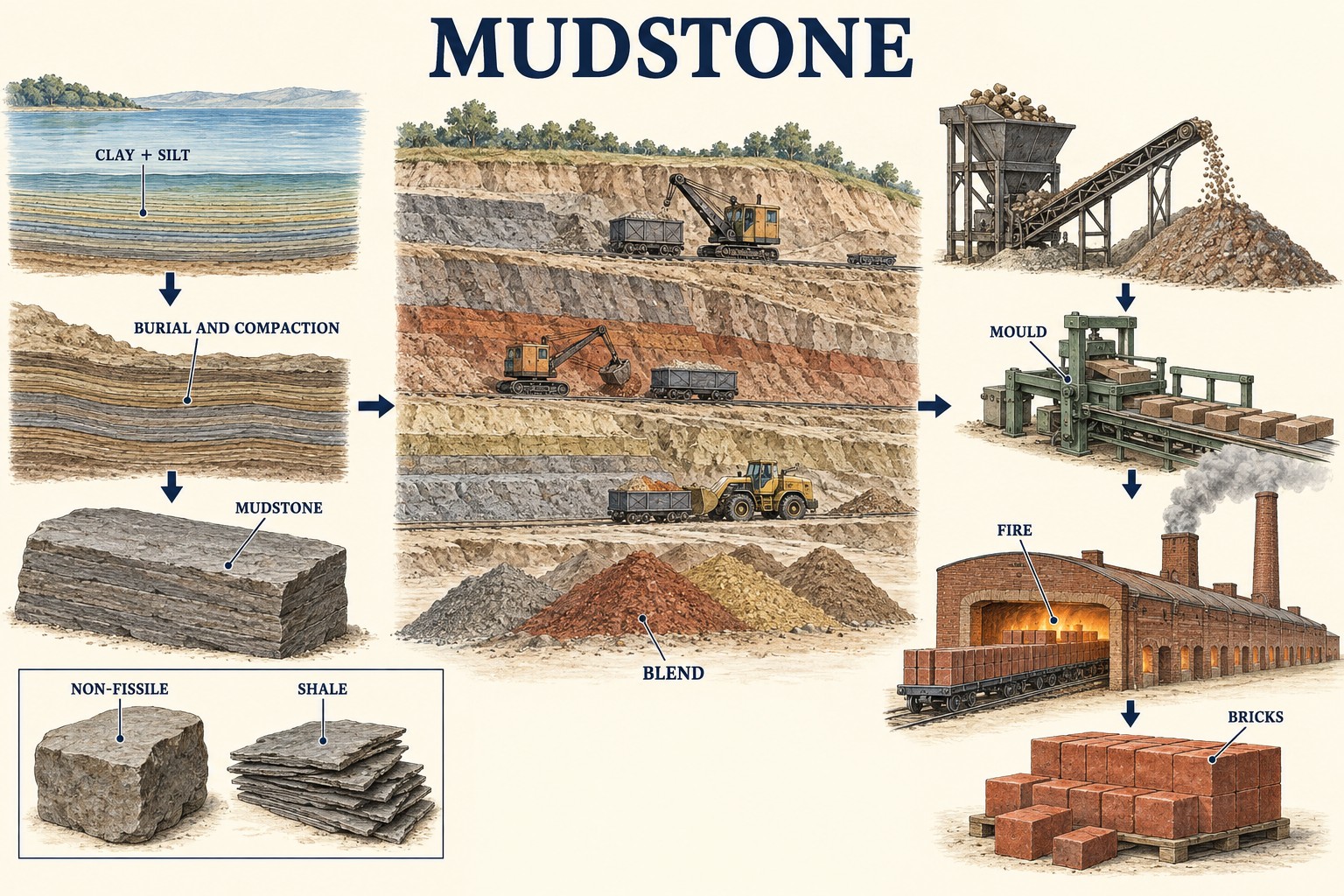
A fine-grained sedimentary rock made of consolidated mud — clay and silt particles below about a sixteenth of a millimetre across — which, unlike shale, does not split readily along bedding planes. The distinction is fissility rather than composition: in the standard classification of mudrocks a fissile rock of that grain size is a shale and a non-fissile one a mudstone, with siltstone and claystone at either end of the range.
Historical usage
Mudstone is the rock most of Britain's bricks are made from, and it is almost never called that in the trade. The industry's own term is 'heavy clay' — an established but, as the official dossier admits, scientifically misleading label covering clays, shales, marls, mudstones, siltstones and brickearth used for structural clay ware: bricks, roofing tiles, field drains, floor quarries and cable covers. Planning documents call the same material 'brick clay', defined as 'clay, shale, mudstone and other such materials'.
In this archive it appears in two quite different roles. It is the parent rock of other commodities — slate is mudstone that has been squeezed and recrystallised until it cleaves, and fireclay is a mudstone seatearth beneath a coal seam. And it is the country rock of a great many workings for something else: the Coal Measures are mudstone and shale with coal in them, and the Welsh and Pennine mines were driven through mudstone to reach veins and seams.
How it worked
Brick clay is worked at or near the surface by opencast quarrying. How the face is cut depends on the rock: where particular beds have to be avoided the quarry is benched or terraced so that they can be left, and where the material is homogeneous and free of bad bands it pays to take a deep, steeply angled face and mix the strata as they come down. Blending is normal — different beds are stockpiled in layers so that what reaches the works is consistent, and a better clay is often added to 'sweeten' a poorer one.
A great deal of it has never been quarried at all. Much Coal Measures mudstone came up as a by-product of coal working, and in Scotland, where about 90 per cent of brick production came from Carboniferous rocks, the vast majority of the shale was retrieved from old colliery bings rather than dug fresh — an industry running on spoil heaps.
Why it was used
Because it is everywhere, and because when fired it makes a structural material out of nothing more than mud and heat. A brick clay needs enough clay mineral to be plastic and hold its shape, and enough fluxing material to vitrify in the kiln; mudstones of the right composition do both, and lie in vast quantities beneath the industrial parts of Britain.
Some are better than that. The Lower Oxford Clay of the Fletton brick industry carries so much carbonaceous matter — the calorific equivalent of nearly 5 per cent organic material — that it fires largely on itself: fuel is needed to start the kiln and hold the temperature, and the bricks reach their full firing heat on the organic content of the clay alone. Coal Measures shales do the same thing on a smaller scale, and Scottish makers deliberately blended in 'firey' organic-rich shale to cut the fuel bill.
Value over time
Mudstone has never had a price as a rock; its value is the value of what is made from it, and that has always been a low-margin, high-tonnage business tied to housebuilding. It is too cheap to carry far, so works sit on their pits, and the map of the brick industry is essentially the map of workable clay.
The long trend has been fewer, larger operations. Sales of clay and shale for brick, pipe and tile making, and the number of bricks produced from them, have been tracked since 1990 and fell heavily through the recessions of the early 1990s and 2008-09 before recovering only partly; extraction is now concentrated at a much smaller number of sites, largely in England. The pressure on the good clays is a planning pressure rather than a market one: the Etruria Marl outcrop is small and much of it lies under towns, and the industry expects to blend more, and to want more premium clay, as the poorer resources are worked out.
Hazards & challenges
The rock itself is not toxic, and its dangers are mechanical and respiratory rather than chemical. A deep, steeply angled clay face is unstable ground — mudstone weathers and slakes on exposure, and a face that stood dry through the summer can slip after rain — which is why quarries with awkward beds are benched instead. Underground, mudstone is the roof and floor rock of the coalfields rather than the thing being won, and it kills there: falls of ground from a weak mudstone roof were the steadiest cause of death in British coal mining, and this archive's disaster records carry more of them than of explosions.
Dust is the occupational hazard. Grinding and milling a hard mudstone releases respirable silica from the quartz that makes up much of the rock, with the same silicosis risk as any other hard-rock working. Coal Measures mudstone carries pyrite, which oxidises to give acidic, sulphate-rich water in old workings and spoil, and carbonaceous mudstone spoil heaps have caught fire and burned for years.
Risks & limitations
Most mudstone is not worth digging. It is too weak for building stone and too soft for roadstone, and even as brick clay much of it fails: siltstone and sandstone bands in the sequence, thick overburden, and impurities such as carbon and gypsum all rule ground out. Carboniferous mudstones, which supply about a quarter of UK brick production, are variable enough that only a small proportion is fit for brickmaking — most are too high in carbon and sulphur.
The impurities show up in the finished brick. Coarse carbonate causes 'lime-blowing', where nodules of lime hydrate after firing and blow the face off the brick; pyrite in Coal Measures material gives black coring. Both can be managed — grinding the feed fine enough disperses sideritic and calcareous nodules — but they are why blending, not simply digging, is the industry's central skill. The best resource of all, the Etruria Formation of Staffordshire, has a very restricted outcrop, much of it already sterilised beneath housing.
Regional variation
Brickmaking follows the mudstone. The Mercia Mudstone Group of the Midlands — the old 'Keuper Marl' — is the single largest source, supporting around 35 per cent of UK brick production and its distinctive red and pink bodies. Carboniferous mudstones, mainly in the north of England and Scotland, account for about a quarter, and most clay drainage pipes are made from them. The Etruria Formation, or Etruria Marl, of Staffordshire and the West Midlands supplies about a fifth and is close to the ideal brick clay: most clay roof tile makers use it. The Oxford Clay of Bedfordshire and Cambridgeshire is the Fletton clay, and the Weald and Wadhurst clays supply the south-east.
Related terminology
Mines associated with this term
Included only where MineArchive's own research gives a reasonable evidential basis — not every mine where this might plausibly apply.
- Balgonie Colliery — Fife (well documented example)
Named 3 times in this record, first in the summary: “…coal, with clay in 1896 and blaes — the Scots word for the shale and mudstone between the seams — through the 1900s and 1910s, and had a…” - Cynwyd Forest Quarry — Denbighshire (well documented example)
Named twice in this record, first in the summary: “…what it produced: a section in the Late Ordovician siltstones and mudstones of the Dolhir Formation, yielding a rich shelly fauna of brachiopods…”
See every mine that worked mudstone →
Sources
- (primary) Brick Clay: Mineral Planning Factsheet (April 2022) — British Geological Survey / NERC
- (primary) Mineral Dossier No. 22: Common Clay and Shale — Mineral Resources Consultative Committee, HMSO
Record created: 5 September 2026 · Last researched: 6 September 2026