 MineArchive
Cynwyd Forest Quarry
| Also known as | Chwarel Coedwig Cynwyd, Bwlch y Gaseg, Bwlch-y-Gaseg, Cerrig Coedog |
|---|---|
| Location | Cynwyd Forest, near Corwen, Denbighshire — 52.9494, -3.3538 (exact) |
| Commodity | Mudstone |
| Type | Quarry |
| Worked | ended by 1983 |
| Maximum depth | Unknown. |
Overview
Cynwyd Forest Quarry is a very small disused quarry beside a track in the Cynwyd Forest near Corwen, notified as a Site of Special Scientific Interest in 1983 and covering less than a fifth of a hectare. It is there for what it cut through rather than what it produced: a section in the Late Ordovician siltstones and mudstones of the Dolhir Formation, yielding a rich shelly fauna of brachiopods together with trilobites, bivalves, bryozoans, crinoids and cystoids.
History
The industrial history of this quarry is not recorded. No owner, no dates, no output, no workforce; what is documented is a section beside a forest track and the fossils in it. The site is sometimes referred to in the literature as Bwlch y Gaseg, and lies very close to the area of that name; nineteenth-century collections from it are also labelled Cerrig Coedog, at the south base of Moel Ferna.
What happened here belongs to the history of collecting rather than of quarrying. In the second half of the nineteenth century Champernowne, Lee, Parrott and Ruddy took large collections of well-preserved fossils from the Ddolhir Formation in the quarry, and Ruddy published lists of them in 1879 and 1885 that included specimens which became the types of various species. The site was then effectively lost for almost a century - long enough that it was notified as a Site of Special Scientific Interest in 1983, for geology and palaeontology, while nobody could say exactly where it was. It covers 0.18 hectares, about four tenths of an acre.
Forest Enterprise re-excavated it in 1996, clearing some 38 metres of rock roughly across strike and parallel to the forestry track; complete trilobite exoskeletons, juveniles among them, were recovered both in place and from loose material. The detailed site report and the analysis of that fauna were still awaited when the Geological Conservation Review published its account, which is where the quarry's significance is set out - one of the most diverse and best-preserved Rawtheyan faunas in the Welsh Basin, and a classic site for the faunas of that stage.
Geology
The quarry exposes Late Ordovician micaceous siltstones and mudstones of the Ddolhir Formation - written Dolhir in some accounts - of the Ashgill Series and the Rawtheyan Stage, the very end of the Ordovician, shortly before the glaciation that closed the period. The rock is a hard buff, grey or dark-blue mudrock varying little through the section, with the fossils commonly replaced by limonite, especially in the lower twelve metres; some beds consist almost entirely of branching and filamentous bryozoans. The beds dip and young north-east at 35 to 40 degrees at the northern end of the section and about 30 degrees at the southern, cut by small normal faults with slickensides. Price's reassignment of the trinucleid trilobites to Tretaspis sortita dates the formation here to the late Rawtheyan, though the formation as a whole probably reaches down into the middle Cautleyan.
The rock yields a rich shelly fauna dominated by brachiopods. Trilobites are represented by several genera, but the fauna is dominated by Gravicalymene arcuata, the species Price described in 1982; Illaenus davisii, Remopleurides, two species of Pseudosphaerexochus, Calyptaulax and Tretaspis are also present, and Whittington listed some sixteen trilobite species from here, two of them with their type locality at this quarry. Alongside them are bivalves, the bryozoans Pinnatoporella carinata, Phylloporina and Graptodictya, the brachiopod Leptaena, the cephalopod Zitteloceras costatum, the crinoid Cupulocorona rugosa, and the cystoids Regulaecystis inconstans and Dendrocystoides, with cephalopods, conulariids, sponges and corals in the wider collections. Most are illustrated in the Palaeontological Association's field guide to fossils of the Upper Ordovician, which is a fair indication of how representative the section is.
Geological setting: Sedimentary Beds and Seams (surviving physical example)
Workings
A very small quarry beside a track in the forest — the notified area is 0.18 hectares. Nothing on record describes its faces, its depth, its plant or what the stone was taken for.
Closure
The closure date is not known. The quarry was disused by the time of its notification in 1983 and nothing on record narrows it further.
What remains
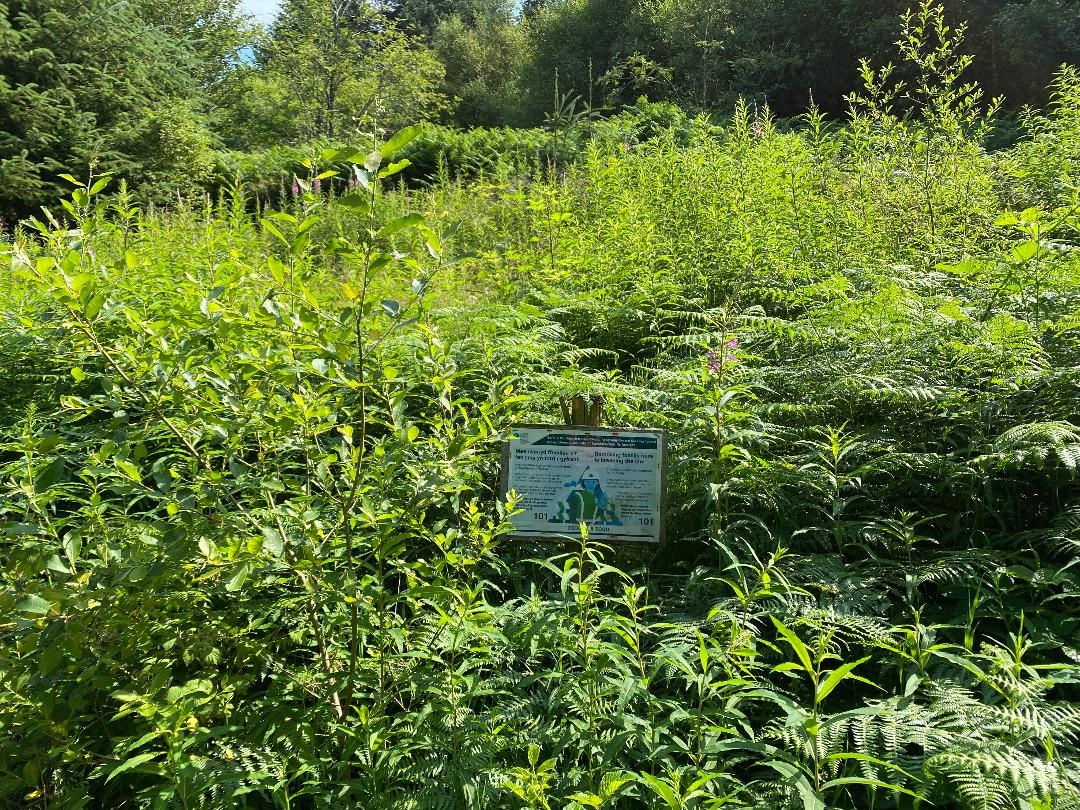
A designated Site of Special Scientific Interest of 0.18 hectares within forestry, beside a track. The site had been effectively lost for almost a century when it was notified in 1983, and was re-excavated by Forest Enterprise in 1996, clearing some 38 metres of rock across strike alongside the existing track. The faces were photographed in July 2021. It is the exposure rather than any quarry structure that is protected.
The quarry faces beside the forest track, re-opened in 1996 and the reason for the designation. Nothing on record describes a surviving quarry structure.
Nearby mines
- Deeside and Moelfferna Quarries — 2.1 miles (3.4 km) E
- Cambrian Quarry — 6.3 miles (10.1 km) E, Wrexham
- Wynne Quarry — 6.9 miles (11.0 km) E, Wrexham
- Craig-y-Mwyn Mine — 7.3 miles (11.7 km) S, Powys
- Llangynog Mine — 9.2 miles (14.8 km) S, Powys
Straight-line distance, within 9 miles (15 km). Show on the map.
Recorded claims
Individual factual claims, each attached to the source(s) that support it below. Where sources disagree, both are kept.
- Cynwyd Forest Quarry is a Site of Special Scientific Interest located beside a track within the Cynwyd Forest near Corwen, Denbighshire, notified on 16 May 1983 for geology and palaeontology, covering 0.18 ha at grid reference SJ 09135 39969. 1
- The quarry exposes Late Ordovician micaceous siltstones and mudstones of the Dolhir Formation, of the Ashgill Series and Rawtheyan Stage, which yield a rich shelly brachiopod fauna. 1
- Trilobites are represented by several genera although the fauna is dominated by Gravicalymene arcuata Price, 1982; bivalves, bryozoans and various Echinodermata, including crinoids and cystoids, are also present. 1
- The site is sometimes referred to in the literature as 'Bwlch y Gaseg', and is in very close proximity to the area of the same name. 1
- The quarry faces were photographed in July 2021. 2
- Nineteenth-century collectors found here one of the most diverse and best-preserved Rawtheyan faunas in the Welsh Basin, and the site is the type locality for several species, especially trilobites. The Geological Conservation Review calls Cynwyd, in the northern Berwyn Hills, a classic site for later Rawtheyan faunas. 3
- The site was effectively lost for almost a century before being found again, and was re-excavated by Forest Enterprise in 1996 - thirteen years after it had been notified as a Site of Special Scientific Interest. 3
- Some 38 metres of rock were cleared in 1996, roughly across strike and parallel to the forestry track. The beds dip and young to the north-east at 35 to 40 degrees at the northern end of the section and more gently, about 30 degrees, at the southern, with small-scale normal faults carrying slickensides and slight rotation of the bedding at various levels. 3
- The lithology varies little: a hard buff, grey or dark-blue mudrock, commonly with the fossils replaced by limonite, especially through the lower twelve metres of the section. Some beds are made up almost entirely of branching and filamentous bryozoans, with rarer sponges, preserved in limonite. 3
- Champernowne, Lee, Parrott and Ruddy made large collections of well-preserved fossils from the Ddolhir Formation here in the second half of the nineteenth century. In the Natural History Museum and the British Geological Survey these are variously labelled Cynwyd, Bwlch-y-Gaseg west of Moel Fenna, and Cerrig Coedog at the south base of Moel Ferna, but all probably come from this one locality. Ruddy listed some of the faunas in 1879 and 1885, including specimens that became the types of various species. 3
- Whittington listed some sixteen species of trilobite from Cynwyd, two of which have their type locality here, to which Gravicalymene arcuata Price, 1982 can be added - a species described partly from material recovered when the site was found again. The Review figures a bed of it as a 'graveyard' of the species. 3
- Price reassigned to Tretaspis sortita the trinucleid trilobites Whittington had put close to T. kiaeri, which dates the Ddolhir Formation here to the late Rawtheyan; the formation as a whole probably ranges much further down, into the middle Cautleyan. 3
- The detailed site report and the analysis of the fauna recovered in 1996 were still awaited when the Review went to press. 3
Photographs & further reading
The fullest account of the site, with the SSSI details and a species-level list of the trilobites, brachiopods, bryozoans, crinoids and cystoids the section has yielded.
View sourceThe statutory conservation review's site account, with the history of the nineteenth-century collections, the 1996 re-excavation, the measured section and the fauna.
View sourceSources
- (secondary) Cynwyd Forest Quarry — Wikipedia
- (observational) Cynwyd Forest Quarry, July 2021 (photograph) — Wikimedia Commons
- (primary) British Cambrian to Ordovician Stratigraphy, Geological Conservation Review Series No. 18: Cynwyd — Joint Nature Conservation Committee

Record created: 4 September 2026 · Last researched: 28 September 2026