 MineArchive
Cambrian Quarry
| Also known as | New Cambrian Slate Quarries, Cambrian Slate Quarries |
|---|---|
| Location | West of Glyn Ceiriog, at the head of Nant Lafar, Wrexham — 52.9321, -3.2058 (approximate) |
| Commodity | Slate |
| Type | Slate |
| Worked | 1857 (company–15 March 1947 |
| Maximum depth | Unknown. |
| Operators | Hazeldine & Edwards (1818–?), Cambrian Slate Company Ltd (1857–1947) |
Overview
The largest slate workings at Glyn Ceiriog: small quarries from at least the 1770s, worked commercially by the Cambrian Slate Company from 1857 through a 600-yard drainage tunnel, four interconnected pits and underground chambers on four levels, with an incline to the Glyn Valley Tramway. Output peaked near 4,000 tons in 1908; the quarry closed in March 1947.
History
Slate may have been dug west of Glyn Ceiriog from the seventeenth century, and was certainly being quarried by the 1770s at Chwarel Isaf, the Lower Quarry, where William Davies was killed by a rock fall in 1770. When Chwarel Isaf farm was sold in 1799 it had two slate quarries in full work. The Shrewsbury ironmaster William Hazeldine bought the quarry in 1818 and worked it with William Edwards as Hazeldine and Edwards. In 1857 the Cambrian Slate Company was formed to work Ceiriog slate commercially and spent £22,000 on tramways, an incline, a water engine and buildings; Buddlepit dates major working at Martin's quarry, the old Chwarel Uchaf, from 1854.
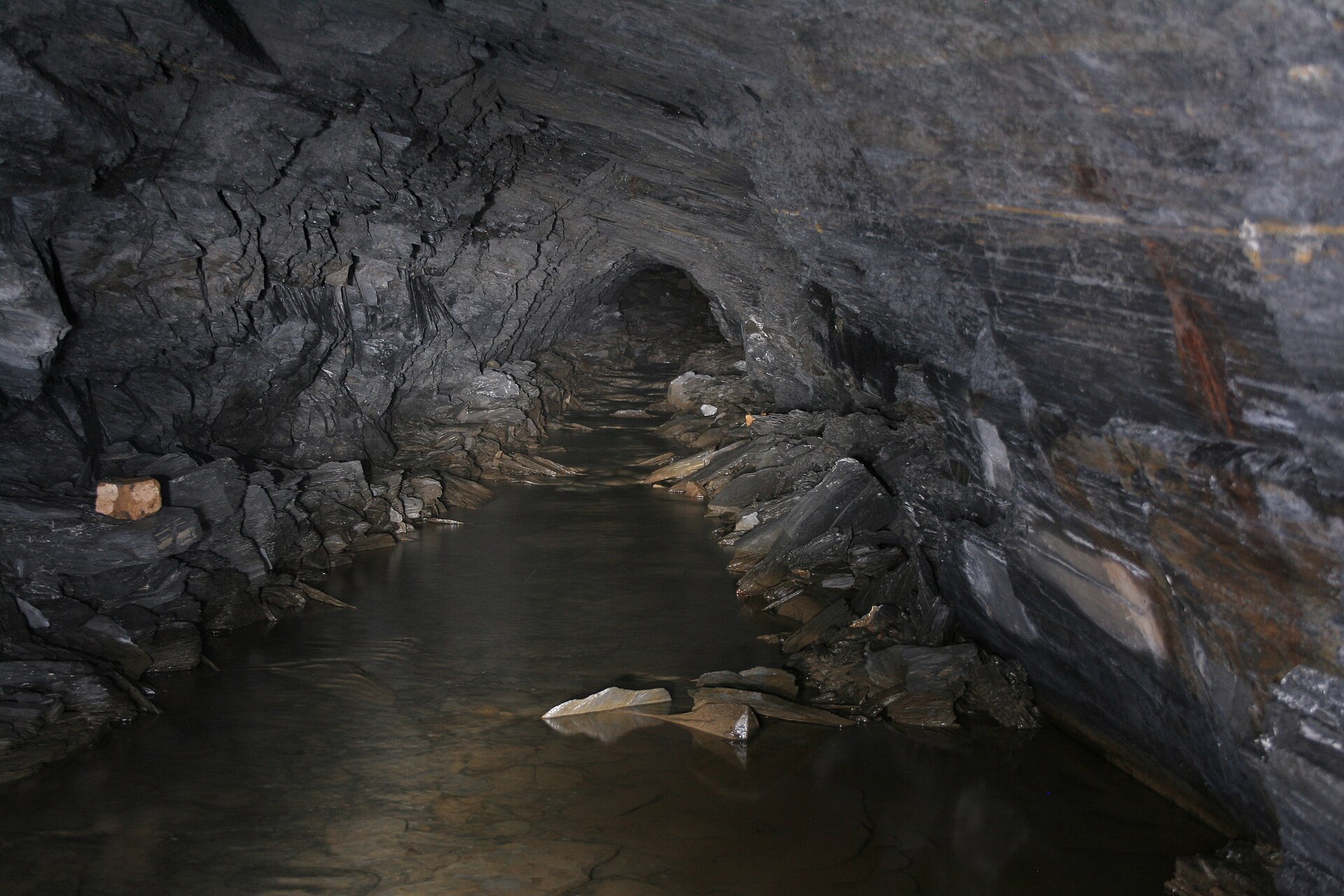
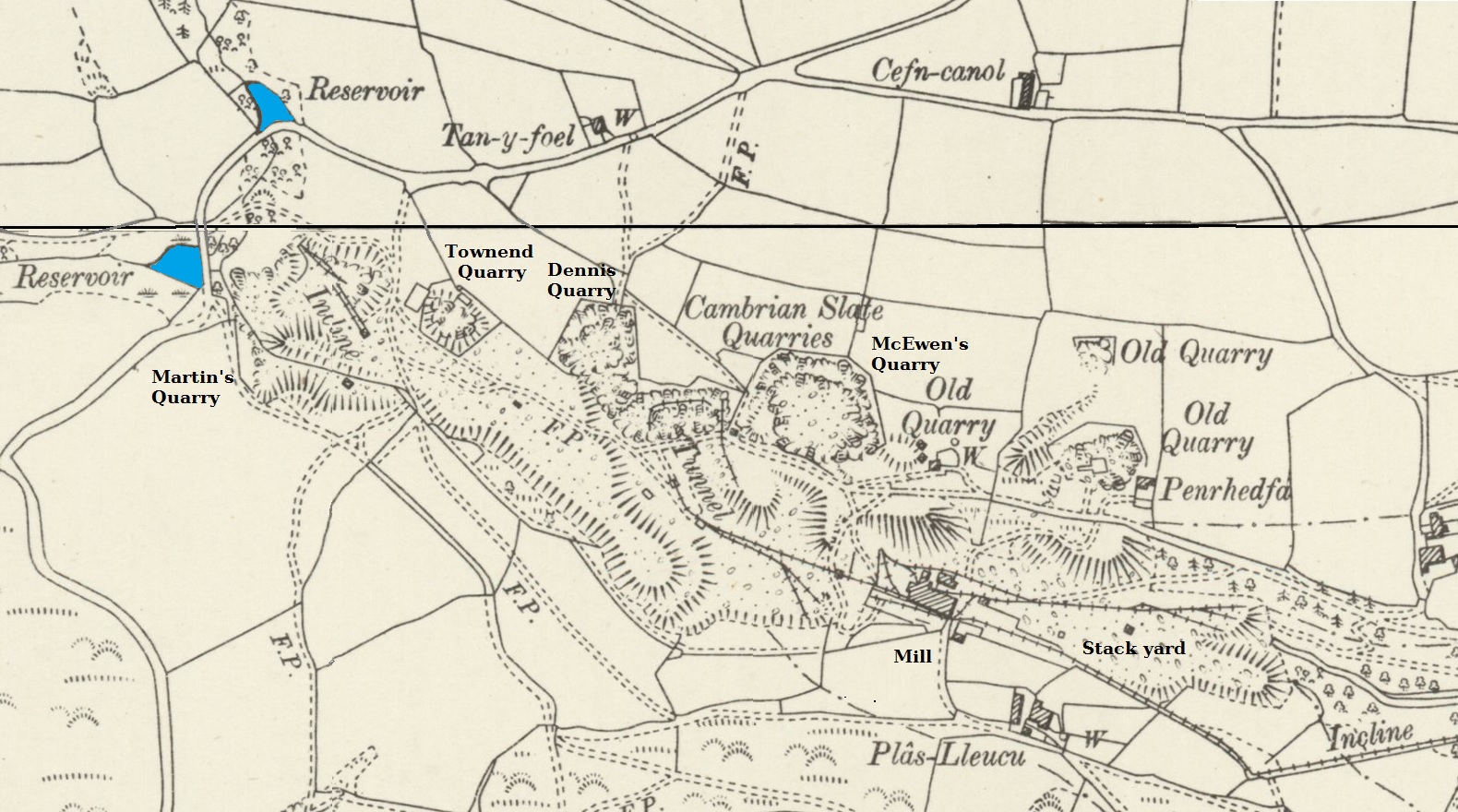
Chwarel Isaf became McEwen's quarry and Chwarel Uchaf Martin's, with a water-wheel mill. As Martin's deepened into a pit a tunnel was driven some 600 yards east from its floor, and two shafts sunk to it became Townsend's and Dennis's quarries. Work stopped in the slump of the 1870s and resumed in the 1880s. The company paid half the cost of the road from Chirk, and from 1873 the Glyn Valley Tramway, with a half-mile gravity incline down from the quarry, carried its slate to the railway and canal at Chirk. Underground working began in the late 1890s, in chambers eventually on four levels. Dennis's was abandoned about 1900 and flooded behind a concrete plug, its water driving a turbine for the dressing mill. Horses hauled the internal 2-foot gauge lines until a small Bagnall locomotive came in 1910, replaced by petrol locomotives in 1921 and 1929.
Output averaged 2,500 tons or more a year, reaching nearly 4,000 tons in 1908, with 73 men in 1898 and 115 in 1938. The company bought the incline when the tramway closed in 1936, and in the Second World War the chambers stored equipment for the Automatic Telephone Company. After the hard winter of 1946-47 many of the men did not return, and the quarry closed on 15 March 1947, its chairman Alan Taylor having kept it going with some £10,000 of his own money. The pumps failed and the lower chambers flooded; the plant was auctioned in July 1948. The Forestry Commission later owned the site, which has been afforested, and in 1978 the Quarry Pool was drained as a precaution against flooding in the village.
Geology
Silurian (Wenlock) slate on the north side of the Ceiriog valley, soft and comparatively hard to split, with iron disulphide and marine fossils; the beds dip at about 15 degrees with cleavage at 25 degrees.
Workings
Four interconnected pits, Martin's, Townsend's, Dennis's and McEwen's, drained and served by a 600-yard tunnel; underground chambers on four levels; water-wheel and later internal-combustion mills; up-haul inclines for waste; a half-mile incline to the Glyn Valley Tramway; internal 2-foot gauge lines worked by horses and then locomotives.
Closure
Closed on 15 March 1947 after the men did not return from the winter lay-off; plant auctioned 14 July 1948.
What remains
Afforested; much of the underground workings are flooded, and the drainage tunnel is partly blocked by a landslide noted in 1975.
Few buildings survive and the remains are much degraded; traces include a rubbish-haul incline with engine house and weighbridge remains, parts of the mill site, and the head of the incline toward the village.
Redevelopment
Planted with forestry after closure; the Quarry Pool was stocked with trout and drained in 1978.
Related mines
- Wynne Quarry — The two slate quarries of Glyn Ceiriog, both served by the Glyn Valley Tramway.
Nearby mines
- Wynne Quarry — 0.6 miles (1.0 km) E
- Deeside and Moelfferna Quarries — 4.2 miles (6.7 km) W, Denbighshire
- Black Park Colliery — 5.9 miles (9.5 km) E
- Quinta Colliery — 6.0 miles (9.6 km) E, Shropshire
- Cynwyd Forest Quarry — 6.3 miles (10.1 km) W, Denbighshire
Straight-line distance, within 9 miles (15 km). Show on the map.
What's uncertain
Points where sources disagree or the record could not be settled; both accounts are kept. All open questions in the archive.
- Major working began in 1854 at Martin's quarry, formerly Chwarel Uchaf. (uncertain) 4
Recorded claims
Individual factual claims, each attached to the source(s) that support it below. Where sources disagree, both are kept.
- Slate was quarried at Chwarel Isaf by 1770, when William Davies died there in a rock fall. 1
- The Cambrian Slate Company was formed in 1857 to work the quarry commercially. 1,2,3
- Major working began in 1854 at Martin's quarry, formerly Chwarel Uchaf. (uncertain) 4
- Output averaged 2,500 tons or more a year and peaked at nearly 4,000 tons in 1908. 2,4
- The quarry employed 73 men in 1898 and 115 by 1938. 2
- The quarry closed in March 1947, chiefly for lack of workers after the winter of 1946-47. 1,2,4,5
Photographs & further reading
The RCAHMW site record: development, workforce, output and closure.
View sourceA full history: the pits, tunnel, locomotives, the tramway and the closure.
View sourceThe pits and underground workings, with what remains of them.
View sourceSources
- (secondary) Cambrian quarry — Wikipedia
- (secondary) New Cambrian Slate Quarries; Cambrian Slate Quarries, Glynceiriog (NPRN 308675) — Coflein (RCAHMW)
- (observational) Cambrian slate quarry - Glyn Ceiriog - March 2025 — 28DaysLater
- (secondary) Cambrian — Buddlepit Mine Database
- (secondary) Glyn Ceiriog (NPRN 268090) — Coflein (RCAHMW)
Record created: 4 October 2026 · Last researched: 4 October 2026