 MineArchive
Black Park Colliery
| Location | Black Park, near Chirk, Wrexham — 52.9426, -3.0658 (exact) |
|---|---|
| Commodity | Coal |
| Type | Coal |
| Worked | Early 19th century–1949 (shaft to 1968) |
| Maximum depth | Unknown. |
| Operators | John Stott, Milne and Company (1869–1880), Black Park Colliery Company (1880–1947), National Coal Board (1947–1949) |
Overview
One of the oldest collieries in North Wales, at Black Park near Chirk, worked from the early nineteenth century on the Main and Two Yard seams and closed as uneconomic in 1949. It had its own railway dock on the canal at the north end of Chirk cutting, later the Glyn Valley Tramway's Bottom Wharf, and it sent out the last recorded shipment of coal ever carried on that canal, in 1933. One of its shafts was reopened in 1966 to ventilate Ifton Colliery and finally closed with it in 1968.
History
Black Park Colliery was sunk near Chirk in the early years of the nineteenth century and was among the oldest collieries in North Wales, working mainly the Main and Two Yard seams. In 1869 it was in the hands of John Stott, Milne and Company; by 1880 the owners were the Black Park Colliery Co. Ltd, under whom Edmund Plunkett managed the pit through the 1890s with about 440 men below ground and 58 on the surface in 1894 and rather fewer through the following decade. The Inspector of Mines list for 1896 gives 460 men in all, fifty of them on the surface. Plunkett himself was killed at the colliery in the first week of February 1903: he was inspecting underground with his son when a large fall struck him on the neck and killed him instantly, his son escaping.
The colliery's coal went out by canal. A railway dock was cut at the north end of the Chirk cutting on what is now the Llangollen Canal, with a winding hole opposite it so that boats could turn at right angles to enter; the dock was later used by the Glyn Valley Tramway and known as Bottom Wharf. The Shropshire Union's own coal boats stopped trading in 1921, and the last shipment of coal recorded anywhere on that canal came from Black Park in 1933. Employment ran at 503 in 1908 and 215 in 1918, and by 1923 the workforce of 366 was producing house and steam coal from the Yard and Half, Main and Trevor seams; there were 520 men in 1938 and 465 in 1945. The colliery was closed in 1949 as no longer economic and its shafts were filled with ash and capped with concrete, but that was not quite the end: one shaft was reopened in 1966 as a ventilation shaft for Ifton Colliery across the border, and was finally closed when Ifton ceased in 1968.
Geology
The colliery worked the southern end of the Denbighshire coalfield beside Brynkinalt and Ifton, taking mainly the Main and Two Yard seams and, by the 1923 return, the Yard and Half, Main and Trevor, for house and steam coal.
Geological setting: Sedimentary Beds and Seams (well documented example)
Workings
Shaft working with its own railway running down to a dock on the canal at the north end of the Chirk cutting, where a winding hole was cut opposite the entrance so that boats could turn at right angles to enter the dock; the dock passed later to the Glyn Valley Tramway as Bottom Wharf. After the colliery closed in 1949 the shafts were filled with boiler ash and capped with concrete, one of them being reopened in 1966 purely to ventilate Ifton Colliery.
Closure
Closed in 1949 because it was no longer economic, its shafts filled with ash and capped with concrete. One shaft was reopened in 1966 to ventilate Ifton Colliery at St Martins and was closed for good when Ifton ceased in 1968, so the site remained in use for nearly twenty years after the colliery itself stopped.
What remains
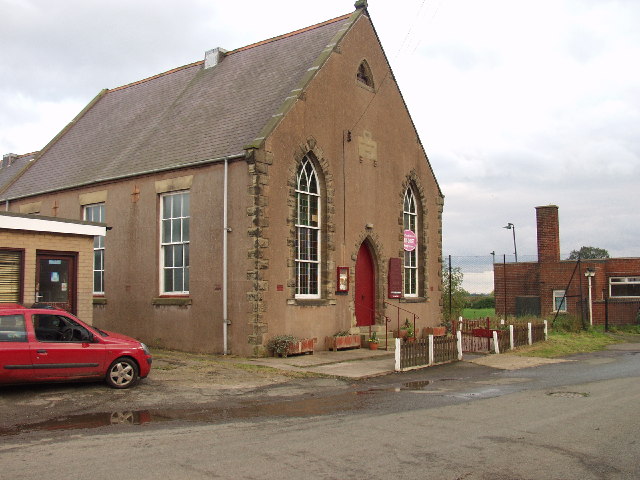
The colliery is gone and the ground given over to the settlement that grew with it; Black Park is now a small village of houses with its Primitive Methodist chapel of 1875 still in regular use. The winding hole on the canal survives as a feature of the Chirk cutting.
Nothing of the colliery itself; the canal winding hole and the village it built survive.
Redevelopment
The colliery village of Black Park remains in residential use.
Related mines
- Brynkinalt Colliery — The two Chirk pits, a mile apart at the southern end of the North Wales coalfield, both ended as ventilation shafts for Ifton Colliery and both were finally closed when Ifton ceased in November 1968.
- Ifton Colliery — One of Black Park's shafts was reopened in 1966 as a ventilation shaft for Ifton Colliery and was finally closed when Ifton ceased in 1968.
Nearby mines
- Brynkinalt Colliery — 0.8 miles (1.4 km) SE
- Quinta Colliery — 1.8 miles (3.0 km) S, Shropshire
- Ifton Colliery — 2.2 miles (3.5 km) E, Shropshire
- Wynnstay Colliery — 2.8 miles (4.4 km) N
- Vauxhall Colliery — 4.3 miles (6.8 km) N
Straight-line distance, within 9 miles (15 km). Show on the map.
Disasters & major incidents
-
Black Park Colliery scalding, 1896
27 January 1896 · Other · 2 fatalities
Two men hosing hot ashes at the foot of Black Park Colliery's boiler-chimney shaft, near Chirk, were scalded to death on 27 January 1896 when falling debris turned the steam back on them.
Recorded claims
Individual factual claims, each attached to the source(s) that support it below. Where sources disagree, both are kept.
- Black Park Colliery was sunk near Chirk during the early years of the nineteenth century and was one of the oldest collieries in North Wales, working mainly the Main and Two Yard seams. 1
- In 1869 the colliery was in the hands of John Stott, Milne and Co., and by 1880 the Black Park Colliery Co. Ltd were the owners; Edmund Plunkett was manager through the 1890s. 1,2
- The colliery employed 460 men in 1896 including 50 on the surface, 503 in 1908, 215 in 1918, 366 in 1923, 520 in 1938 and 465 in 1945. 1
- By 1923 the workforce was producing house and steam coal from the Yard and Half, Main and Trevor seams. 1
- In the first week of February 1903 the manager, Edmund Plunkett, aged 49, was inspecting underground with his son when a large fall struck him on the neck and killed him instantly; his son escaped. 1,2
- The colliery had a railway dock at the north end of the Chirk cutting, with a winding hole opposite so that boats could turn at right angles to enter; the dock was later used by the Glyn Valley Tramway and known as Bottom Wharf. 3
- The last recorded shipment of coal on the canal came from Black Park Colliery in 1933, the Shropshire Union Canal's own coal boats having ceased trading in 1921. 4
- The colliery closed in 1949 because it was no longer economic and its shafts were filled with ash and capped with concrete; one shaft was reopened in 1966 as a ventilation shaft for Ifton Colliery and finally closed in 1968. 1
Photographs & further reading
A working history of the pit from Inspector of Mines lists, with owners, manpower by year, the seams worked and the death of its manager in 1903.
View sourceSources
- (secondary) Black Park Colliery and Brynkinalt Colliery, Chirk (Welsh Coal Mines) — Welsh Coal Mines
- (primary) Durham Mining Museum: Black Park Colliery Co., Ltd. — Durham Mining Museum
- (primary) Coflein NPRN 405986: Black Park Collieries Railway Dock turning basin, Llangollen Canal — Royal Commission on the Ancient and Historical Monuments of Wales
- (secondary) Coal (Pontcysyllte Aqueduct and Canal World Heritage Site) — Pontcysyllte Aqueduct and Canal World Heritage Site
Record created: 9 September 2026 · Last researched: 9 September 2026