 MineArchive
Cleavage
| Also known as | Slaty Cleavage |
|---|---|
| Category | Ground Conditions & Hazards |
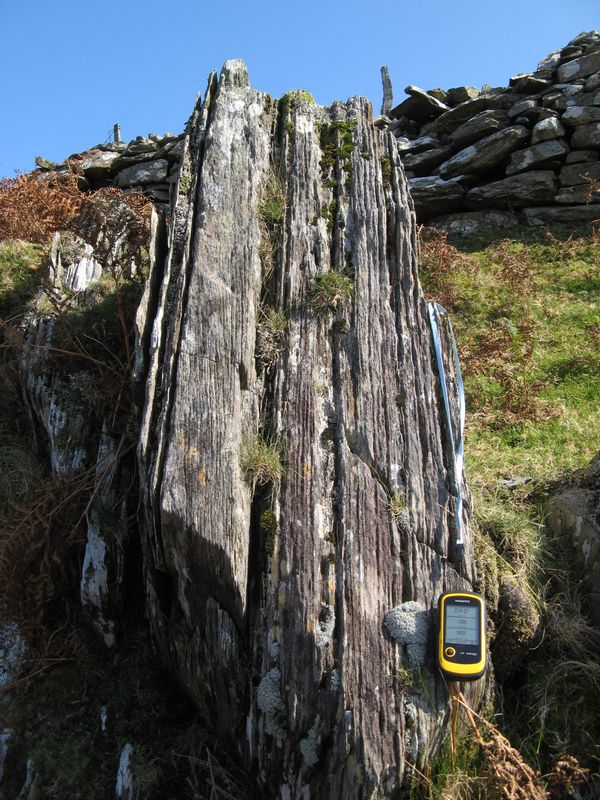
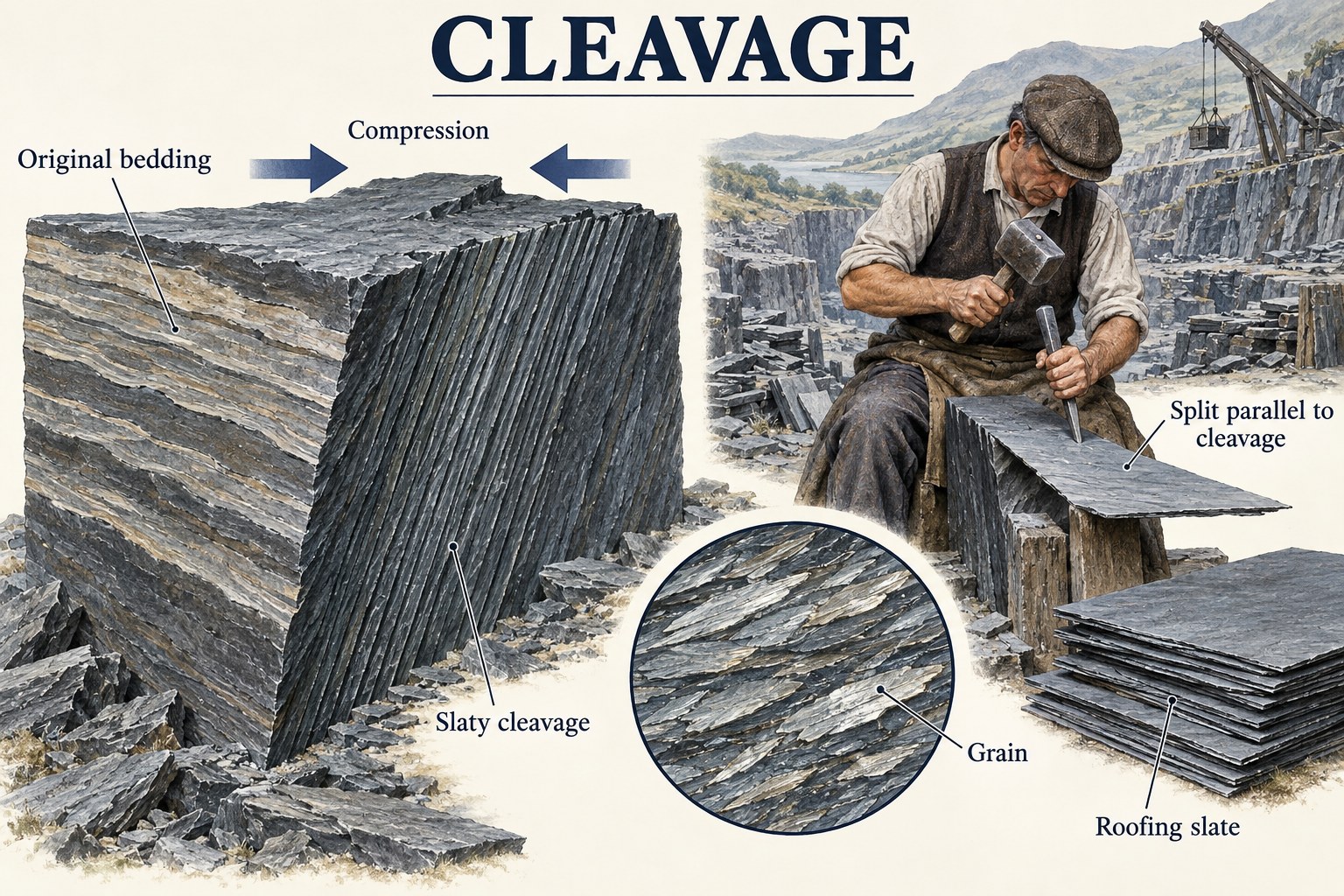
The set of closely spaced parallel planes along which a metamorphosed fine-grained rock splits cleanly — in slate, the property that lets a block be opened into roofing sheets. It is created by compression during metamorphism and is independent of the original bedding.
Historical usage
Cleavage is the reason there is a slate industry at all. Slate is a fine-grained metamorphic rock derived from mudstone, and its foliation, called slaty cleavage, is produced by strong compression in which fine clay flakes regrow in planes perpendicular to that compression — not along the sedimentary layering. Struck parallel to those planes, the rock opens into thin flat sheets that hold their shape and stack.
How it worked
A slate block has two lines of breakability, the cleavage and the grain, and the splitter works with both. Splitting was done with a mallet and chisel and proved stubbornly resistant to mechanisation: in the Welsh quarries sawing and dressing were mechanised through the nineteenth century — John Whitehead Greaves’s sawing table of 1859 produced blocks for the splitter, and a rotary dressing machine followed — but the splitting itself was still being done by hand into the second half of the twentieth century.
Why it was used
A rock that splits reliably into thin, flat, weatherproof sheets is a roofing material that needs almost no working beyond splitting and trimming. Nothing else available in Britain did the job as cheaply or as durably, which is why Welsh slate reached roofs across the world.
Risks & limitations
Cleavage governs mine design as much as it governs the product, because the planes are rarely conveniently oriented. Where they stand close to vertical — as through the Nantlle belt in Caernarfonshire — the slate has to be taken downwards into deep open pits rather than worked along a hillside, which forced those quarries into expensive haulage and constant pumping. Cleavage also has to be distinguished from mere fissility: some rocks sold as slate, such as the Angus flagstones, split along bedding rather than metamorphic cleavage and are not true slates.
Regional variation
The Cambrian and Ordovician slate belts of north-west Wales are the classic British example, and the steepness of their cleavage differs from belt to belt — a difference that shows directly in how each group of quarries was laid out. Elsewhere the word is used of any rock with the same property, and loosely of stone that splits along bedding, which is a different thing.
Related terminology
Mines associated with this term
5 examples chosen from 19 linked records — the term page is not an index.
- Alexandra Quarry — Gwynedd (well documented example)
Named in this record’s geology: “…modern workings shows the sharp contrast between the even, fine cleavage of the productive slate beds and the rough, unproductive sandstone…” - Catpund Quarries — Shetland Islands (well documented example)
Named in this record’s history: “…better to discover that at the quarry. The rock breaks along natural cleavage lines, which is why the square and rectangular vessels distinctive…” - Dorothea Quarry — Gwynedd (well documented example)
Named in this record’s geology: “The Nantlle slate belt runs through Cambrian rocks whose cleavage stands close to vertical, and that single fact shaped everything…” - Stonesfield Slate Mines — Oxfordshire (well documented example)
Named in this record’s geology: “…in the geological sense — it is not metamorphic rock split along a cleavage plane, but a variably oolitic, very fine quartz-sandy limestone that…” - Aberfoyle Slate Quarries — Stirling (well documented example)
Named in this record’s geology: “…with a mottled 'tartan slate', its colour layers parallel to the cleavage and cut by thin quartz veins; fine to medium in texture, coarser…”
Disasters associated with this term
Included only where MineArchive's own research gives a reasonable evidential basis, with the nature of the relationship stated — not every disaster where this term might plausibly apply.
- Ammanford Colliery roof fall, 1910 (contextual relationship)
Named twice in this record, first in the cause: “…collapsed under uneven weight from a smooth parting above and a cleavage break at the side of the road.”
Sources
- (secondary) Cleavage (geology) — Wikipedia
- (secondary) Slate industry in Wales — Wikipedia
- (secondary) Slate industry in the Nantlle Valley — Wikipedia
Record created: 8 September 2026 · Last researched: 8 September 2026