 MineArchive
Aberfoyle Slate Quarries
| Also known as | Aberfoyle Quarries |
|---|---|
| Location | North of Aberfoyle, beyond Craigmore, Stirling — 56.1983, -4.4104 (approximate) |
| Commodity | Slate |
| Type | Slate |
| Worked | 1625 (first record)–1954 (some accounts 1958) |
| Maximum depth | Unknown. |
| Operators | Aberfoyle Slate Quarries Co (1882–1947) |
Overview
Slate quarries north of Aberfoyle, recorded from 1625 and a major industry from about the 1820s. Their blue, grey, green and purple 'tartan' slate went down an inclined plane to the railway from the 1880s; they reopened after the Second World War and closed in the 1950s.
History
Slate working at Aberfoyle is recorded from 1625, roofing slates were being worked from 1742, and the quarries were a major industry from about the 1820s. The Aberfoyle Slate Quarries Company, with its registered office in Glasgow, was registered on 10 August 1882 to acquire the Perthshire properties, and in 1893 took power to quarry slate anywhere in Scotland. The quarrying was important enough to warrant the branch railway that reached Aberfoyle in 1882. A mineral tramway, opened in 1885, ran along the north side of Craigmore, and at its end the slate was lowered 225 metres to the road by an inclined plane about 0.65 kilometres long, the weight of full trucks raising the empty ones; by this means, it was said, a thousand slates reached Aberfoyle station for two shillings and fourpence.
In 1901 the company had been working for nineteen years, with 80 to 100 men producing about 6,000 tonnes of slate a year. The slate was blue, grey, green and purple, with a mottled purple and green called 'tartan slate'; the green, fashionable and rarer, fetched higher prices. It was worked in seven main seams 2 to 6 metres thick in the Low Quarries, and in a seam some 10 metres thick in the higher West Quarry. Quarrying lasted here long after it had stopped in many other Scottish slate districts, probably because the industrial heartland was close, and Aberfoyle was one of the few quarries to reopen in 1947 after the war, the year the old company went into voluntary liquidation. The revival was short: the quarries closed in 1954, or by another account in 1958, by which time the workings covered some 40 hectares.
Geology
Clay slate in seven main seams 2 to 6 metres thick in the Low Quarries and one of about 10 metres in the West Quarry: blue, grey, green and purple, with a mottled 'tartan slate', its colour layers parallel to the cleavage and cut by thin quartz veins; fine to medium in texture, coarser than the best Welsh slate.
Workings
The Low Quarries and the higher West Quarry, about 40 hectares in all; a mineral tramway of 1885 along Craigmore and a self-acting inclined plane about 0.65 km long dropping 225 metres to the road.
Closure
Reopened in 1947 after the war and closed in the 1950s; the dates given are 1954 and 1958.
What remains
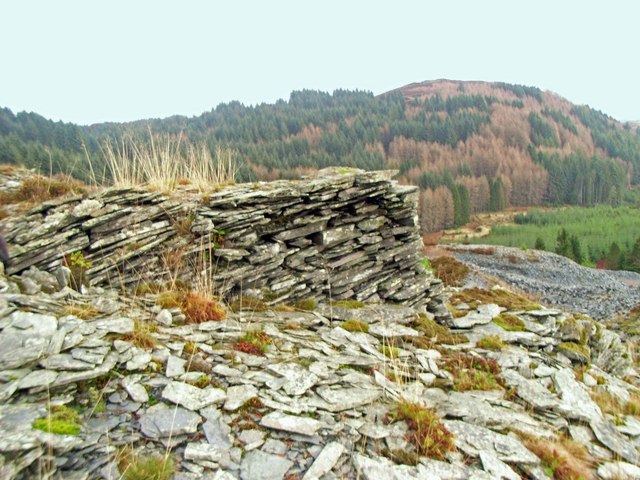
Disused and surrounded by forestry; considerable reserves of slate remain.
Slate tips; the line of the tramway through the forest, and some winding gear and abutments of the inclined plane on the slopes between Craigmore and the tramway.
Redevelopment
Unknown.
What's uncertain
Points where sources disagree or the record could not be settled; both accounts are kept. All open questions in the archive.
- After reopening in 1947 the quarries finally closed in 1954. (disputed) 1
- The quarries closed in 1958. (disputed) 2
Recorded claims
Individual factual claims, each attached to the source(s) that support it below. Where sources disagree, both are kept.
- Slate working at Aberfoyle is documented from 1625, and roofing slates were worked from 1742. 1
- A tramway with a steep incline was laid from the quarries to the railway at Aberfoyle after 1882 and opened in 1885. 1,2
- About 1901 the quarries employed 80 to 100 men and produced about 6,000 tonnes of slate a year. 1
- The Aberfoyle Slate Quarries Co was registered on 10 August 1882 and went into voluntary liquidation in 1947. 3
- After reopening in 1947 the quarries finally closed in 1954. (disputed) 1
- The quarries closed in 1958. (disputed) 2
Photographs & further reading
The slate, its seams and colours, output and the incline.
View sourceThe quarries' tramway and incline to the railway.
View sourceThe company's registration, powers and liquidation.
View sourceSources
- (secondary) Geology of the Aberfoyle district: Applied geology: Quarry products — British Geological Survey (Earthwise)
- (secondary) Aberfoyle Quarries — Railscot
- (secondary) Aberfoyle Slate Quarries Co — Grace's Guide
Record created: 4 October 2026 · Last researched: 4 October 2026