 MineArchive
Stonesfield Slate Mines
| Location | Stonesfield, West Oxfordshire — 51.8510, -1.4295 (approximate) |
|---|---|
| Commodity | Limestone |
| Type | Slate |
| Worked | From the Roman period–1911 |
| Maximum depth | Shafts typically around 6m (20ft) deep |
Overview
A cluster of shallow shaft workings around the village of Stonesfield in west Oxfordshire, worked from at least Roman times until 1911 for "Stonesfield Slate" — thin, durable roofing stone split from the rock by frost rather than cut. The workings are better known to science than to roofers: this is the site where William Buckland described Megalosaurus in 1824, the first dinosaur ever formally named, and where the earliest known pre-Tertiary mammal jaws turned up in 1812.
History
Stone has been dug at Stonesfield since at least Roman times, when slabs from the village's shallow pits were already being used to roof local buildings. The trade stayed small and informal for centuries, worked piecemeal by local families rather than any single company, until the 16th or 17th century brought the discovery that made the village's name: freshly dug blocks of the rock, left out over winter, would split cleanly along their bedding under the action of frost into thin, tough sheets ideal for roofing. From that point Stonesfield Slate became sought-after well beyond the village, prized for the roofs of Oxford colleges and other prestigious buildings where its texture and colour were valued over cheaper alternatives. Production continued on this frost-dependent, small-scale basis into the early 20th century, with the last of the mines closing in 1911 — after which stone roofing at Stonesfield effectively ended, since the method could not easily be mechanised.
The mines' lasting fame, though, rests on what the slate-makers found while splitting the rock rather than on the roofing stone itself. Workers routinely set aside unusual bones and impressions turned up in the blocks, and by the early 19th century Stonesfield's fossils were reaching the attention of Oxford geologists. In 1824 William Buckland, Reader in Geology at Oxford, used jaw and limb fragments recovered from the Stonesfield workings to give the formal scientific description of Megalosaurus — the first dinosaur ever to be named and described, years before the word "dinosaur" itself was coined. The exact date Buckland obtained his specimens is unclear, but is thought to have been no later than 1818. Twelve years earlier, in 1812, slate from the same workings had already yielded something arguably just as significant to science: jaw fragments that turned out to be the earliest known mammal remains from the Mesozoic era. Buckland's recognition that these tiny mammals had lived alongside Megalosaurus and its contemporaries triggered a real controversy in early-19th-century geology, at a time when many assumed mammals could not have coexisted with such reptiles. The workings also produced an exceptionally rich insect fauna — one specimen was for years described as the earliest known butterfly, before being reidentified as an extinct bug relative — along with a diverse Middle Jurassic flora of over twenty plant species, and abundant marine and flying reptiles including plesiosaurs, the crocodile Steneosaurus and the pterosaur Rhamphocephalus.
Geology
Despite the name, Stonesfield Slate is not true slate in the geological sense — it is not metamorphic rock split along a cleavage plane, but a variably oolitic, very fine quartz-sandy limestone that splits along its original sedimentary bedding. The bed sits low in the Taynton Limestone Formation (Middle Jurassic, mid-Bathonian age) and is confined to a small, roughly oval area within about 1.5km of Stonesfield village, where it reaches a maximum thickness of about 1.8m — well short of the mineable extent of a typical sedimentary bed elsewhere in Britain. It is thought to represent a localised facies laid down in a shallow marine environment during the early stages of the 'Taynton Limestone transgression'. Sedimentary structures within the bed point to a high-energy depositional setting, with storm-generated scours filled by shell lags — the likely mechanism by which bones, plant material and insects were swept in from further offshore by storm-driven currents and rapidly buried, concentrating the fossil record that later made the site famous. The bed has also yielded biostratigraphically important ammonites, including the earliest known British Clydoniceras, richer in species and genera at this level than comparable faunas from the Cotswold Slates of Eyford.
Geological setting: Sedimentary Beds and Seams (well documented example)
Workings
Workings took the form of vertical shafts, typically around 6m deep, from which short horizontal galleries were driven out to follow the productive bed — small-scale, shallow mining suited to a bed rarely more than about 1.8m thick. The rock was not cut or blasted into finished slates underground: rough blocks called 'pendles' were simply hoisted to the surface and left in nearby fields, wetted and covered with earth, to await frost. When cold weather was forecast a bell would be rung in the village to summon workers, known as slatters, to clear the covering earth so the frost could act directly on the damp stone. Moisture trapped along the rock's fine bedding planes expanded on freezing and split the pendles into thin, regular sheets — a far gentler and more effective method than hammer and chisel for producing the thin, durable slates the trade depended on. Rounded offcuts from the process were known locally as 'potlids'. Because the method relied entirely on hard frost, production was seasonal and unpredictable, and the workings never scaled beyond a small, family-based industry even at their peak.
Closure
The last of the Stonesfield mines closed in 1911, bringing to an end a trade that had run, in some form, since at least the Roman period. No single event or exhaustion of the resource is recorded as forcing closure; the frost-dependent method was inherently limited in scale and never mechanised, and cheaper mass-produced roofing materials had long since undercut the market for hand-split stone slate.
What remains
The old workings at four localities around the village — at national grid references SP392172, SP388168, SP379173 and SP387171 — were notified as the Stonesfield Slate Mines Site of Special Scientific Interest in 1955 (revised 1977, renotified under the Wildlife and Countryside Act 1981 in 1986), covering a combined 0.76ha. The designation protects the geological and palaeontological interest of the exposed workings rather than any built structure; the adit at SP379173 is also included within the neighbouring Reed Hill SSSI. No dedicated exploration report on the underground workings was found as of August 2026.
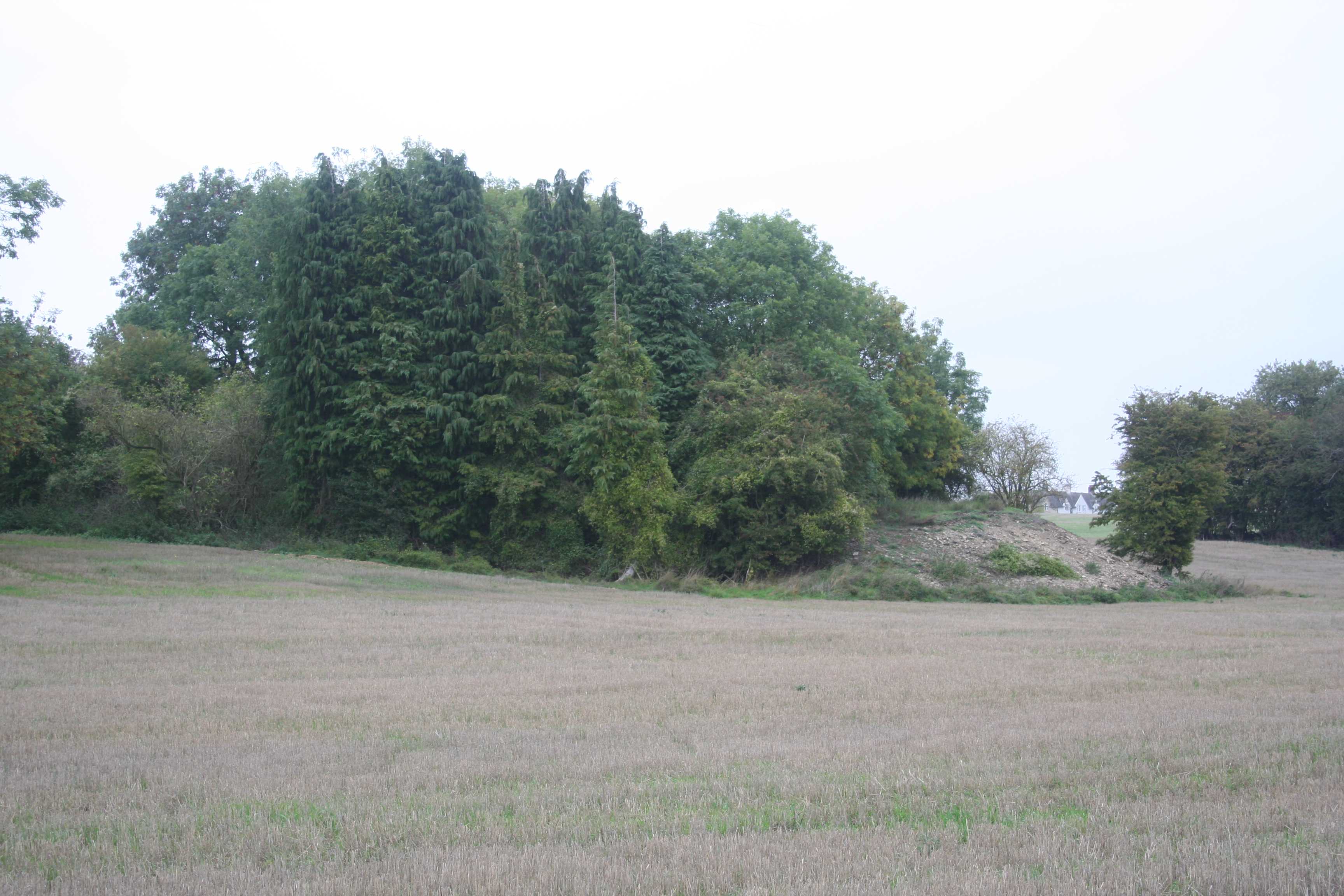
Spoil tips from the old shafts survive around the village and are visible from public footpaths, including on routes such as the Oxfordshire Way that pass near the disused workings; a 2010 photograph of one such spoil heap is used on this page. The wider landscape immediately south of the village — Stonesfield Common, Stockey Bottom and Baggs Bottom — is separately protected as a biological SSSI for its unimproved limestone grassland, itself a product of the same thin, stony ground the mines were dug into.
Nearby mines
- Fawler Ironstone Mine — 2.2 miles (3.5 km) NW
Straight-line distance, within 9 miles (15 km). Show on the map.
The old shafts are shallow, unmanaged and long disused — this entry describes history and general location only, not an access guide.
Recorded claims
Individual factual claims, each attached to the source(s) that support it below. Where sources disagree, both are kept.
- Rough blocks ('pendles') were hoisted from the shafts and left in open fields, wetted and covered with earth, until frost split them along their bedding into thin roofing slates; workers ('slatters') were summoned by bell when frost was expected, and round offcuts were known as 'potlids'. 1,2
- Workings comprised shafts around 6m deep with horizontal galleries following a productive bed no more than about 1.8m thick, confined to a roughly oval area within 1.5km of the village; the SSSI covering four localities totals 0.76ha. 3,4
- William Buckland formally described Megalosaurus — the first dinosaur ever recognised and named — to the Geological Society of London on 10 February 1824, using jaw and limb material recovered from the Stonesfield workings; the exact date of the find is unrecorded but thought to be no later than 1818. 3,2
- The Stonesfield Slate yielded, in 1812, the earliest known pre-Tertiary mammal jaws — two triconodont species and one eupantothere — a find whose implication that mammals coexisted with dinosaurs caused a major controversy in early-19th-century geology. 3
- Quarrying and mining for Stonesfield Slate, recorded since at least the Roman period, ended with the closure of the last mine in 1911. 4,1
Sources
- (secondary) Stonesfield (GCR block 16, Fossil Fishes) — Geological Conservation Review / Scottish Geology Trust GeoGuide
- (secondary) Stonesfield Slate, Fossil Exhalations, and William Buckland — GeologyWriter.com (Bill Thompson)
- (primary) Stonesfield Slate Mines SSSI citation — Natural England
- (secondary) Stonesfield Slate Mines (GCR block 32, Fossil Mammals) — Geological Conservation Review / Scottish Geology Trust GeoGuide
Record created: 26 August 2026 · Last researched: 26 August 2026