 MineArchive
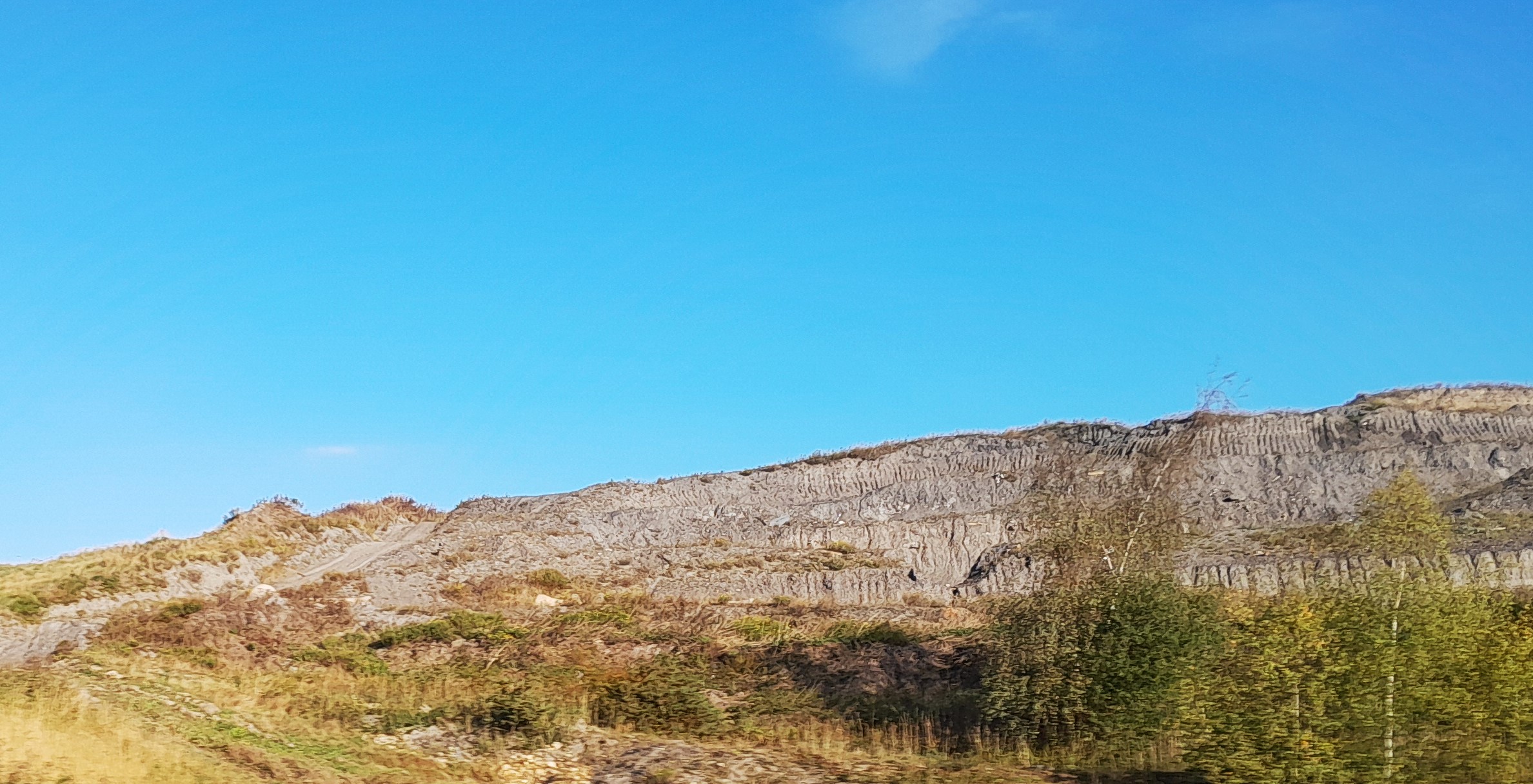
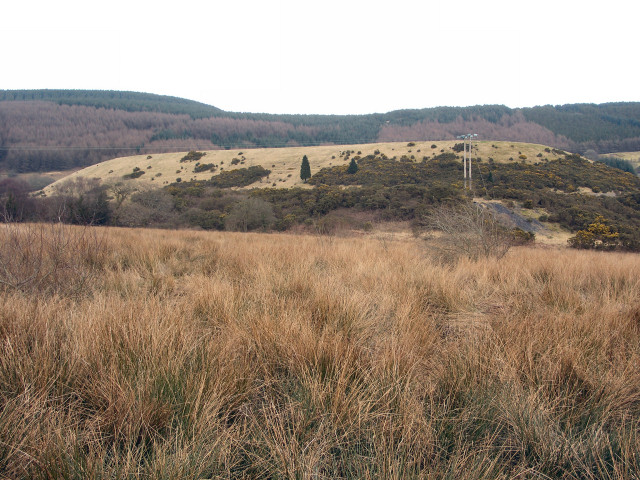
Spoil Heap
| Also known as | Pit heap (North East England), Colliery spoil tip (Full form), Bing (Scottish), Batch (Somerset), Waste tip (Common formal usage, including in the Aberfan tribunal), Spoil tip (the usual form on a colliery, and the word used in the Mines and Quarries (Tips) Act 1969), Hillocks (Derbyshire) |
|---|---|
| Category | Mine Workings & Access |
A surface pile of waste rock and processed tailings removed from a mine but containing no economically recoverable mineral — built up over a mine's working life and often remaining as its most visible, and longest-lasting, legacy long after closure.
Historical usage
Every mine of any real scale produced a spoil heap, and many were revisited decades after the original working ended once new processing technology made it worthwhile to extract value once considered waste — spoil heaps at Grassington Moor were reworked for barytes, fluorspar and residual lead between 1916 and 1963, Millclose's tips yielded a further 140,000 tons of ore, and Snaefell's surface spoil was reprocessed for lead and zinc in the 1950s. Some closed collieries' tips have since been deliberately reclaimed — Sutton Manor's, in Merseyside, now carries Jaume Plensa's sculpture Dream after 50,000 trees were planted to turn it into community woodland. Most gravely, one of Merthyr Vale Colliery's tips, Tip 7, collapsed as a saturated slurry onto the village of Aberfan on 21 October 1966, killing 144 people, 116 of them children — Britain's worst tip disaster and the direct cause of the Mines and Quarries (Tips) Act 1969, the first legislation to regulate tip stability nationally.
How it worked
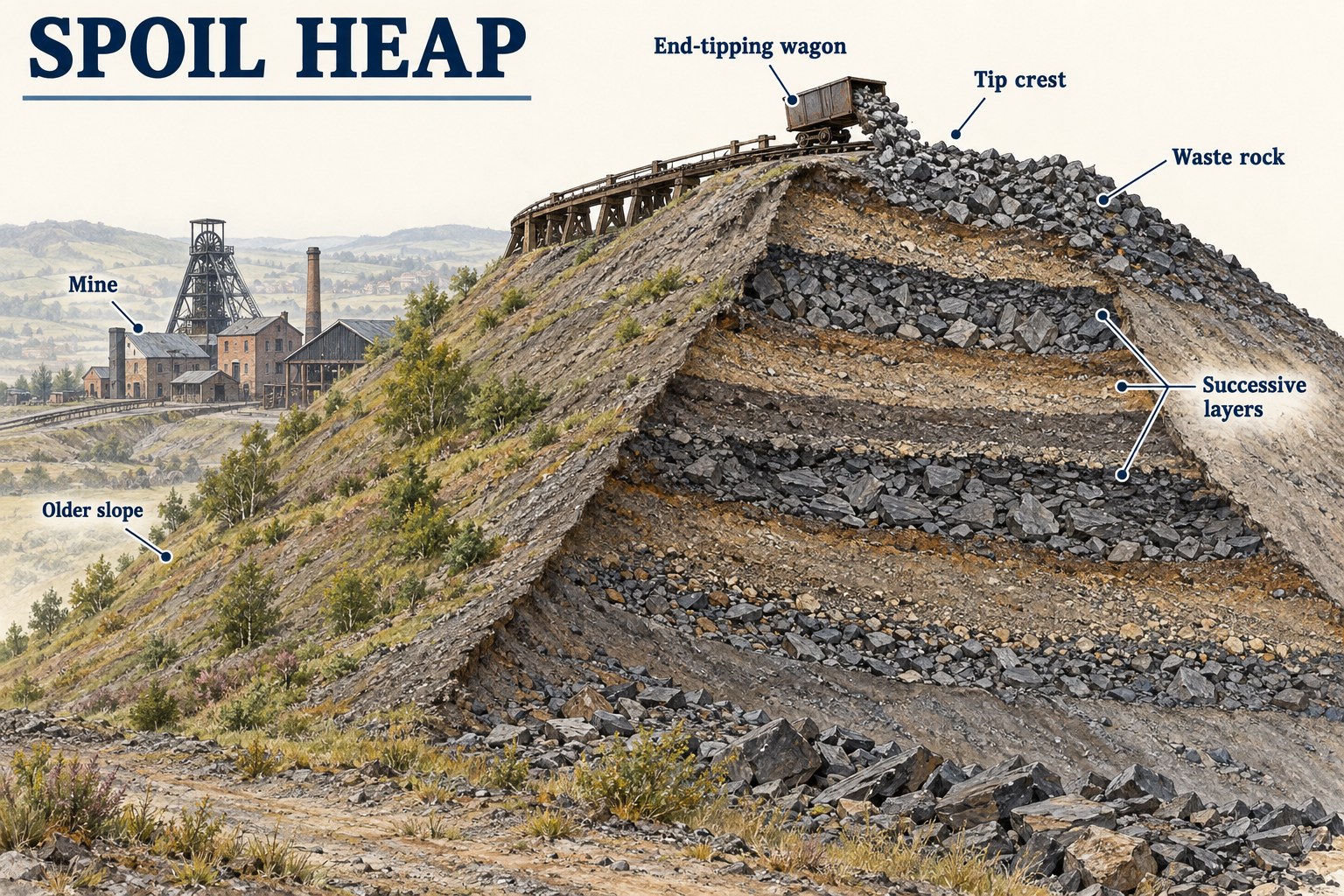
Waste went up the shaft with the coal, was separated on the screens, and was carried out to the tip — by tramway and end-tipping wagon, by aerial ropeway, or later by conveyor and dump truck. Tipping from the crest builds a heap at the natural angle of repose of loose shale, which is stable enough when dry. The danger is water. Colliery shale weathers, breaks down and loses strength; a tip built across a hillside spring or over ground that concentrates groundwater can become saturated at its base, and saturated fine spoil can liquefy and run. That is what happened at Aberfan on 21 October 1966, when Tip 7 flowed down into the village and killed 116 children and 28 adults.
Why it was used
Separating ore from barren rock inevitably produces waste, often in far greater volume than the ore itself, especially in low-grade metal mining and in coal, where dirt and stone had to be picked out of every tub before the coal was saleable — a spoil heap was simply where that unavoidable waste went.
Risks & limitations
Instability and flow slides are the acute risk; the chronic ones are acid and metal-rich runoff, spontaneous combustion in tips containing coal, dust, and the sheer difficulty of ever growing anything on the surface. Aberfan changed the law: the Mines and Quarries (Tips) Act 1969 placed a duty on mine and quarry operators to make and keep tips secure, extended the same duty to liquid waste lagoons, made endangering a tip's security a criminal offence, and gave local authorities powers to require remedial work on disused tips or carry it out themselves and recover the cost. The problem has not gone away. Wales has 2,573 disused coal tips and an estimated 20,000 other disused tips, now graded A to D by their potential to affect public safety — Category A tips inspected at least twice a year — and the Disused Mine and Quarry Tips (Wales) Act 2025 has put the whole regime on a modern statutory footing.
Regional variation
Tip in the South Wales coalfield and generally in colliery usage; spoil heap, pit heap or pit hill in the north-east; bing in Scotland, particularly of the oil-shale tips of West Lothian; batch in parts of Somerset. Metal-mining districts more often speak of dumps, deads or burrows, and the waste from ore dressing rather than from driving is tailings, a different material with different problems. The Scottish word is the best attested of them: Barrowman's 1886 glossary gives bin or bing simply as a heap — a coal bing, a dirt bing — and the Scottish Mining Website the same, a heap of coal, debris or colliery waste. The North East glossaries use pit heap for both the tip and the place on it where the pickers worked, which is why the phrase turns up in descriptions of surface work as often as of waste disposal.
Related terminology
Blaes, Colliery Brickworks, Deads, Shaft Capping, Smelt Mill Flue, Spontaneous Combustion, Subsidence, Tailings
Mines associated with this term
5 examples chosen from 205 linked records — the term page is not an index.
- Catpund Quarries — Shetland Islands (surviving physical example)
The Historic Environment Scotland scheduling text lists spoil tips as one of the surviving forms of steatite working here, normally beside a visible quarry pit, and records that those tips have themselves produced artefacts discarded during manufacture — spoil as an archaeological deposit rather than simply waste. - Addiewell Oil Works — West Lothian (well documented example)
Named 3 times in this record, first in the current condition: “…2008, together with an adjoining recycling centre. The spent-shale bing raised by the works' retorting process survives immediately…” - Auchengeich Colliery — North Lanarkshire (well documented example)
The colliery closed in 1965 but its spoil tip was not formally abandoned until 1982, seventeen years after the pit itself. - Browns Folly Mine — Somerset (well documented example)
Named twice in this record, first in the history: “…was found here in January 2000. Downland flora has taken the spoil heaps, with wild thyme, harebell and nine species of orchid including the…” - Bullcroft Colliery — South Yorkshire (well documented example)
Named twice in this record, first in the history: “…that year; the Bullcroft shafts were filled with spoil from the pit heaps and capped, the last remaining seam being reachable from Brodsworth.…”
Disasters associated with this term
Included only where MineArchive's own research gives a reasonable evidential basis, with the nature of the relationship stated — not every disaster where this term might plausibly apply.
- Aberfan disaster, 1966 (direct cause)
The collapse of Merthyr Vale Colliery's Tip 7 as a saturated slurry was the direct cause of the disaster. - Cannock Old Coppice Colliery cage accident, 1900 (contextual relationship)
Named in this record’s narrative: “…Colliery at Cheslyn Hay, near Cannock, lowered its day shift in batches. On the morning of Monday 3 September 1900 about seventy-five men…” - Greenrigg Colliery pithead fire (contextual relationship)
Named in this record’s memorials: “…in 1960 and its site is now waste ground, woodland and the reworked bing.” - Little Raith Colliery overwinding, 1883 (contextual relationship)
Named in this record’s narrative: “…could get off. James Adams and his brother John were thrown on to a bing of blaes eighty feet from the pit mouth; James was killed outright…” - Tylorstown landslip, 2020 (contextual relationship)
Named 3 times in this record, first in the summary: “…February 2020, during Storm Dennis, the upper of two former colliery spoil heaps on the Llanwonno hillside above Tylorstown, in the Rhondda Fach,…”
Sources
- (primary) Coal tip safety — Welsh Government
- (primary) Glossary of Scotch Mining Terms — James Barrowman (1886), via Scottish Mining Website
- (primary) Mines and Quarries (Tips) Act 1969 — legislation.gov.uk
- (primary) Mines and Quarries (Tips) Bill, House of Lords, 28 January 1969 — Hansard
- (secondary) Aberfan disaster — History.com
- (secondary) Learning Lessons From The Aberfan Disaster — Institution of Civil Engineers
- (secondary) Mining Terms — Scottish Mining Website
- (secondary) Pit Terminology — Healey Hero
- (secondary) Spoil tip — Wikipedia
Record created: 22 August 2026 · Last researched: 11 September 2026