 MineArchive
Oil Shale
| Category | Commodities |
|---|---|
| Commodity page | Oil Shale → |
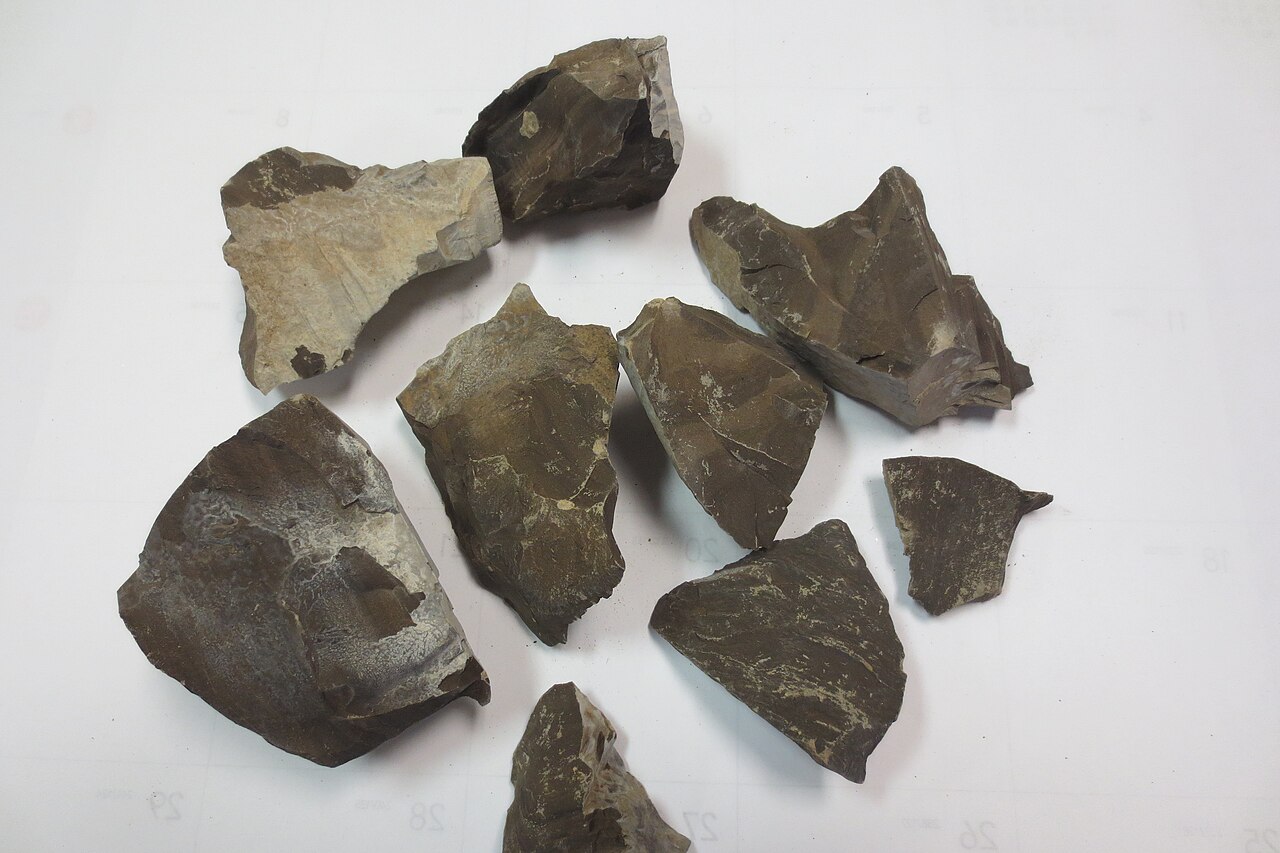
A fine-grained sedimentary rock rich in kerogen, which yields a petroleum-like oil when heated (retorted) — the basis of an entire Scottish industry built around it decades before conventional oil was ever struck in Britain.
Historical usage
Scotland's oil shale industry began in 1858, more than a year before the world's first modern oil well was drilled at Titusville, Pennsylvania, in 1859. James 'Paraffin' Young had already set up the world's first purpose-built oil refinery in 1851, extracting oil from shale to make crude oil, paraffin oil, paraffin wax, naphtha, gas, coke and ammonium sulphate fertiliser. Over the century that followed, the West Lothian shale field alone is estimated to have produced around 75 million barrels of oil and 500 billion cubic feet of gas, worked at scale by an industry using standardised retort designs — over 1,500 Pumpherston-type retorts were in use by 1910 — before finally closing in 1962.
How it worked
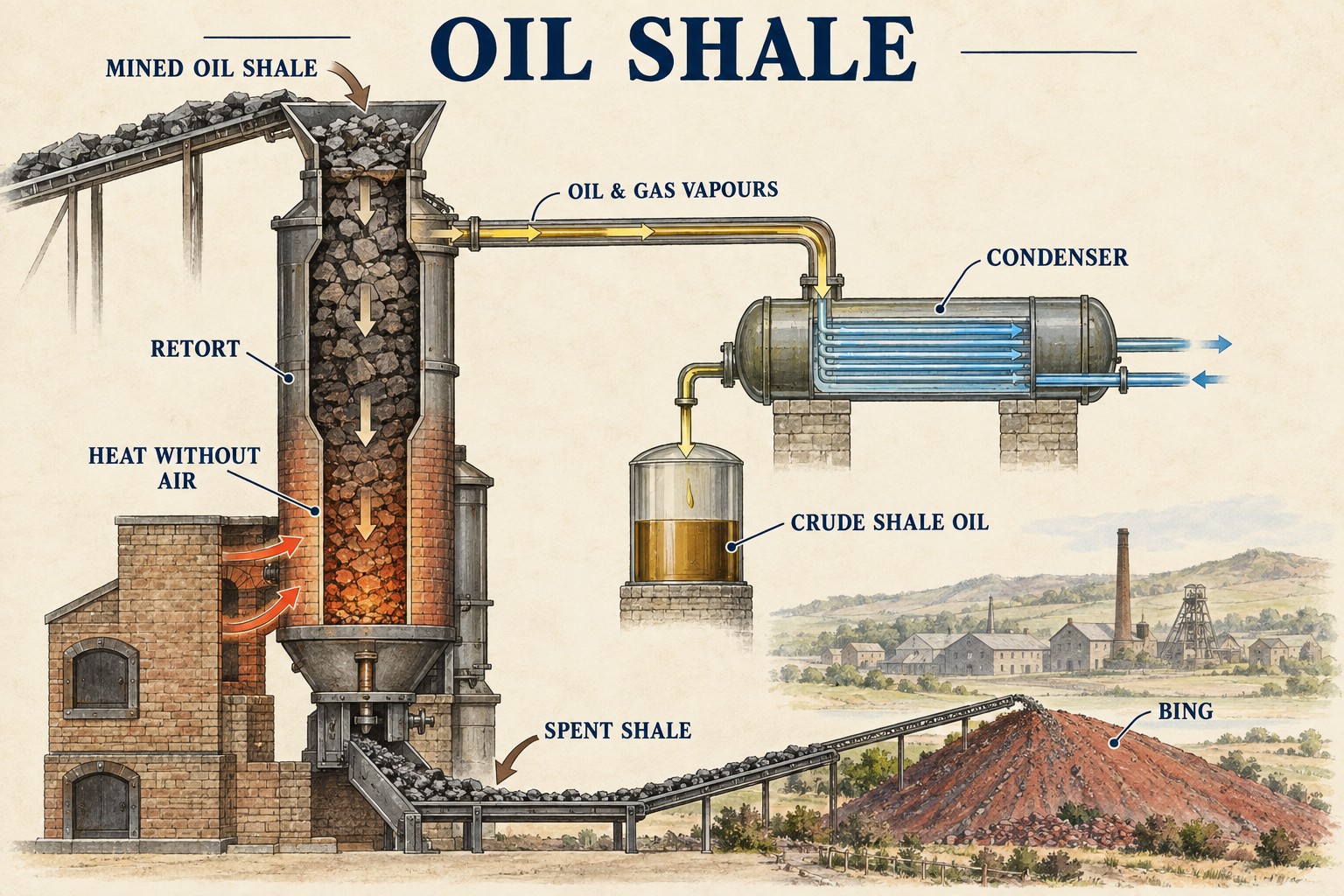
Shale was mined underground, much like coal, then brought to the surface and heated in banks of retorts, driving off a crude oil that was then refined into paraffin, lubricating oils and other products; the huge quantities of spent, burnt shale left over were tipped into the enormous red waste heaps, or 'bings', that still dominate the West Lothian landscape today.
Why it was used
Oil shale gave Scotland a genuine domestic oil industry decades before conventional crude oil was found anywhere in Britain, and the industry survived the initial shock of cheap American oil from the 1860s onward by running an efficient, integrated process that also made productive use of its own by-products, keeping Scottish shale oil commercially viable for a century after Pennsylvania crude first threatened to undercut it.
Value over time
Scottish shale oil held its own for decades even after Pennsylvania's 1859 oil strike, because the shale distillation process was, for a long period, still more efficient than shipping in crude from America; the industry's real decline came only gradually, over the early-to-mid 20th century, as cheaper imported petroleum from an increasingly global oil market steadily undercut it, ending in final closure in 1962.
Hazards & challenges
Shale mining shared coal mining's worst underground hazards directly — firedamp explosions caused real loss of life, most severely in the 1947 disaster at this site's own Burngrange mine — and workers also faced 'chokedamp' (a suffocating mixture of carbon dioxide and nitrogen), falls, and being run over by shale tubs underground. Above ground, retort work carried its own dangers: nine men were burned in explosions during the 1930s alone, with further blasts in the 1940s and 1950s, and epidemiological studies later found progressive massive fibrosis (a severe form of pneumoconiosis) in around 1% of miners and retort workers, alongside skin disease linked to prolonged shale oil exposure.
Regional variation
The industry was overwhelmingly concentrated in West Lothian and neighbouring Midlothian, exploiting a particular band of oil-rich shale (the Lothian or cannel shales) not worked at any comparable scale elsewhere in Britain.
Related terminology
Mines associated with this term
5 examples chosen from 10 linked records — the term page is not an index.
- Addiewell Oil Works — West Lothian (well documented example)
Named twice in this record, first in the summary: “…of the global shale-oil industry. Its retorts processed local oil shale into paraffin, naphtha and lubricating oils for over half a century…” - Kimmeridge Oil Shale Workings — Dorset (well documented example)
Named in this record’s geology: “…but only one was ever worth extracting — the Blackstone, a band of oil shale about a metre thick, at sea level on the west side of the bay and…” - Balgonie Colliery — Fife (well documented example)
Named 3 times in this record, first in the summary: “…raised manufacturing and steam coal, with clay in 1896 and blaes — oil shale — through the 1900s and 1910s, and had a brickworks of its own whose…” - Binnend Oil Works — Fife (well documented example)
Named in this record’s geology: “The works exploited oil shale — a sedimentary rock holding kerogen, solid organic matter from…” - Broxburn Oil Works — West Lothian (well documented example)
Oil shale working around Broxburn began in the 1860s and 70s under Robert Bell, who held the local mineral rights and ran several scattered operations.
See every mine that worked oil shale →
Disasters associated with this term
Included only where MineArchive's own research gives a reasonable evidential basis, with the nature of the relationship stated — not every disaster where this term might plausibly apply.
- Burngrange Oil Shale Mine explosion and fire, 1947 (hazard involved)
The 1947 Burngrange disaster was a firedamp explosion in an oil shale mine, a direct illustration of the underground hazards this term describes.
Sources
- (primary) Epidemiologic studies of Scottish oil shale workers: I. Prevalence of skin disease and pneumoconiosis — American Journal of Industrial Medicine
- (primary) Historical review paper: the shale-oil industry in Scotland 1858-1962. I: Geology and history — Oil Shale journal
- (secondary) Scottish oil shale workers — Heritage Hunter
- (secondary) The Scottish Oil-Shale Industry — Northern Mine Research Society
Record created: 21 August 2026 · Last researched: 21 August 2026