 MineArchive
Oil Works
| Also known as | Paraffin Works (the term more often used for James Young's own pioneering works and its immediate successors) |
|---|---|
| Category | Structures & Machinery |
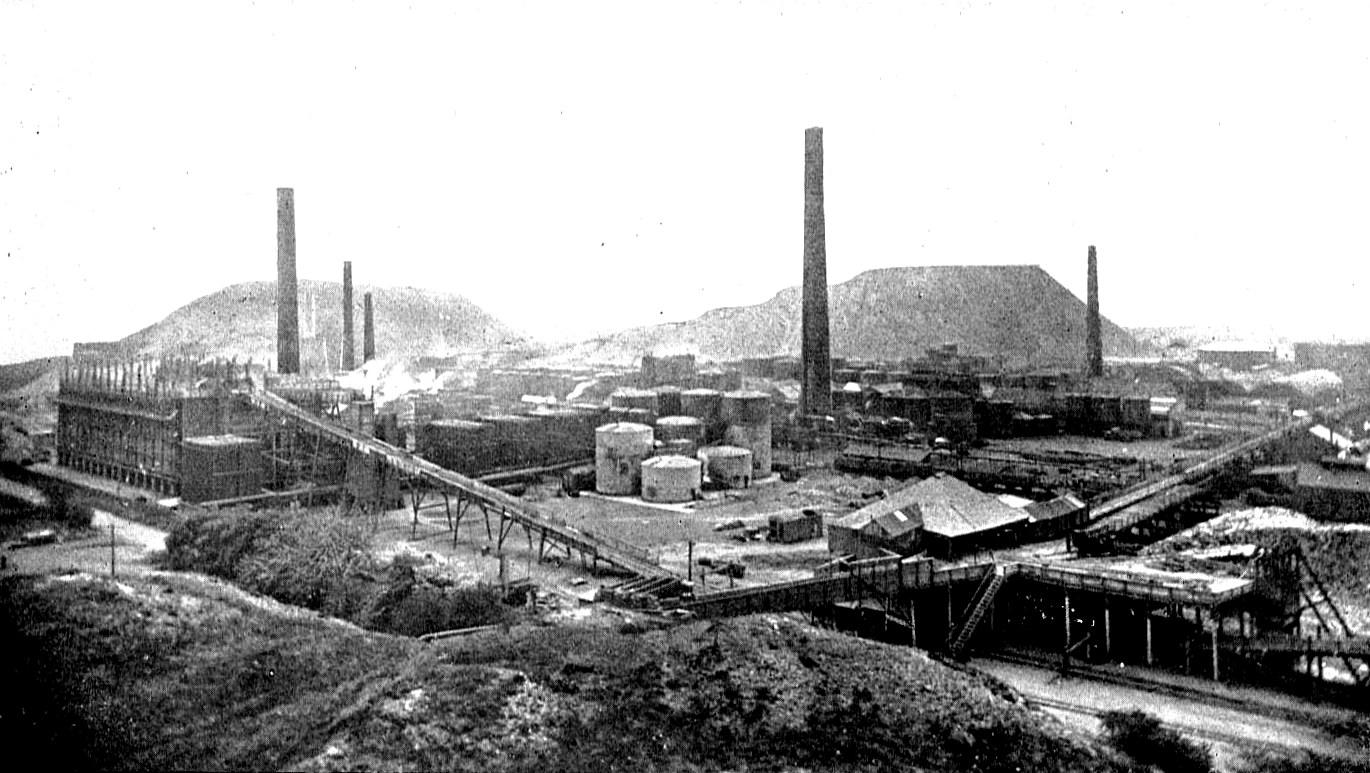
The surface works attached to a Scottish shale mine where crushed oil shale was retorted -- heated in the absence of air -- to drive off crude oil, gas and ammonia, distinct from the mine itself.
Historical usage
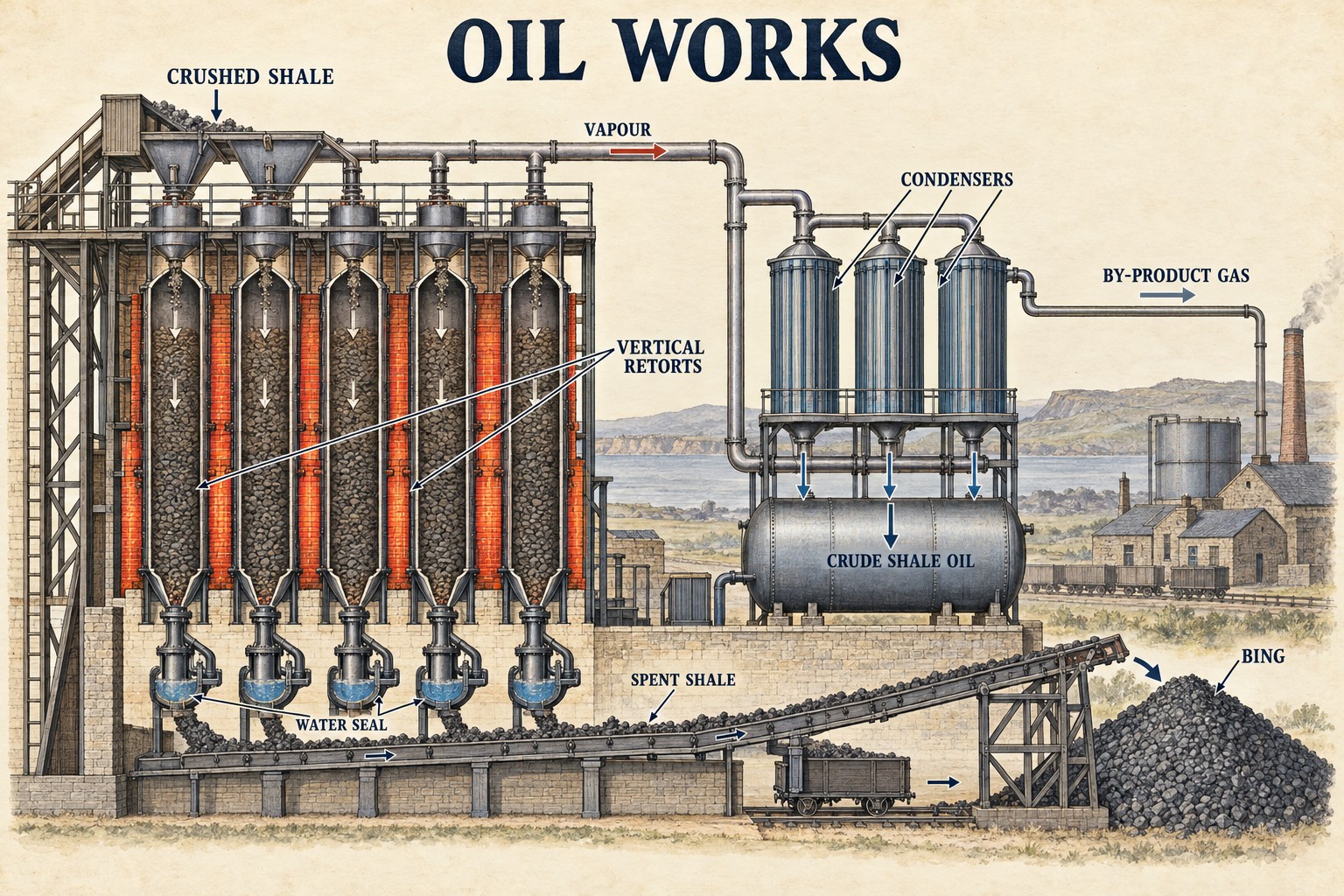
James 'Paraffin' Young built the world's first commercial oil-shale works near Bathgate in 1850-51, initially retorting cannel coal before switching to shale in 1862; the industry his invention created went on to employ around 10,000 people at its 1913 peak. Early oil works used horizontal retorts, adapted from coal-gas manufacture, that burned off the heavier oils and paraffin as fuel; once paraffin itself became the valuable product, vertical retorts took over, since solid hydrocarbons broke down less under that arrangement. A works typically grouped six to eight vertical retorts together, charged from hoppers at the top and continuously drawing off spent shale through a water seal at the bottom -- the 'continuous system'. The industry's last works closed around 1962, unable to compete with cheap imported Middle Eastern crude.
How it worked
Crushed shale was fed into a retort and heated without access to air, driving off its hydrocarbon content as a vapour that was condensed into crude shale oil; this crude oil was then further distilled and refined on site into paraffin oil, paraffin wax, naphtha, lubricating oils, ammonium sulphate fertiliser and fuel gas -- with almost every by-product finding a commercial use.
Why it was used
Retorting had to happen close to the mine, since raw shale was heavy, bulky and worth transporting only after most of its useful content had been extracted; siting the works beside the mine also let the enormous quantity of spent shale -- around three-quarters of the original weight -- go straight onto a nearby bing rather than being hauled any distance.
Related terminology
Mines associated with this term
5 examples chosen from 10 linked records — the term page is not an index.
- Addiewell Oil Works — West Lothian (well documented example)
Named in this record’s summary: “…1866 by James 'Paraffin' Young, Addiewell was for a time the biggest oil works in the world — a 28ha shale-oil refinery and candleworks that…” - Baads Colliery — West Lothian (well documented example)
Named 3 times in this record, first in the summary: “…selling to Scottish Oils, it closed in 1962 within weeks of the oil works, and its office and stores buildings still stand as a farm store.” - Binnend Oil Works — Fife (well documented example)
Named in this record’s summary: “A shale oil works, refinery and candle factory on the slopes of the Binn above…” - Kilrenny Oil Works — Fife (well documented example)
Named in this record’s summary: “The oil works built beside the Pitcorthie shale mines in 1866, at the eastern…” - Tarbrax Oil Shale Mine — South Lanarkshire (well documented example)
A shale oil works was established here by 1870, comprising a bench of forty-one retorts with condensers.
Sources
- (secondary) 1911 Encyclopaedia Britannica/Paraffin — Encyclopaedia Britannica (1911)
- (secondary) The Scottish Oil-Shale Industry — Northern Mine Research Society
Record created: 31 August 2026 · Last researched: 31 August 2026