 MineArchive
Binnend Oil Works
| Also known as | Burntisland Oil Works, Binnend Oil and Mineral Works, The Binn |
|---|---|
| Location | The Binn, about a mile north-east of Burntisland, Fife — 56.0719, -3.2217 (exact) |
| Commodity | Oil Shale |
| Type | Mineral |
| Worked | 1878–1894 (mines) |
| Maximum depth | No shaft depth is recorded. The mines were inclines following the shale at 10 to 27 degrees, and the furthest point of each was well below sea level. |
| Operators | Binnend Oil Co. Ltd. (1878–1881), Burntisland Oil Co. Ltd. (1881–1896) |
Overview
A shale oil works, refinery and candle factory on the slopes of the Binn above Burntisland, with its own mines following the shale out under the Firth of Forth. Built in 1878 at the northern end of a shale bed running 22 miles from Cobbinshaw in the Lothians, it employed close to a thousand men at its peak and processed 500 tons of shale a day. It lasted sixteen years. The village built for its workers outlived it by sixty.
History
James 'Paraffin' Young had launched the Scottish shale oil industry in West Lothian around 1850, and when his patent expired in 1864 a crop of new ventures followed, several of them in Fife. Binnend was promoted by George Simpson, an Edinburgh coalmaster, with fellow directors from Glasgow, West Calder and Pittenweem. Ground was broken in 1878 to work the shale of the lower east Binn — the northern extremity of a bed stretching 22 miles from Cobbinshaw.
The works comprised shale mines, retorts, and factories making oil and wax products: burning and lubricating oils, paraffin candles, paraffin wax, naphtha for paint and rubber, and sulphate of ammonia for fertiliser. The rateable value rose from £1,200 in July 1878 to £3,000 by 1881. At full output 500 tons of shale a day yielded some 15,000 gallons of crude oil, refined on site.
The Burntisland Oil Company Ltd was formed in 1881 to take over the works but ran into financial trouble and went into voluntary liquidation in 1892 — the year a 'crush' occurred underground, large sections of roof falling in as stoops were being drawn and doing damage that cost nearly £10,000 to clear. A new Burntisland Oil Company was registered in 1893 with little success and was wound up in 1896. Very little work was done after 1892 and the mines closed in 1894.
The village emptied slowly. Many left as soon as the works failed, but Binnend continued to be occupied for another sixty years; its last resident, George Hood, left in 1954.
Geology
The works exploited oil shale — a sedimentary rock holding kerogen, solid organic matter from which liquid hydrocarbons can be distilled by heating. The Lothians and Fife hold large reserves, and the Binn deposit formed the northern end of a single bed running some 22 miles south-west to Cobbinshaw. The shale dipped consistently, and the mines followed it down at angles usually between 10 and 27 degrees.
Geological setting: Sedimentary Beds and Seams (well documented example)
Workings
Four workings served the site — Burntisland No. 1, No. 2 and No. 3 mines and a No. 4 pit. Each followed the shale bed underground on its dip, at between 10 and 27 degrees, until the furthest point was well below sea level. The seam was taken out in successive rectangular blocks called stoops: the shale was brought down by blasting, and once a stoop was cleared its supporting walls were robbed until the roof came in behind. Above ground the shale was broken small and fed into the tops of retorts — tubes about 30 feet high and two feet across, heated to about 1,100°F in their upper part and 1,800°F lower down, through which a charge took roughly 24 hours to descend. Spent shale was drawn off at the base and tipped on the bing.
Closure
The Burntisland Oil Company went into voluntary liquidation in 1892 and very little work was done after that; the mines closed in 1894. A successor company registered in 1893 was wound up in 1896. The works were presumably dismantled after 1894, though the candle-house stood until about 2000.
What remains
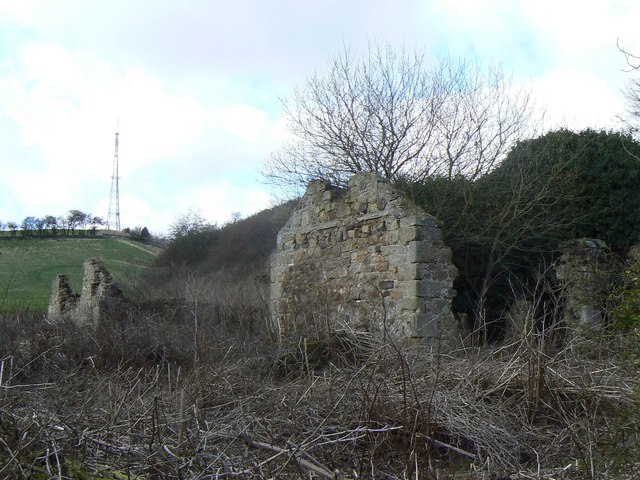
Woodland. The bing has been used as a waste lagoon. Fragmentary ruins of the High Binn village survive on the hillside — enough to make out the lines of the miners' rows — and some remains of the works can still be seen close to the main road. Little else is left of what was, for sixteen years, one of the larger industrial undertakings in Fife.
Fragments of the High Binn village, the shale bing (used as a waste lagoon), and some remains of the works near the main road. The candle-house survived until about 2000.
Redevelopment
The works site has reverted to woodland; the bing has been used as a waste lagoon.
Nearby mines
- Seafield Colliery — 2.6 miles (4.2 km) NE
- Dundonald Colliery — 4.2 miles (6.8 km) N
- Dunnikier Colliery — 4.3 miles (6.9 km) NE
- Donibristle Colliery — 4.7 miles (7.5 km) W
- Little Raith Colliery — 4.9 miles (7.8 km) NW
Straight-line distance, within 9 miles (15 km). Show on the map.
Recorded claims
Individual factual claims, each attached to the source(s) that support it below. Where sources disagree, both are kept.
- The works were promoted by the Binnend Oil Company Ltd, established 1878, whose directors included George Simpson, an Edinburgh coalmaster, and James Thornton; ground was broken that year. 1,2
- At peak the works employed almost a thousand men and processed about 500 tons of shale a day, yielding some 15,000 gallons of crude oil, refined on site. 2,3
- The works produced burning and lubricating oils, paraffin candles, paraffin wax, naphtha for paint and rubber manufacture, and sulphate of ammonia as fertiliser. 1,3
- Four workings served the site — Burntisland No. 1, No. 2 and No. 3 mines and No. 4 pit — following the shale underground at angles usually between 10 and 27 degrees until their furthest points were well below sea level. 1,3
- The seam was worked in successive rectangular stoops: shale was brought down by blasting, and once a stoop was cleared its supporting walls were removed until the roof collapsed. 3
- Shale was broken small and fed into the tops of retorts about 30 feet high and two feet in diameter, heated to roughly 1,100°F in the upper part and 1,800°F in the lower, taking about 24 hours to pass through; the spent shale was tipped on the bing. 3
- It was reported at the company's 1892 annual meeting that a 'crush' had occurred that year, large sections of roof falling in as stoops were being removed and doing damage that cost almost £10,000 to clear. 3
- Very little work was done after 1892 and the mines closed in 1894; the successor company registered in 1893 was wound up in 1896. 1,4
- The village continued to be occupied long after the works failed; its last resident, George Hood, left in 1954. 3,4
Photographs & further reading
The museum's site record, giving the succession of companies, the mines and pit that served the works, and a year-by-year table of rateable value from 1878.
View sourceArchive postcards of the miners' rows, the Square and the school alongside photographs taken in 2010 showing what is left of High and Low Binn.
View sourceA local account of the works' sixteen-year life, setting it in the context of the Scottish shale rush that followed the expiry of James Young's patent in 1864.
View sourceSources
- (primary) Binnend Oil Works — Museum of the Scottish Shale Oil Industry
- (secondary) The Burntisland Shale Oil Works — Burntisland Heritage Trust
- (secondary) Binnend — Abandoned Communities
- (secondary) Binnend — Wikipedia
- (observational) Binnend village (High Binn) — Museum of the Scottish Shale Oil Industry
Record created: 3 September 2026 · Last researched: 3 September 2026