 MineArchive
Miners' Row
| Category | Structures & Machinery |
|---|
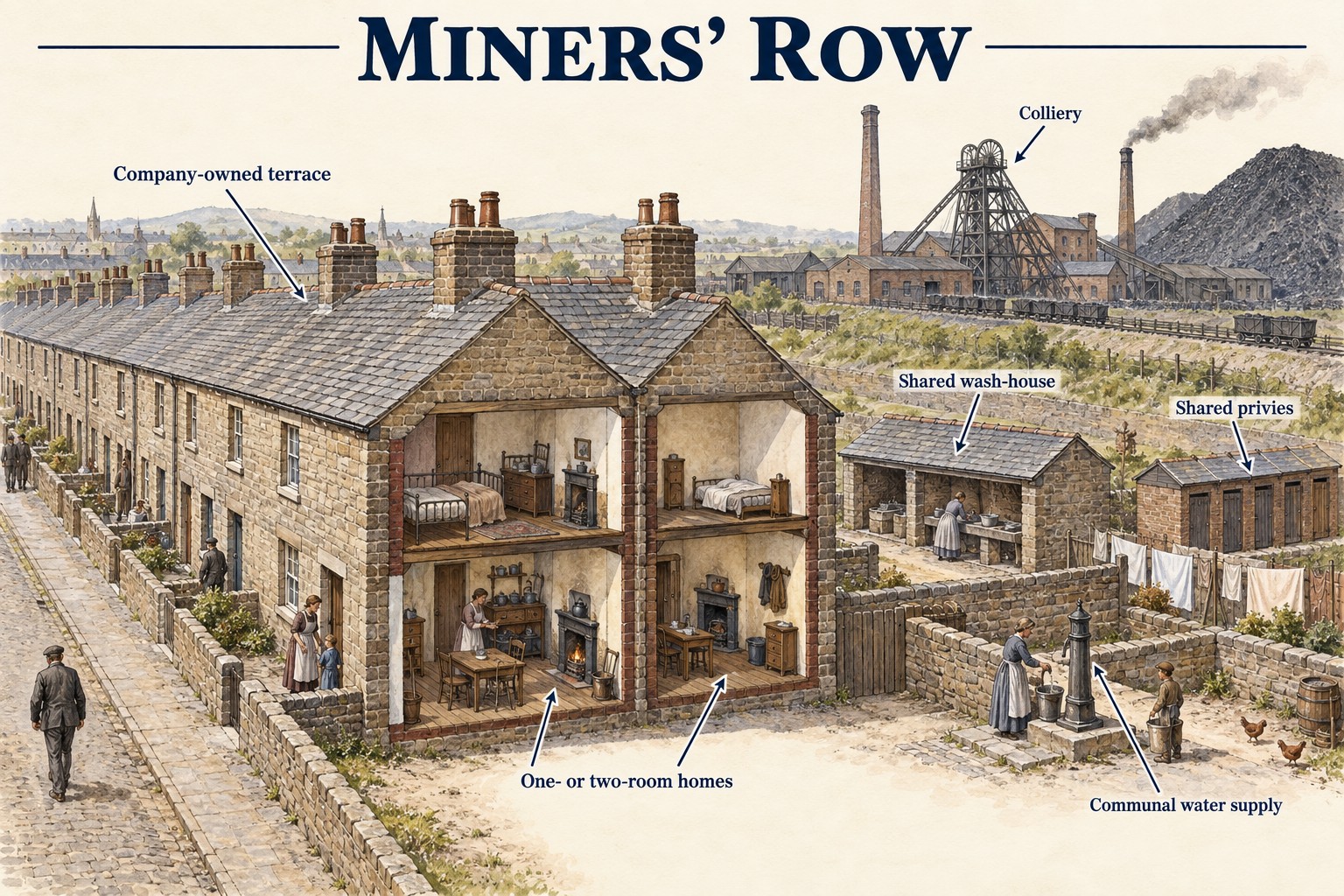
Terraced housing built and owned outright by a colliery or quarry company specifically to house its own workforce, standard practice across British coalfields and many metal-mining and quarrying districts from the 19th century onward.
Historical usage
As mining expanded rapidly through the 19th century, companies opening new pits or quarries in remote or thinly-populated districts often had no existing workforce to draw on, and built housing on-site to attract and hold one. Ayrshire alone recorded whole rows built by name -- Skares, raised by William Baird & Company in the early 1870s with further rows added some twenty years later; Glengyron, 44 north-facing houses built around 1872 by the Eglinton Iron Company. The pattern recurs across the archive far beyond Scotland: the Aberdovey Slate Company built the entire village of Abergynolwyn to house workers at Bryn Eglwys quarry, William Baird and Company built three Miners' Rows plus shops, a butcher and a pub at Annathill for Bedlay Colliery, and Dixon's built its own rows at Blantyre. Housing of this kind was almost always basic: typically one or two rooms, shared outdoor toilets and wash-houses, and water drawn from a nearby burn rather than piped supply, which in some rows did not arrive until decades after the houses themselves were built. Most miners' rows were cleared in slum-clearance programmes from the late 1940s through the early 1960s, as councils built modern replacement housing and the close-knit communities the rows had supported came to an end within a generation.
Why it was used
A company opening a mine or quarry away from any existing town had no other way to secure a workforce -- building housing on-site let it recruit and hold miners who would otherwise have had nowhere to live within reach of the pit.
Risks & limitations
Because the company that employed a man also owned the roof over his family's head, a miners' row gave an employer real power over its workforce beyond the workplace itself -- eviction from a tied cottage was a genuine threat hanging over any dispute with management, and it was carried out for real at Blantyre, where 34 widows of men killed in the colliery's own 1877 disaster were evicted from their homes just six months later. Sanitation and water supply in most rows lagged decades behind ordinary town housing, and overcrowding was common in what were often single-room family homes. Not every row was quite so basic -- a handful, like Reform Row at Elsecar (1837) and New Bolsover (1891), were deliberately built as 'model villages' with schools, churches and green space, though these were the exception rather than the rule.
Related terminology
Mines associated with this term
5 examples chosen from 12 linked records — the term page is not an index.
- Glenbuck Colliery — East Ayrshire (well documented example)
Named in this record’s current condition: “…coal void. Only a handful of structures survive — of the original miners' rows, a small number of houses were left standing near Glenbuck Loch —…” - Auldhouseburn Colliery — East Ayrshire (well documented example)
Named in this record’s surface remains: “The bing; the brick footings of the miners' row built west of the Bankhead cottages; the earthworks of the water…” - Bannockburn Colliery — Stirling (well documented example)
Named twice in this record, first in the history: “…village's population had passed 3,000. The Alloa Coal Company built miners' rows to house them — Murray Row and Mitchell Row first, with ten more…” - Bedlay Colliery — North Lanarkshire (well documented example)
William Baird and Company built three Miners' Rows of housing, plus shops, a butcher and a pub, at Annathill to house Bedlay Colliery's workforce. - Binnend Oil Works — Fife (well documented example)
Named in this record’s current condition: “…survive on the hillside — enough to make out the lines of the miners' rows — and some remains of the works can still be seen close to the main…”
Sources
- (secondary) 10 Places with Coal Mining History — Historic England (The Historic England Blog)
- (secondary) Cumnock History Group — Miners Rows — Cumnock History Group
Record created: 30 August 2026 · Last researched: 30 August 2026