 MineArchive
Glenbuck Colliery
| Location | Glenbuck, near Muirkirk, East Ayrshire — 55.5366, -3.9965 (approximate) |
|---|---|
| Commodity | Coal |
| Type | Coal |
| Worked | From 1795–1933 |
| Operators | Glenbuck Iron Company (1795–1813) |
Overview
A cluster of small pits around the remote upland village of Glenbuck, worked from the early 19th century until the last colliery, Grasshill, closed in 1933. The village that grew up around the mines was entirely demolished for opencast coal extraction in the 1990s, but it lives on as the unlikely birthplace of Liverpool manager Bill Shankly and some fifty other professional footballers who passed through its junior club, the Glenbuck Cherrypickers.
History
Glenbuck grew up around the Glenbuck Iron Company, which built coal-fired blast furnaces here in 1795 and operated them until 1813 — a short-lived works whose iron rails, according to local tradition, went on to be used on the Kilmarnock and Troon Railway, one of the first steam-worked railways in Scotland. Coal mining continued at Glenbuck long after the ironworks itself closed, worked through a series of small pits across the 19th century — the Mining Remediation Authority's own abandonment plans for the site run in an almost unbroken sequence from 1849 through to 1919 — and the village grew alongside them, reaching a peak population of 1,079 in 1891 with its own school, church, post office, Co-operative store and, from 1873, a station on the Caledonian Railway's Muirkirk branch. By the early 20th century the last working colliery was Grasshill, which at its peak employed around 150 of the village's roughly 200-strong workforce; sources differ on whether it closed in 1931 or 1933, though the Mining Remediation Authority's own abandonment record for Grasshill is dated 1933, and later 20th-century opencast working revisited the same ground under the same name. With the underground pit gone, Glenbuck's economy collapsed: the school closed in 1951, the Co-op in 1953, and by 1954 the village had been entirely depopulated, its remaining residents rehoused on a council estate in Muirkirk. What buildings still stood were then swept away when opencast coal working returned to the site in the 1990s, erasing all but a handful of structures.
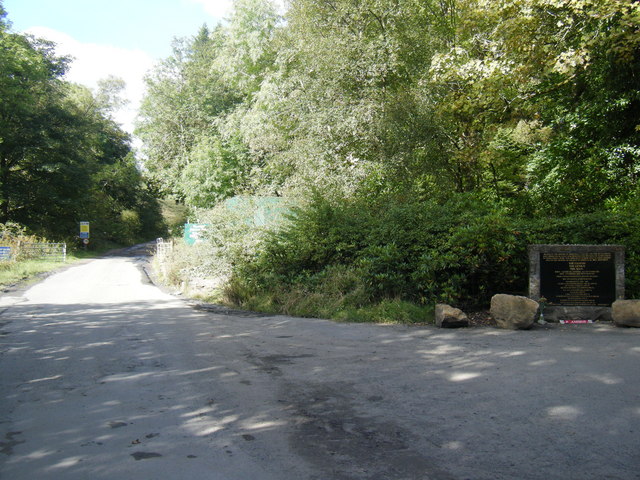
Glenbuck's more famous legacy has nothing to do with coal. From the 1870s the village fielded a junior football team, the Glenbuck Cherrypickers, which for a mining community of barely a thousand people produced an extraordinary run of talent: around fifty players went on to the professional game before the club folded in 1931, the same era as the village's own decline. Chief among them was Bill Shankly, whose four older brothers all played for the Cherrypickers before he went on to captain Scotland and build Liverpool into a dominant force as manager. A memorial to Shankly now stands on the plot where his family home once stood, alongside interpretation boards telling the village's story.
Geology
The coal worked at Glenbuck belongs to the Scottish Upper Coal Measures of the Ayrshire coalfield's eastern, upland extension, where productive seams sit within a Carboniferous sequence of sandstones, mudstones and thin coals laid down in deltaic and swamp conditions on the northern edge of the Midland Valley basin. The same sequence carried the ironstone and blackband bands that made small-scale local iron smelting viable in the 1790s, before coal alone became the resource worth working here.
Workings
Glenbuck was worked as a succession of separate, comparatively small pits rather than one continuous colliery, reflected in the string of individual Mining Remediation Authority abandonment plans covering the site between 1849 and 1919. The last of these, Grasshill, was a conventional shaft-worked deep mine; the ground was later reworked by opencast methods in the 20th century, a method that requires stripping the overlying land entirely rather than tunnelling beneath it — which is what ultimately consumed the site of the village itself.
Closure
Grasshill, the last deep-worked colliery at Glenbuck, closed in 1933 (a small number of sources give 1931). Large-scale opencast coal working returned to the immediate area in the 1990s, by which time the village itself had already stood empty for decades; that later working removed the last standing remains of Glenbuck.
What remains
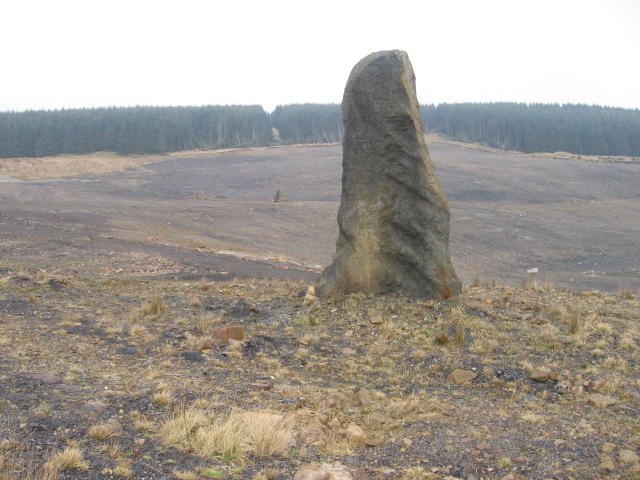
The site of the village and its former pits is now dominated by a large disused opencast coal void. Only a handful of structures survive — of the original miners' rows, a small number of houses were left standing near Glenbuck Loch — and the wider area is managed as the Glenbuck Heritage Village, with interpretation boards and a relocated Bill Shankly memorial marking the site of the Shankly family home. Glenbuck Loch itself, an early-19th-century reservoir immediately north of the old village and now a designated SSSI, survives essentially unaffected by the mining that surrounded it.
The former opencast void and its spoil are the dominant visible feature; a few original cottages remain standing near the loch, and the football pitch used by the Glenbuck Cherrypickers can still be traced on the ground.
Related mines
- Auldhouseburn Colliery — The Cairntable Gas Coal Company owned pits at Glenbuck three miles east as well as Auldhouseburn, and its Glenbuck output was the larger of the two; officials from the Glenbuck property came over to help during the 1898 inundation.
- Muirkirk Collieries — The Muirkirk company was driving a level to a seam at Glenbuck by October 1791, and the works canal was later replaced by Baird's Railway running east to Glenbuck.
Nearby mines
- Auldhouseburn Colliery — 2.5 miles (4.0 km) SW
- Muirkirk Collieries — 3.0 miles (4.9 km) SW
- Kames Colliery — 3.4 miles (5.5 km) SW
- Auchlochan Colliery — 3.5 miles (5.7 km) E, South Lanarkshire
- Kennox Colliery — 4.0 miles (6.4 km) E, South Lanarkshire
Straight-line distance, within 9 miles (15 km). Show on the map.
The former colliery and opencast ground are not open for exploration — this entry describes history and general location only, not an access guide; the Heritage Village's public paths and interpretation boards are the way to visit.
Culture
- Glenbuck Cherrypickers F.C. (Sports)
The colliery whose closure in 1930-31 ended the village's viability and, with it, the football club.
What's uncertain
Points where sources disagree or the record could not be settled; both accounts are kept. All open questions in the archive.
- Grasshill, the last working colliery, employed around 150 of the village's roughly 200-strong workforce; Wikipedia gives its closure as 1931, while The Lost Villages and the Mining Remediation Authority's own abandonment record both give 1933. (disputed) 3,1,2
Recorded claims
Individual factual claims, each attached to the source(s) that support it below. Where sources disagree, both are kept.
- The Glenbuck Iron Company operated coal-fired blast furnaces at Glenbuck from 1795 to 1813; local tradition holds that its iron rails were used on the early Kilmarnock and Troon Railway. 1
- Mining Remediation Authority abandonment plans record workings at Glenbuck across at least 1849, 1857, 1858, 1879, 1880, 1882 and 1919, with the last colliery, Grasshill, separately recorded as abandoned in 1930 and 1933. 2
- Grasshill, the last working colliery, employed around 150 of the village's roughly 200-strong workforce; Wikipedia gives its closure as 1931, while The Lost Villages and the Mining Remediation Authority's own abandonment record both give 1933. (disputed) 3,1,2
- Glenbuck's school closed in 1951, its Co-op store in 1953, and the village was entirely depopulated by 1954; surviving buildings were later demolished when opencast coal working returned to the site in the 1990s. 3,1
Sources
- (secondary) Glenbuck — Wikipedia
- (primary) BGS/Mining Remediation Authority mine plans — Glenbuck and Grasshill — British Geological Survey / Mining Remediation Authority
- (secondary) Glenbuck — The Lost Villages (oral history project, East Ayrshire)
Record created: 26 August 2026 · Last researched: 26 August 2026