 MineArchive
Abandonment Plan
| Also known as | Plan of Abandoned Mine (The wording used in the nineteenth-century statutes.), Mine Abandonment Plan, Abandoned Mine Plan |
|---|---|
| Category | Law & Custom |
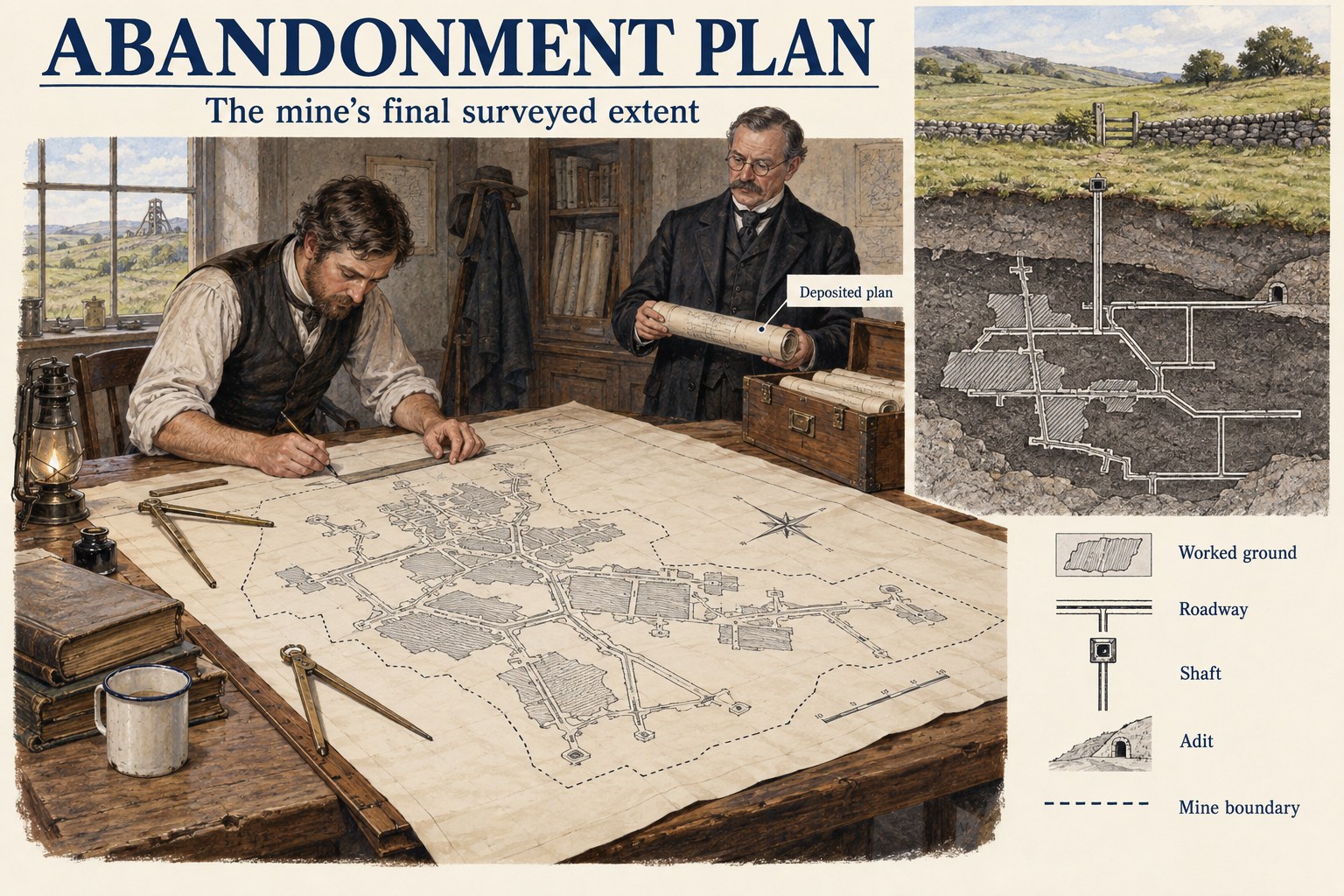
The plan of a mine's workings that its owner was required by law to deposit with the government when the mine was abandoned. Abandonment plans show the areas worked, the extent of the excavations and the positions of mine entrances, and they are the single most important surviving record of what lies underground at a site where nothing remains on the surface.
Historical usage
The obligation is old and was built up piecemeal. For coal mines a legal duty to deposit plans already existed under the Coal Mines Inspection Act 1850. The Metalliferous Mines Regulation Act 1872 extended the requirement to mines of every other description — excepting coal, stratified ironstone, shale, salt and firestone — obliging owners to deposit plans of abandoned mines with the Home Secretary; catalogues of the plans deposited under that Act were published by HMSO in the 1920s. The Mines and Quarries Act 1954 required working mines to deposit maps and plans with the Mining Record Office.
In 1950, by agreement between the Ministry of Fuel and Power and the newly formed National Coal Board, coal plans were separated from those of other minerals. Plans deposited under the 1954 Act and earlier statutes were distributed to local record offices during the 1990s. Coal-mine abandonment plans are held by the Mining Records Office of what was the Coal Authority and is now the Mining Remediation Authority; the plans catalogue is that body's, and it is often the only citable primary record a small or short-lived mine leaves behind.
How it worked
A plan was surveyed and drawn to scale showing the roadways, faces and worked-out ground, the shafts and adits by which the mine was entered, and usually the boundaries of the take. On abandonment it was deposited with the responsible department, which catalogued it. Because the obligation attached to abandonment rather than to working, the plan records the mine at its greatest extent — the last state of the workings before they were left.
Why it was used
Originally for safety and for the settlement of disputes: knowing where old workings ran mattered to any mine driving towards them, since holing into flooded abandoned ground has killed miners repeatedly. That remains the practical use today. Abandonment plans underpin coal-mining subsidence and land-stability reports, guide construction over former coalfields, and are the starting point for anyone trying to establish what a vanished mine actually did.
Risks & limitations
The record is incomplete and unevenly so. Mines abandoned before the relevant statute left no deposited plan at all, and the 1872 Act's exceptions mean whole classes of working — stratified ironstone, shale, salt, firestone — fall outside it. Plans were sometimes inaccurate, and workings extended after a plan was drawn do not appear on it. In this archive most searches of the plans catalogue return nothing, which is a fact about the record rather than about the mine: the absence of an abandonment plan is not evidence that a mine was small or short-lived.
Related terminology
Adit, Borehole, Gale and Gaveller, Old Workings, Shaft
Mines associated with this term
5 examples chosen from 193 linked records — the term page is not an index.
- Auchengeich Colliery — North Lanarkshire (well documented example)
Named in this record’s closure notes: “Auchengeich closed in 1965, six years after the disaster; the abandonment plans are dated to that year, and the spoil tip was formally abandoned in…” - Chisnall Hall Colliery — Lancashire (well documented example)
Named in this record’s history: “…between 1981 and 1983 and opened to the public. The colliery's abandonment plans, twenty-four of them, are held by the Mining Remediation Authority.” - Glenbuck Colliery — East Ayrshire (well documented example)
Named twice in this record, first in the history: “…across the 19th century — the Mining Remediation Authority's own abandonment plans for the site run in an almost unbroken sequence from 1849 through to…” - Lofthouse Colliery — West Yorkshire (well documented example)
Named in this record’s closure notes: “Lofthouse closed in 1981; the Coal Authority's abandonment plans for the colliery and its spoil heap are dated April 1981.” - Monktonhall Colliery — Midlothian (well documented example)
Named in this record’s geology: “…Foot (Claiknowes), Splint, Parrot and other seams recorded in the abandonment plans. The mine water carries enough iron to stain the settling ponds…”
Disasters associated with this term
Included only where MineArchive's own research gives a reasonable evidential basis, with the nature of the relationship stated — not every disaster where this term might plausibly apply.
- Clay Cross Colliery inundation, 1861 (contributing factor)
The working plans were inaccurate.
Sources
- (primary) Mines and mining (research guide) — The National Archives
- (secondary) Coal Mines Regulation Act 1872 — Wikipedia
Record created: 3 September 2026 · Last researched: 3 September 2026