 MineArchive
Firestone
| Dialect | Surrey |
|---|---|
| Category | Commodities |
| Commodity page | Firestone → |
A hard, siliceous building stone from the Upper Greensand of the North Downs, used for construction and for lining fireplaces and kilns.
Historical usage
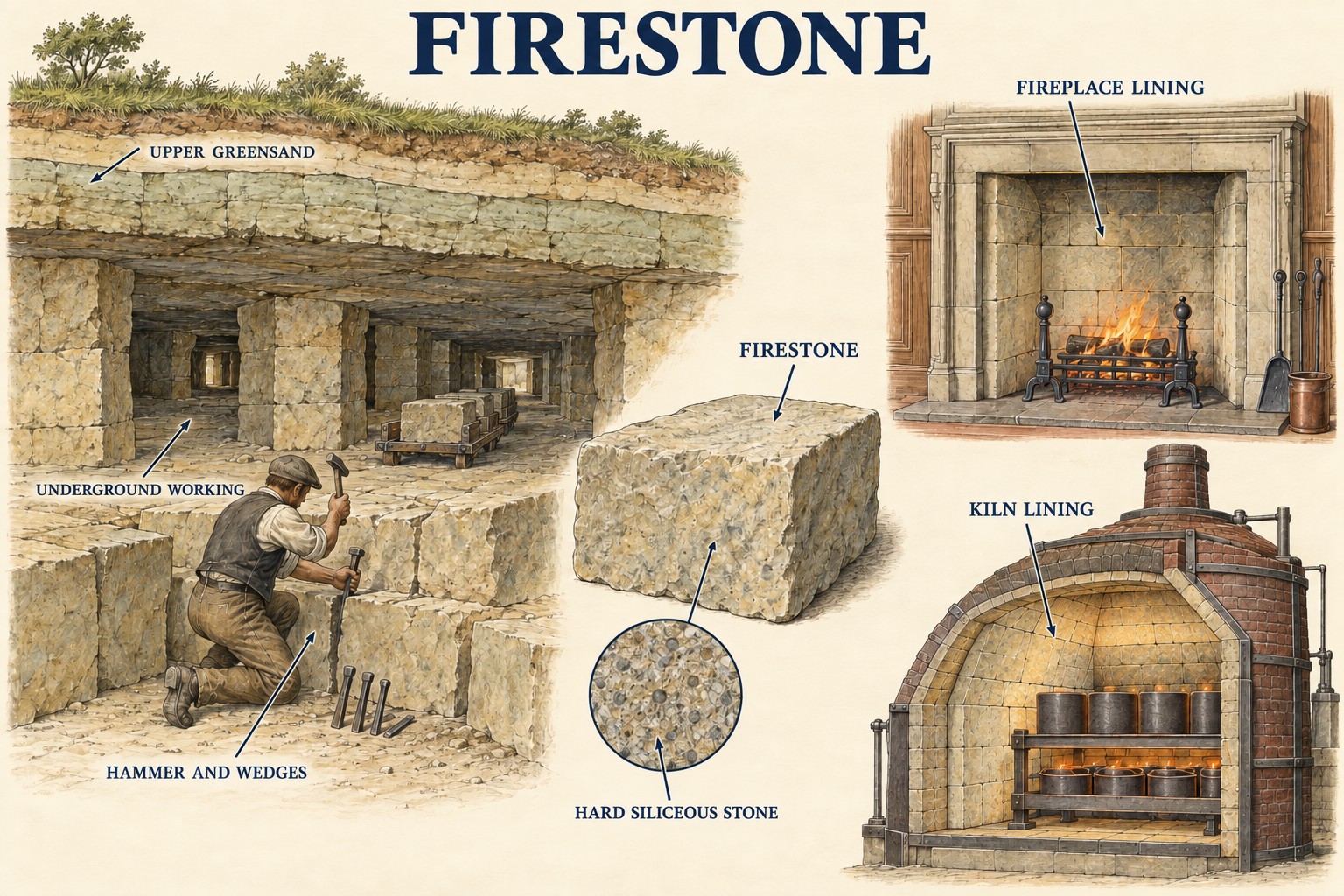
Firestone and its softer companion stone Hearthstone are both varieties of Reigate Stone, quarried underground from the Upper Greensand along a narrow strip of the North Downs between Godstone and Brockham in east Surrey — the same beds worked at Merstham. Firestone's harder, siliceous character suited it to ordinary building work and to lining fireplaces, kilns and furnaces, where its heat resistance was valued long after its use as an ordinary building stone had declined.
How it worked
Mined underground in lumps using hammers and wedges, following the natural joints in the rock, in passages that were typically rough rather than carefully dressed, since the finish did not matter for firestone's principal industrial uses.
Why it was used
Firestone's hardness and resistance to heat made it useful as an ordinary building stone and, once the wider building trade moved to other materials, kept a market as a refractory lining material for fireplaces, kilns and furnaces.
Value over time
Reigate Stone was a royal stone before it was an industrial one. Roger of Reigate supplied Westminster Abbey in 1253, the Prophete family were appointed masters of the Merstham and Chaldon quarries by Edward III in 1359 with powers to impress labour, and the stone went to Windsor, old St Paul's and London Bridge, shipped by way of Kingston and Vauxhall; from the eleventh century to the sixteenth it was the principal freestone of south-east England. Its value fell with the coming of better stone. The Croydon, Merstham and Godstone Railway of 1805 ran to the Quarry Dean workings and a standard-gauge spur reached them by 1868, but what the railways actually did was bring Portland and other stones into London at prices Reigate could not meet, and the trade fell back on its industrial grades: firestone for furnace and oven linings, and in the Victorian years hearthstone, the softest stone, sold for whitening doorsteps. Even that could not last, and the last Reigate Stone quarry closed in 1961.
Hazards & challenges
A soft, weakly cemented stone worked underground with axe and hammer, along joints, in galleries that were left rough because the finish did not matter; the hazards were those of any unsupported soft-rock mine, roof falls above all, rather than anything in the stone itself, though the dust of a sandstone worked by hand carried the usual silica risk. The stone's real failing was in use rather than extraction: it weathers badly, which is why so much medieval Reigate Stone has been replaced with Portland.
Risks & limitations
As transport improved through the 18th and 19th centuries and other building stones became more easily available, firestone lost most of its market for ordinary construction, surviving mainly in its narrower refractory role.
Regional variation
A Surrey and Kent term for this particular Upper Greensand building stone; elsewhere in Britain comparable stone is known by different local names.
Related terminology
Mines associated with this term
5 examples chosen from 7 linked records — the term page is not an index.
- Godstone Mine — Surrey (well documented example)
Named 8 times in this record, first in the summary: “An underground firestone and hearthstone quarry in the Upper Greensand beneath Godstone Hill,…” - Allenheads Mines — Northumberland (well documented example)
Named in this record’s history: “…Sun, Diana and Blackett veins. Fawside Level, a horse level on the firestone side, was begun in Sir William Blackett's time and completed in…” - Flushiemere Barytes Mine — County Durham (well documented example)
Named twice in this record, first in the history: “…that side, in ground between the base of the Great Limestone and the Firestone that Dunham described as traversed by a remarkable complex of veins.…” - Greenlaws Mine — County Durham (well documented example)
Named twice in this record, first in the history: “…the team seven years to reach a depth of around 260 feet down the Firestone level, opening access to the first of the flats abandoned in 1897…” - Marden Mine — Surrey (well documented example)
Named 6 times in this record, first in the summary: “…the Upper Greensand stone quarries under Godstone Hill, worked for firestone from the mid-19th century, then as a mushroom farm, then as a…”
See every mine that worked firestone →
Sources
- (primary) The many faces of Reigate Stone: an assessment of variability in historic masonry (npj Heritage Science, 2020) — Springer Nature
- (primary) Underground Surrey — Wealden Cave & Mine Society
- (secondary) History of Merstham — Reigate and Redhill Society
- (secondary) The Exploitation, Distribution and Use in Buildings of Reigate Stone pt1 — Croydon Caving Club
- (secondary) The Exploitation, Distribution and Use in Buildings of Reigate Stone pt2 — Croydon Caving Club
Record created: 27 August 2026 · Last researched: 8 September 2026