 MineArchive
Freestone
| Category | Commodities |
|---|---|
| Commodity page | Freestone → |
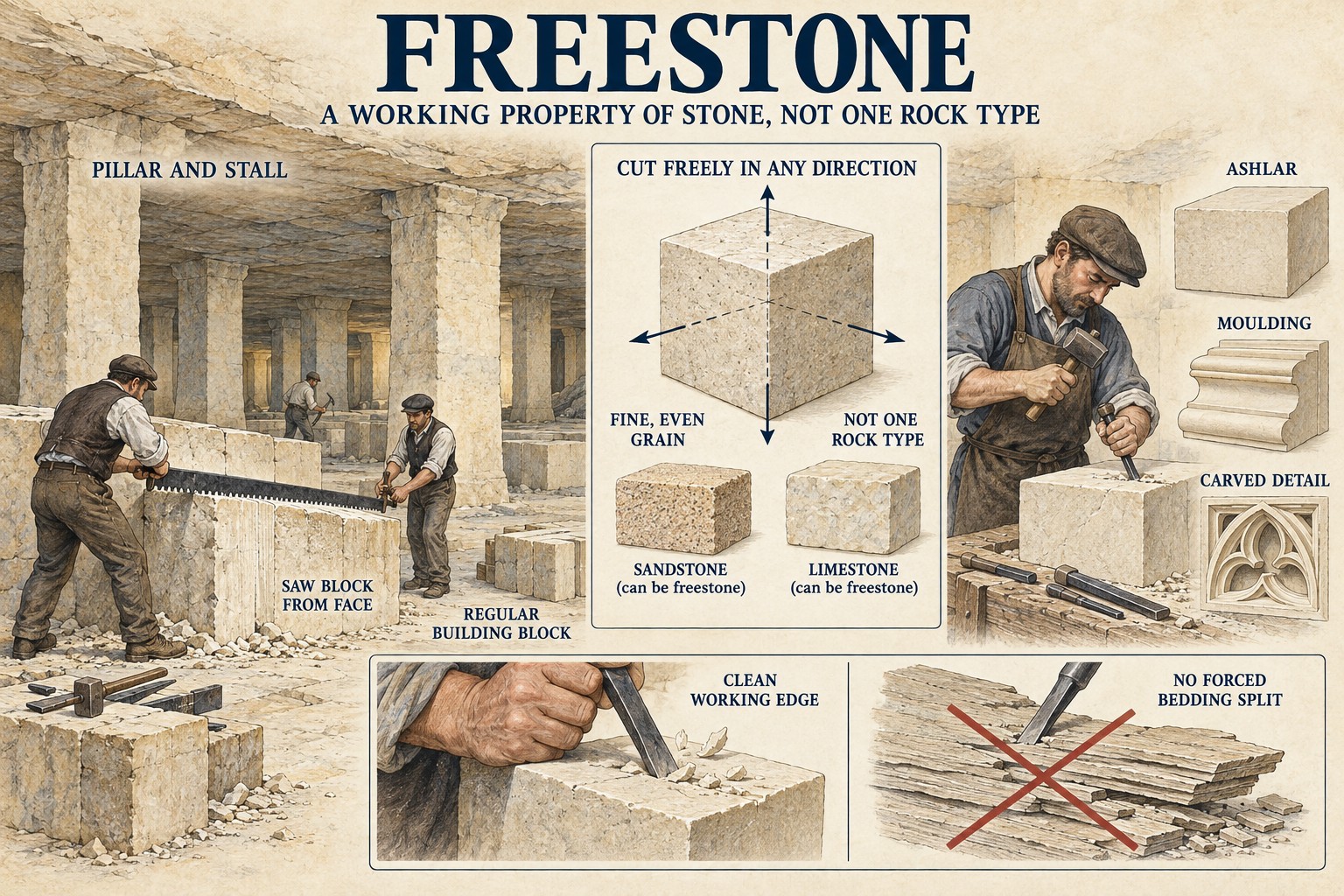
A general term, not one specific rock, for any fine-grained sandstone or limestone that can be cut and worked freely in any direction without splitting along natural bedding planes — the quality that made Bath, Portland and Beer stone Britain's premier building stones for a thousand years.
Historical usage
Portland stone was already being shipped from Dorset to London by the 14th century, used in the Tower of London and the old Palace of Westminster, but its defining moment came after the Great Fire of London in 1666, when Christopher Wren specified it for St Paul's Cathedral and dozens of rebuilt City churches, cementing its status as England's premier monumental stone. Bath stone was worked underground at Combe Down from the early 18th century, developed by Ralph Allen to supply the Georgian rebuilding of Bath itself, with major underground extraction continuing into the early 20th century. Beer stone, quarried in Devon since Roman times, supplied southern England's medieval cathedrals and churches, with extraction continuing until the 1920s.
How it worked
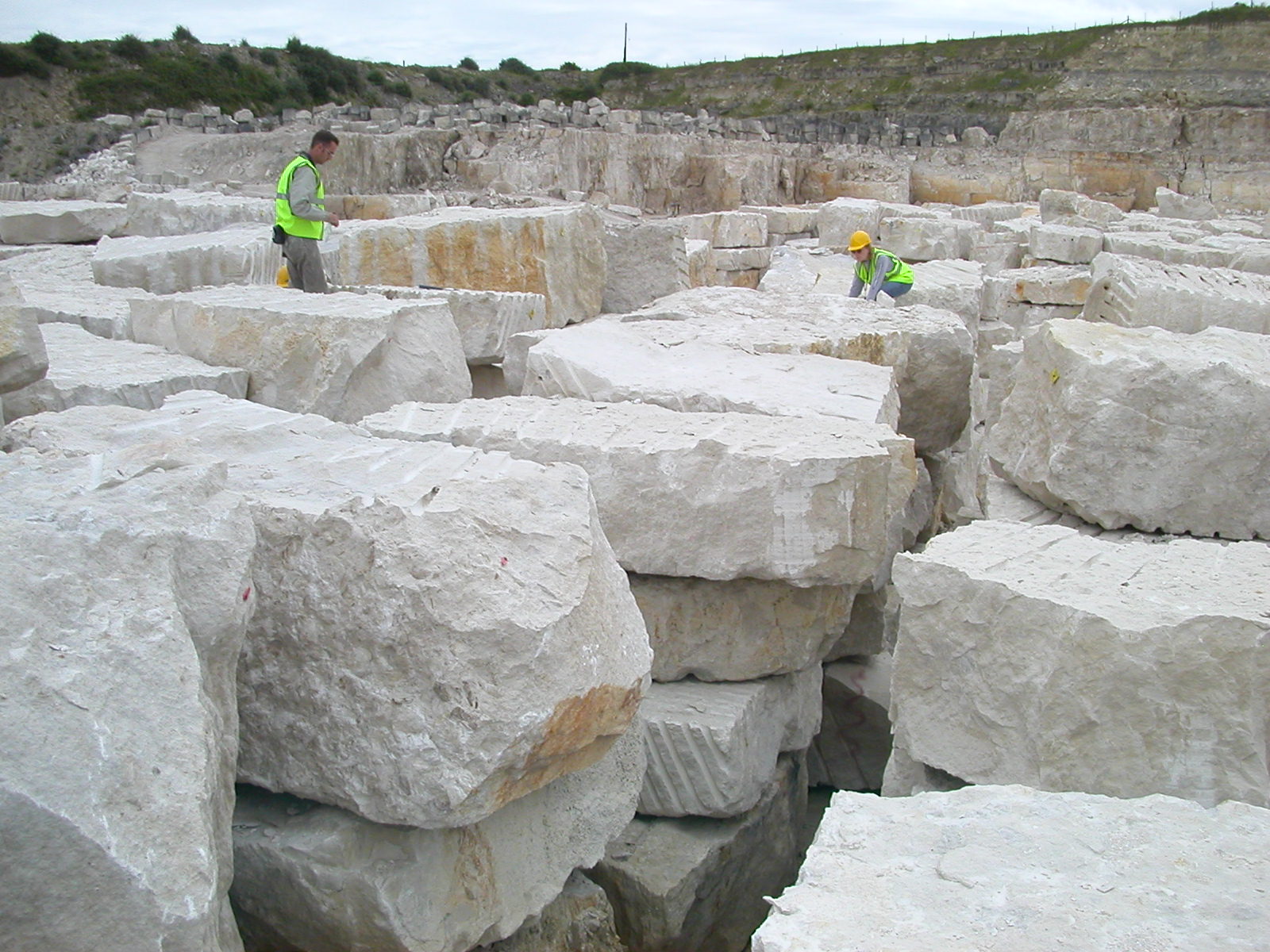
Because freestone can be sawn or squared in any direction, it was typically cut from the quarry face in large, regular blocks using saws and wedges, then dressed with hand tools into ashlar blocks, mouldings and carved detail — unlike slate or granite, it could readily be carved into fine architectural detail. Bath and Beer stone were both worked extensively underground, following the seam by pillar-and-stall mining rather than open quarrying, leaving extensive mined-out galleries beneath Combe Down and the Beer hillside.
Why it was used
Freestone's workability made it the material of choice wherever fine ashlar work, mouldings or carved decoration were needed — cathedral tracery, monumental facades, window and door surrounds — in a way that harder, less forgiving stones like granite could not match.
Value over time
Freestone demand tracked Britain's great building booms — medieval cathedral construction drove Beer stone's peak extraction, and the rebuilding of London after 1666 turned Portland stone into a national trade, shipped by sea in vast quantities for St Paul's and the City churches. Extraction fell into decline from the mid-19th century as resources were gradually worked out and architectural fashion shifted, and the trade never recovered its former scale once 20th-century construction moved to concrete-and-steel frames clad in thin stone slabs rather than load-bearing freestone blocks.
Hazards & challenges
Freestone's fine grain and comparatively low quartz content make it markedly less hazardous to work than granite or hard sandstone, though prolonged exposure to any stone dust carries some respiratory risk; the more distinctive hazard was structural — extensive underground pillar-and-stall workings at Combe Down and Beer left ground stability problems that persisted long after mining ended, in Combe Down's case requiring a major later stabilisation project.
Risks & limitations
Underground freestone mining left extensive networks of pillar-and-stall workings, some later so poorly supported that they required expensive stabilisation or backfilling; freestone quarrying also depends on a limited number of good-quality seams, and demand for the traditional load-bearing block trade fell away as 20th-century building shifted to thin stone cladding over concrete and steel frames.
Regional variation
The Isle of Portland and Combe Down/Bath (Somerset) for England's two most famous freestones; Beer in Devon for a third significant source with its own long cathedral-building history.
Related terminology
Mines associated with this term
5 examples chosen from 15 linked records — the term page is not an index.
- Combe Down Stone Mines — Somerset (well documented example)
Bath stone was quarried elsewhere as a building freestone but mined entirely underground at Combe Down, leaving a void beneath the village. - Barnack Quarries — Cambridgeshire (well documented example)
A limited, finer-grained oolitic freestone at Barnack was reserved for detailed carving such as window tracery, distinct from the coarser 'Barnack Rag' used for ashlar and rubble walling. - Beer Quarry Caves — Devon (well documented example)
Beer stone is a true freestone: cut in any direction, soft and easy to work fresh from the ground, and hardening on exposure — the property that made it a carver's stone. - Box Quarry — Wiltshire (well documented example)
The largest stone mine in Britain, working Bath stone — one of the two English freestones named in this term's own definition. - Carmyllie Quarries — Angus (well documented example)
Contemporary accounts called Carmyllie's paving freestone the most esteemed in Scotland; it went into Edinburgh's New College, Assembly Hall and the Bank of Scotland.
See every mine that worked freestone →
Sources
- (secondary) Bath stone — Wikipedia
- (secondary) Beer Quarry Caves — Wikipedia
- (secondary) Operating the mines — Museum of Bath Stone
- (secondary) Portland stone — Wikipedia
Record created: 22 August 2026 · Last researched: 22 August 2026