 MineArchive
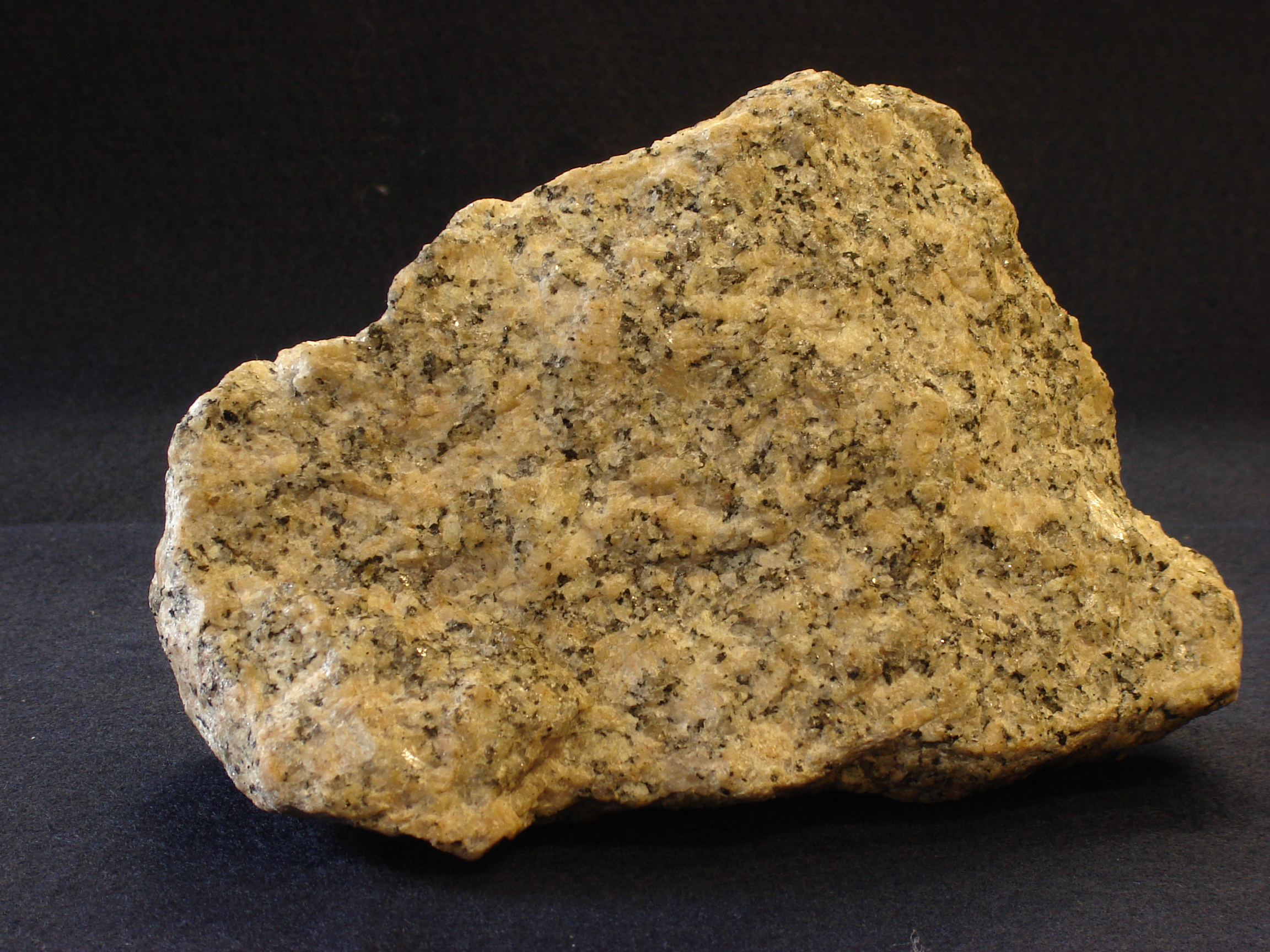
Granite
| Category | Commodities |
|---|---|
| Commodity page | Granite → |
A hard, coarse-grained igneous rock, quarried and dressed across Britain for building, monumental and engineering stone — the material that gave Aberdeen its "Granite City" nickname and paved much of Victorian Britain's streets.
Historical usage
British granite quarrying developed from the late 18th century, concentrated in Aberdeenshire, southwest Scotland, Devon and Cornwall, the Ross of Mull, and Shap in Cumbria. Aberdeen's industry began in earnest in 1730 at Loanhead and grew to include both quarrying and "setts" (paving block) making, with granite yards from the 1830s onward cutting and polishing monuments and building fronts; Rubislaw Quarry alone yielded an estimated six million tonnes over two centuries and supplied much of the city's own Victorian rebuilding, including Marischal College, the world's second-largest granite building. Dartmoor and Cornwall developed their own granite industry through the 19th century, centred on quarries like Haytor, Cheesewring and Penryn, with Haytor granite famously used in Rennie's London Bridge.
How it worked
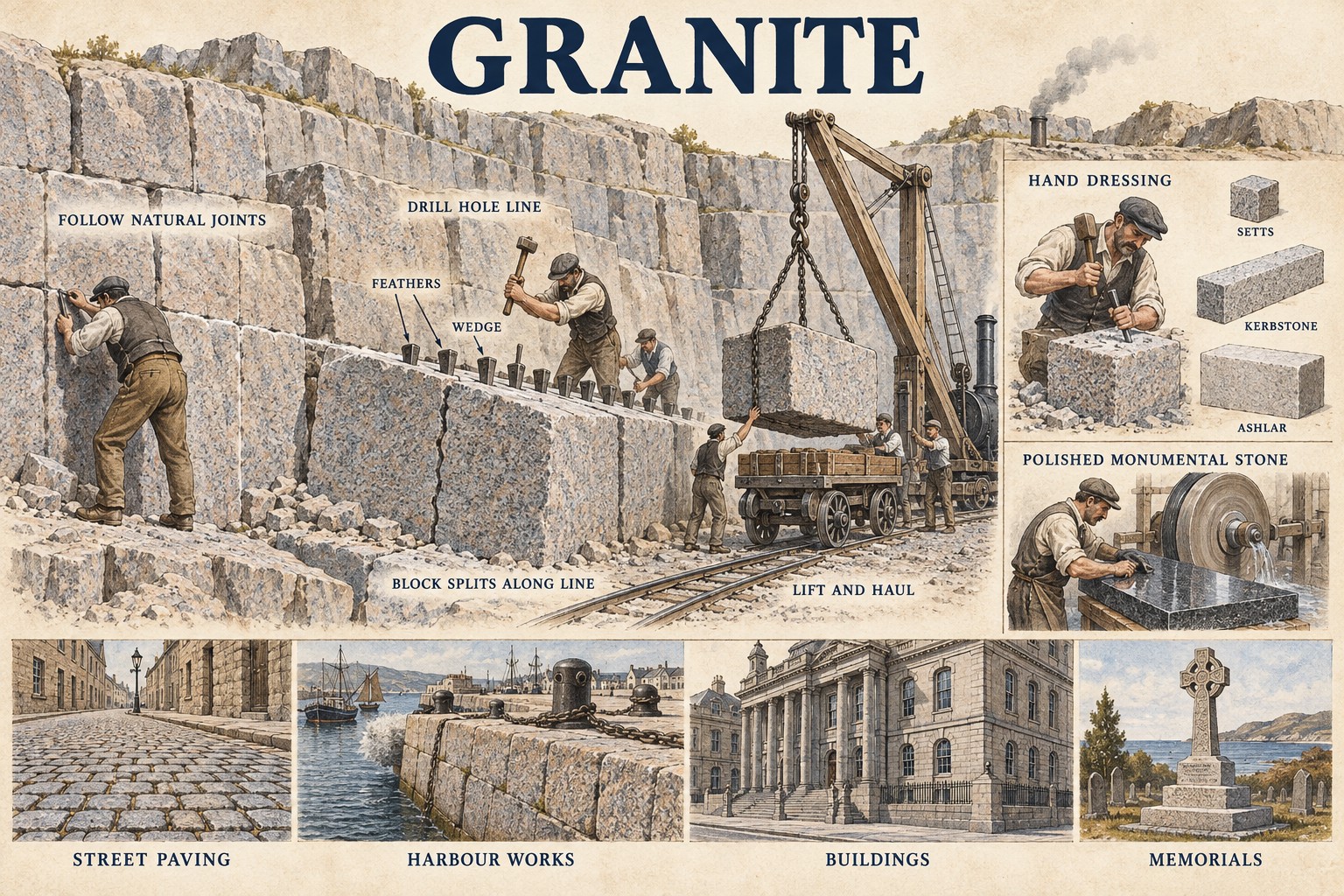
Granite was split from the quarry face using wedges and, later, black powder or dynamite, following the rock's natural jointing where possible to reduce waste. Blocks were then dressed by hand with hammer and chisel into setts, kerbstones, ashlar building blocks or monumental slabs, with the largest quarries running their own polishing and monumental-masonry yards on site.
Why it was used
Granite's exceptional hardness and resistance to weathering and wear made it the preferred stone for street paving (setts and kerbs), harbour and dock engineering, and monumental work, while its capacity to take a high polish made it prized for grand public buildings and memorials.
Value over time
Demand for granite setts and kerbstones grew steadily through the 19th century alongside Britain's road and railway building, and Aberdeen's granite yards added a lucrative monumental and architectural trade from the 1830s. That demand fell away through the 20th century as tarmacadam replaced granite setts on almost all British roads, and cheaper materials — including precast concrete, ironically sometimes made by former granite firms themselves, as at Threlkeld — undercut dressed stone in ordinary building work, leaving only a small specialist monumental and heritage-restoration market today.
Hazards & challenges
Granite quarrying and dressing generates fine crystalline silica dust from the rock's quartz content, and granite workers — quarrymen, dressers and monumental masons alike — have long been recognised as at risk of silicosis (historically called "quarrymen's phthisis" or "grinder's asthma"), a progressive, incurable lung disease; documented studies of granite workers have linked chronic dust exposure to significant, measurable loss of lung function.
Risks & limitations
Granite's very hardness that made it valuable also made it slow and expensive to quarry and dress compared with softer freestones, requiring skilled labour throughout; demand collapsed through the 20th century as tarmac replaced granite setts on roads and cheaper materials replaced dressed stone in construction.
Regional variation
Aberdeenshire is Britain's best-known granite region by far; Cornwall and Dartmoor (Devon) formed the other major English granite industry, with smaller centres at Shap (Cumbria) and the Ross of Mull (Scotland).
Related terminology
Elvan, Growan, Killas, Rhyolite, Sett (Paving Block)
Mines associated with this term
5 examples chosen from 50 linked records — the term page is not an index.
- De Lank Quarries — Cornwall (well documented example)
Named 7 times in this record, first in the summary: “A working granite quarry on the western edge of Bodmin Moor in St Breward parish, and…” - Glensanda Quarry — Highland (well documented example)
Named 5 times in this record, first in the summary: “A granite superquarry on the Morvern peninsula, begun in 1986 and still…” - Meldon Quarry — Devon (well documented example)
Named 3 times in this record, first in the geology: “…baked to a hard hornfels by the heat of the intruding Dartmoor granite; three decades of study here have been genuinely influential in…” - Nant Gwrtheyrn Quarries — Gwynedd (well documented example)
Named 4 times in this record, first in the summary: “Three granite quarries — Cae'r Nant, Porth y Nant and Carreg y Llam — cut into the…” - Rosemanowes Quarry — Cornwall (well documented example)
Named 10 times in this record, first in the summary: “A granite quarry at Herniss near Penryn that supplied stone for Cornish…”
See every mine that worked granite →
Sources
- (primary) Silicosis from quarrying and working of granite — PMC / NIH
- (secondary) Aberdeen's granite men: Hard men, hard work — The History Press
- (secondary) British Granite — The Building Conservation Directory
- (secondary) Ertach Kernow – Granite at the heart of Cornwall's Heritage — Cornwall Heritage Trust
Record created: 22 August 2026 · Last researched: 22 August 2026