 MineArchive
Rhyolite
| Category | Commodities |
|---|---|
| Commodity page | Rhyolite → |
The most silica-rich of the volcanic rocks: a pale, fine-grained lava with the chemical make-up of granite, which cooled quickly at the surface instead of slowly underground.
Historical usage
The name was introduced into geology in 1860 by the German geologist Ferdinand von Richthofen, from the Greek rhýax, a stream of lava. In the north of Ireland rhyolite was quarried around Tardree in County Antrim and used throughout the county as rubble stone, quoins and dressings, usually alongside the local basalt; Stone Database NI records Tardree rhyolite in Antrim Castle, Castle Upton, Clotworthy House, the public library and a gate lodge at Randalstown, and several churches. Elsewhere rhyolite was quarried in prehistory for tools: in eastern Pennsylvania the Carbaugh Run quarry was worked from 11,500 years ago, and its rhyolite was traded across the Delmarva Peninsula for spear points and arrowheads.
How it worked
Rhyolite forms from silica-rich magma erupted from a volcanic vent. The silica makes the magma extremely viscous, so rhyolite eruptions are often explosive and more of it ends up as pyroclastic rock, tuff and pumice, than as lava flows; where it cools too quickly to crystallise it forms obsidian. It is made mostly of quartz, sanidine and plagioclase, often with larger crystals (phenocrysts) set in a fine groundmass, and cristobalite and tridymite are sometimes present with the quartz. In County Antrim the rhyolite lavas and pyroclastic rocks of the Tardree Rhyolite Complex were erupted about 60 million years ago, during a lull between the Lower and Upper Basalts of the Antrim Lava Group, from vents that included Sandy Braes; a borehole at Templepatrick passed through 430 m of rhyolite, and weathering of the Tardree volcano's rocks produced the siliceous bauxite that lies beneath outliers of the Upper Basalts.
Why it was used
Where it could be quarried in blocks, as at Tardree, it gave a pale, hard stone that contrasted with dark basalt, used for rubble walling and for the dressed corners and openings of buildings. More generally rhyolite is used for crushed stone where better material is not available locally, and in prehistory it was knapped into scrapers, blades and projectile points.
Value over time
No price history is recorded for rhyolite. It was a local stone rather than a traded commodity: in County Antrim its value lay in being close at hand, and elsewhere it is used mainly for crushed stone where nothing better can be had locally.
Hazards & challenges
No hazard specific to rhyolite is documented; the general risks of hard-rock quarrying apply.
Risks & limitations
Rhyolite is often full of small cavities (vugs) or highly fractured, and its composition varies, which is why it is rarely used in construction or manufacturing where better stone is available. As a building stone the Antrim rhyolite weathers mainly by scaling: on quoins, once the tooled surface is breached, scaling proceeds relatively quickly as the fine matrix breaks down and quartz grains come loose.
Regional variation
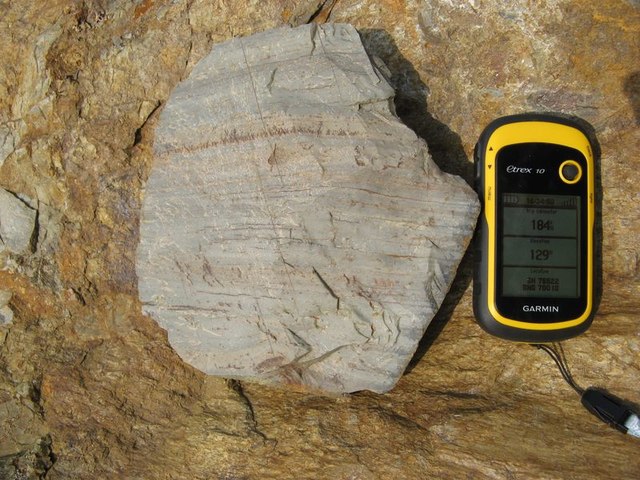
In Northern Ireland rhyolite occurs mainly in County Antrim, at Tardree and Sandy Braes, with small occurrences in County Down; small acidic intrusions of about the same age, of rhyodacite and latite, occur at Shane's Hill east of Portadown. The Tardree stone is pale, with a fine ash-like matrix carrying larger crystals of quartz and rare plagioclase. Rhyolite is also found in Wales, as in the banded Conwy Rhyolite Formation shown here.
Related terminology
Bauxite, Feldspar, Granite, Quartz
Mines associated with this term
Included only where MineArchive's own research gives a reasonable evidential basis — not every mine where this might plausibly apply.
- Tardree Quarry — County Antrim (well documented example)
Named 11 times in this record, first in the summary: “…side of Tardree Mountain, in central County Antrim, cut into the rhyolite of the Tardree Rhyolite Complex, the largest body of this rare rock…”
See every mine that worked rhyolite →
Sources
- (primary) Antrim Lava Group, Palaeogene extrusive igneous rocks, Northern Ireland — British Geological Survey (Earthwise)
- (secondary) Local Rhyolite — Stone Database NI
- (secondary) Rhyolite — Wikipedia
- (secondary) Rhyolite: an extrusive igneous rock — Geology.com
- (secondary) Tardree Rhyolite — Stone Database NI
Record created: 18 September 2026 · Last researched: 18 September 2026