 MineArchive
Feldspar
| Category | Commodities |
|---|---|
| Commodity page | Feldspar → |
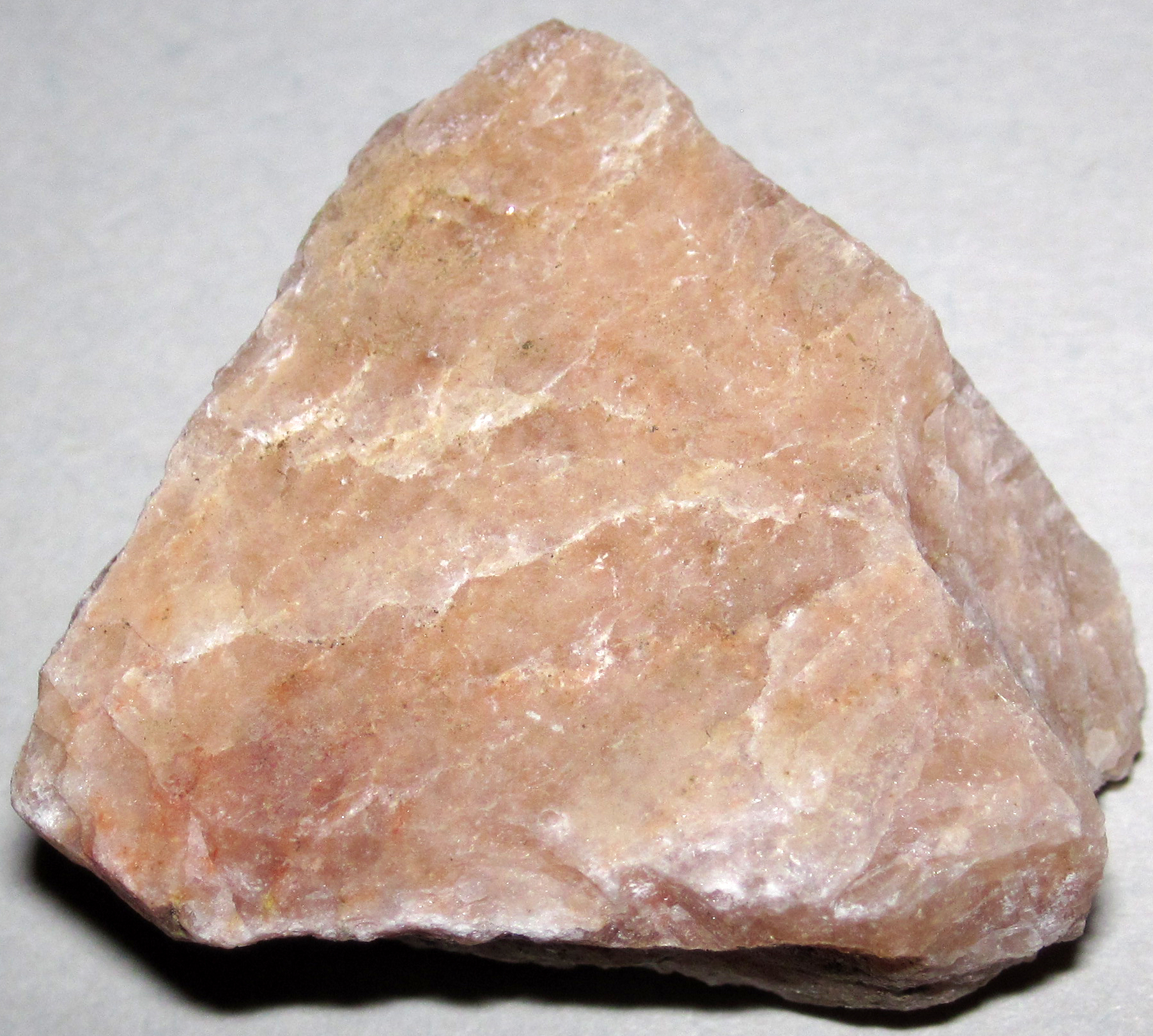
A group of common rock-forming aluminium silicate minerals, crushed and used chiefly as a flux in ceramics and glassmaking.
Historical usage
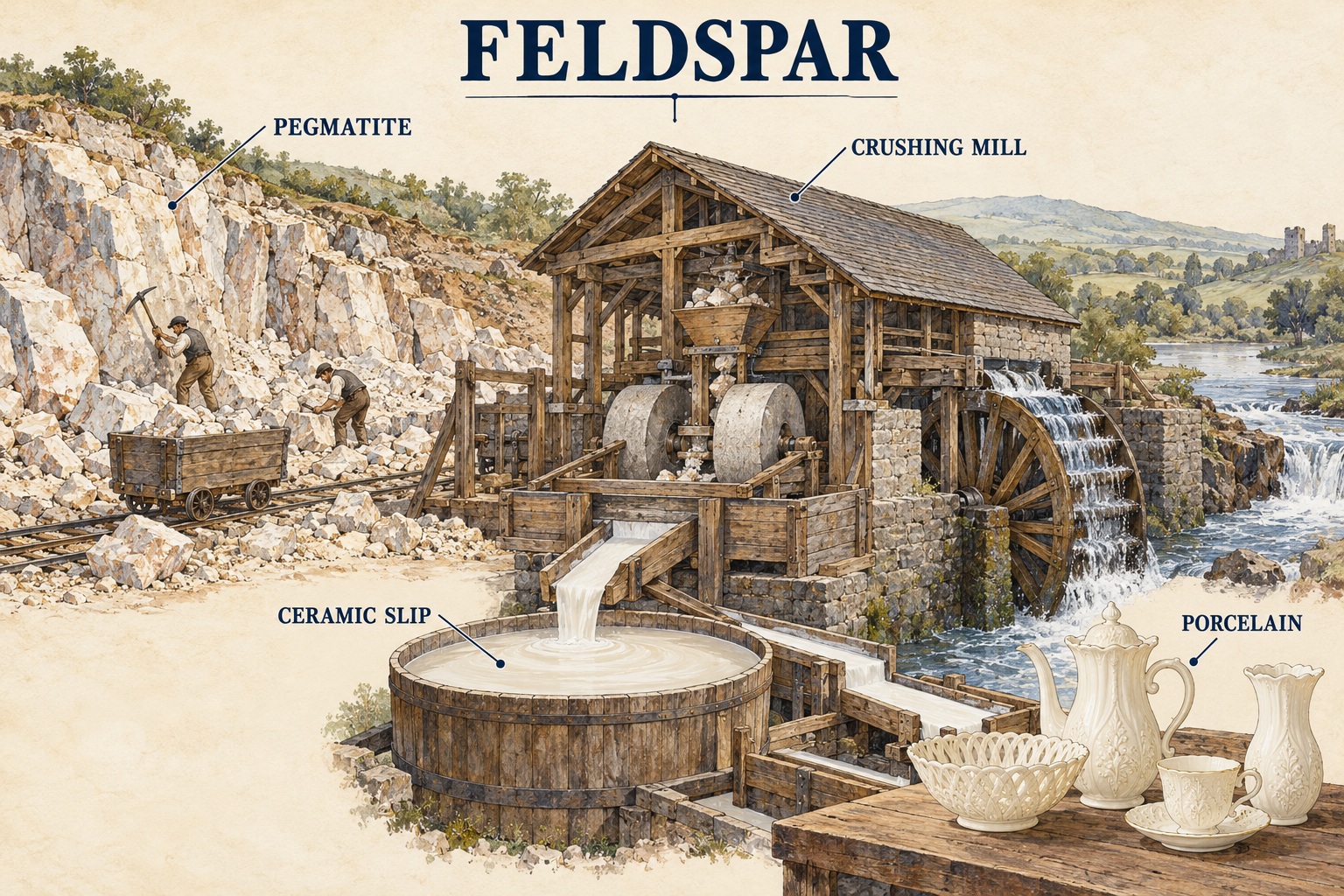
Feldspar's best-known British mining history is bound up with one factory: when John Caldwell Bloomfield inherited the Castle Caldwell estate at Belleek, County Fermanagh, in 1849, he commissioned a geological survey as an amateur mineralogist, which found feldspar, kaolin, flint, clay and shale on his land. Those deposits, worked commercially at Larkhill around eight miles away, supplied the pottery David McBirney and Robert Williams Armstrong founded at Belleek in 1857, and fed the porcelain body Belleek became famous for from 1863 onward. Bloomfield's survey of 1853 found feldspar and kaolin enough at Larkhill, eight miles from Belleek, to be worth mining; the crushing mill went up on the site of an old corn mill on the Erne, and before the pottery existed the minerals were being exported to England under a large contract with Kerr & Binns of Worcester, later Royal Worcester — the Dublin shop of James Kerr's father being where Bloomfield met Robert Armstrong and the pottery was conceived. Britain's other feldspar was worked under other names. Cornwall's china stone, a partially kaolinised, iron-free granite from one area near St Austell, was the last feldspathic material commercially extracted in the United Kingdom: production peaked in the early 1950s at about 70,000 tonnes a year, English China Clays gave it up in 1973 leaving Goonvean the sole producer, sales fell from 8,000 tonnes a year to 2,800 by 2001, and the last quarry closed in 2006. In the Second World War the granite pegmatites of South Harris, at Northton and Roneval, were briefly worked for ceramic feldspar.
How it worked
At Belleek, feldspar and the pottery's other raw minerals were ground into slip — the liquid clay mixture potters use to build ware — by a mill wheel powered by the River Erne at Rose Isle.
Why it was used
Feldspar's alumina and silica content lets it act as a flux, lowering the melting point of the ceramic or glass mixture it's added to and helping bind the fired body into a strong, glassy matrix. At Belleek, a high proportion of feldspar to kaolin in the porcelain body was central to the factory's hard, delicate porcelain and its distinctive iridescent glaze.
Value over time
As a bulk industrial mineral rather than a metal, feldspar's value has always been set by tonnage for its end use rather than by any dramatic price history; the Larkhill deposit's value, specifically, was tied entirely to Belleek Pottery's continuing demand rather than to a wider market. The Cornish figures give the shape of the trade: from 70,000 tonnes a year in the early 1950s to under 3,000 by 2001 and nothing after 2006, as imported feldspar and a shrinking British pottery industry took the market.
Hazards & challenges
Ordinary hard-rock quarrying and crushing hazards apply — chiefly exposure to silica dust — with no additional hazard specific to feldspar itself well documented.
Risks & limitations
Britain has few large-scale feldspar deposits, so unlike bulk stone or coal it was never a major British mineral industry outside a small number of localities feeding specific factories, and it has always competed against larger, better-established Continental European sources.
Regional variation
Larkhill, County Fermanagh, is the standout British locality worked specifically to supply Belleek Pottery; feldspar occurs far more widely within Britain's granite districts, including Cornwall, but has rarely been worked there as a commodity in its own right. What Cornwall called china stone or Cornish stone was feldspathic granite sold to the same potteries for the same purpose; the Hebridean pegmatites were a wartime expedient.
Related terminology
China Clay, China Stone, Growan, Rhyolite
Mines associated with this term
Included only where MineArchive's own research gives a reasonable evidential basis — not every mine where this might plausibly apply.
- Castlecaldwell Feldspar Mine — County Fermanagh (well documented example)
Named 11 times in this record, first in the summary: “A feldspar and kaolin working at Larkhill on the Castlecaldwell estate,…”
See every mine that worked feldspar →
Sources
- (primary) Bulk minerals, mineral resources, Northern Ireland — British Geological Survey (Earthwise)
- (primary) Non-metallic minerals: Geology and man, Northern Highlands of Scotland — British Geological Survey (Earthwise)
- (secondary) Belleek Pottery museum text — Belleek Pottery
- (secondary) China stone — Wikipedia
- (secondary) Company History — Belleek Pottery
Record created: 27 August 2026 · Last researched: 8 September 2026