 MineArchive
Growan
| Also known as | Growan Clay (Fuller dialect form), Moorstone (Cornish) |
|---|---|
| Dialect | Cornish |
| Category | Place-names & Language |
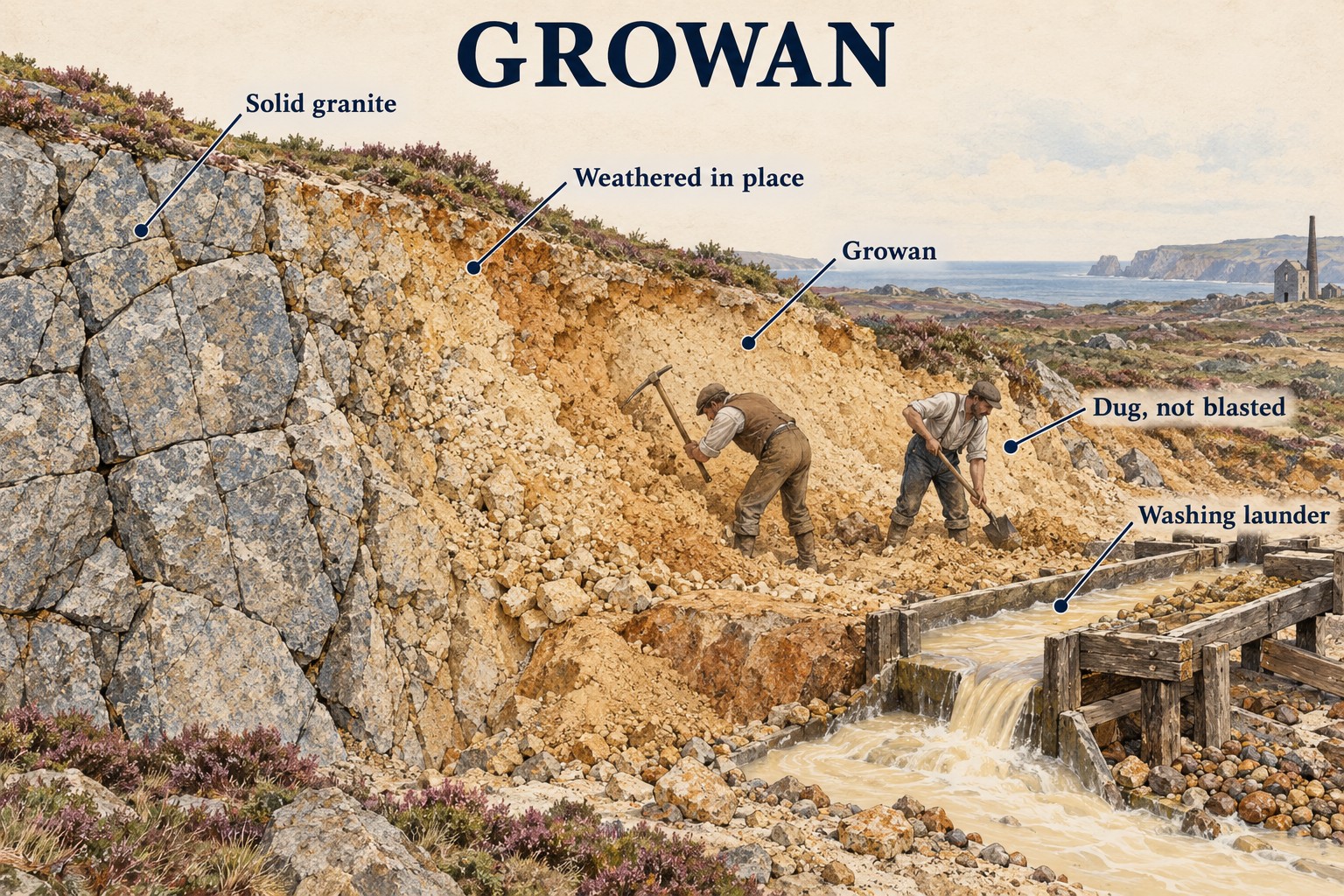
The Cornish dialect word for granite that has decomposed in place into a soft, crumbling mass — not a separate mineral from ordinary granite, but the same rock broken down by weathering into something that could be dug and washed rather than quarried whole.
Historical usage
Cornish miners and quarrymen had a name for decomposed granite long before anyone thought to make porcelain from it: growan, sometimes given as growan clay or moorstone. It was William Cookworthy, a Plymouth chemist searching for the ingredients of true porcelain, who in 1745 recognised that the growan he found at Tregonning Hill near Helston was exactly the material European potters had been importing from China at great expense — and who spent the next twenty years developing a workable porcelain recipe from it before patenting the process in 1768. Deposits identified afterwards in the St Austell district, worked at sites including the Tregargus Valley, grew into the much larger Cornish china clay and china stone industries that followed.
How it worked
Granite decomposes in place, without being moved, where hydrothermal fluids or ordinary weathering break down its feldspar content — the process that produces both china clay (where the breakdown goes furthest) and china stone (where it goes less far, leaving more unweathered feldspar and quartz behind). Growan describes the material at this intermediate, still-recognisably-granite stage, worked by digging rather than blasting and then processed by washing with water to separate what was wanted from what was not.
Why it was used
Growan mattered because it was usable without the effort of quarrying solid rock: once identified, it could simply be dug out and washed, exactly the process Cookworthy needed to isolate a clean, workable porcelain material from what would otherwise have looked like ordinary crumbling ground.
Risks & limitations
Because growan is decomposed rock rather than a distinct mineral, its quality and workability varied with exactly how far the decomposition had gone at any given spot, meaning prospectors had to test ground individually rather than relying on any single predictable seam.
Regional variation
Specifically a Cornish dialect term, tied to the granite country around Tregonning Hill, Hensbarrow and St Austell; the same underlying kaolinisation process elsewhere in Cornwall is described in ordinary geological terms as china clay and china stone once the material passed into the wider industry Cookworthy founded.
Related terminology
China Clay, China Stone, Feldspar, Granite
Mines associated with this term
Included only where MineArchive's own research gives a reasonable evidential basis — not every mine where this might plausibly apply.
- Merrivale Quarry — Devon (well documented example)
Named 3 times in this record, first in the summary: “…as Tor Quarry in the mid-1870s to supply setts when the surface moorstone ran out, and the source of the Falkland Islands war memorial.” - Tregargus China Stone Quarries — Cornwall (well documented example)
The mine's own record names growan directly as the decomposed granite William Cookworthy identified at Tregonning Hill in 1745, the material that led to the wider Cornish china stone industry Tregargus was part of. - Tregonning Hill China Clay Pits — Cornwall (well documented example)
Named in this record’s history: “…him it came from the slopes of Tregonning Hill, where it was called moorstone. He took samples back to his laboratory in Plymouth, found that the…”
Sources
- (secondary) China stone — Wikipedia
- (secondary) Cornish China Clay — The Discovery of Our White Gold — The Cornish Bird
Record created: 25 August 2026 · Last researched: 25 August 2026