 MineArchive
Merrivale Quarry
| Also known as | Tor Quarry, Duke's Quarry, Merrivale Bridge Quarry |
|---|---|
| Location | Merrivale, western Dartmoor, Devon — 50.5575, -4.0540 (approximate) |
| Commodity | Granite |
| Type | Quarry |
| Worked | 1874–1997 |
| Maximum depth | Unknown. |
| Operators | William E. Duke (1874–?) |
Overview
The last working granite quarry on Dartmoor, opened as Tor Quarry in the mid-1870s to supply setts when the surface moorstone ran out, and the source of the Falkland Islands war memorial.
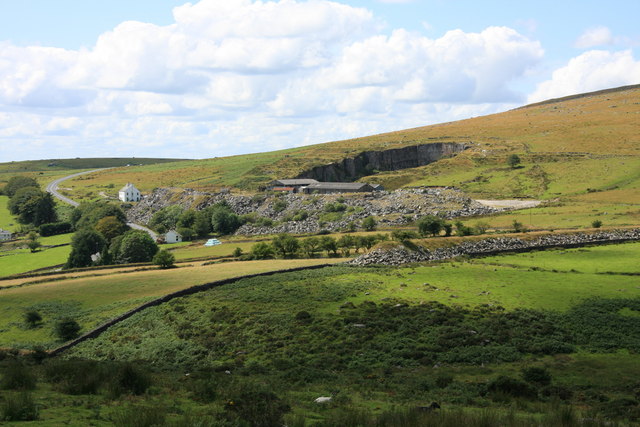
History
The Duke of Cornwall first granted a licence to quarry granite in this part of western Dartmoor in 1847, with the summits of Pew Tor and Roos Tor protected and the protected ground marked out by inscribed boulders. Demand for granite setts, kerbs and paving had grown through the century as the roads of Plymouth and Tavistock were improved, and the sett makers who worked the loose moorstone on the slopes of the Staple Tors, cutting it on the small granite benches still standing there, eventually ran out of suitable surface blocks. That shortage is what called a quarry into being. William E. Duke, a Jerseyman, opened Tor Quarry to supply sett granite; the date is given as 1874 in some accounts and 1875 or 1876 in others. His son took the enterprise on after his death. The quarry appears as Merrivale Bridge Quarry in accounts of the 1880s, including the Tavistock Gazette of 1885, and has also been known as Duke's Quarry. A row of workers' cottages stood at the quarry, with a Wesleyan chapel built in 1904, and the sett makers were paid by the piece at a penny a sett, a good worker cutting sixty in a day and an average one forty. Granite from Merrivale went into New Scotland Yard, Portcullis House at Westminster and the paving of Trafalgar Square, and closer to home into the paving of Tavistock. The quarry cut and worked its own granite until the 1970s, producing gravestones and agricultural rollers among other things; for the last twenty years of its life it dressed and polished stone brought in from elsewhere, gabbro from Norway and Italian marble. In 1982 it made the Falkland Islands war memorial. Merrivale was the last working granite quarry on Dartmoor. It closed in 1997 after about a hundred and twenty years, and the cottages below were demolished.
Geology
The quarry works the granite of the Dartmoor pluton on the moor's western edge, the same rock that stands out as the Staple Tors, Pew Tor and Roos Tor nearby. The stone splits well with tare and feather, and blocks marked by that method are still scattered about the workings and the slopes around them.
Workings
An open quarry cut into the hillside above the River Walkham, with workers' cottages, a Wesleyan chapel of 1904, a school and an explosives hut on the site; rails survive among the detritus. On the slopes of the Staple Tors above are the sett makers' bankers, small granite benches on which moorstone was cut into setts before the quarry opened, dated to about 1870 and possibly as early as 1850.
Closure
The quarry worked its own granite until the 1970s and then dressed imported stone for about twenty years before closing in 1997. Some accounts give 2003 for its closure, which is the year by which the abandoned workings had flooded.
What remains
The workings are abandoned and flooded. The site is a prominent scar on the western edge of Dartmoor National Park, described with disdain by one writer in 1985 as an ugly hole in the hillside.
Rubble remains of the quarry buildings, the row of cottages and an explosives hut survive on the site, together with old rails, and the sett makers' bankers on the slopes above are among the best preserved on Dartmoor.
Redevelopment
The site has not been redeveloped; the flooded quarry and the demolished cottages lie within the National Park.
Related mines
- Haytor Granite Quarry — One of the three major granite quarries of Dartmoor, with Foggintor and Merrivale.
Nearby mines
- Wheal Friendship — 4.8 km NW
- Wheal Betsy — 5.0 km W
- Devon United Mine — 5.1 km NW
- Whiteworks Mine — 5.2 km SE
- Eylesbarrow Mine — 5.9 km SE
Straight-line distance, within 15 km. Show on the map.
What's uncertain
Points where sources disagree or the record could not be settled; both accounts are kept. All open questions in the archive.
- The opening date is 1874. (disputed) 2
- The opening date is 1875, with some observers giving 1876. (disputed) 1
Recorded claims
Individual factual claims, each attached to the source(s) that support it below. Where sources disagree, both are kept.
- The quarry was opened as Tor Quarry by the Jersey-born William E. Duke to supply granite setts, and passed to his son on his death. 1,2
- The opening date is 1874. (disputed) 2
- The opening date is 1875, with some observers giving 1876. (disputed) 1
- Granite from the quarry went into New Scotland Yard, Portcullis House and the paving of Trafalgar Square, and it provided the Falkland Islands war memorial of 1982. 1
- The quarry was operational for about a hundred and twenty years and closed in 1997, the last working granite quarry on Dartmoor. 1,2
- For its last twenty years the quarry dressed and polished imported stone, including gabbro from Norway and Italian marble, rather than its own granite. 1
- Sett makers were paid a penny a sett, a very good worker cutting sixty in a day and an average worker forty. 1
Photographs & further reading
A detailed survey of the quarry, its buildings and the granite benches on the slopes above.
View sourceA gazetteer entry with the quarry's alternative names and Tim Jenkinson's account of its opening.
View sourceSources
- (secondary) Merrivale Quarry (Tor Quarry) and nearby Sett Makers' Bankers — Dartmoor Explorations
- (secondary) Merrivale Quarry — Dartefacts (Dartmoor Magazine and The Moorlander)
Record created: 23 September 2026 · Last researched: 23 September 2026