 MineArchive
Staple Shaft
| Also known as | Staple (North East England), Staple Pit, Stapple (Scottish) |
|---|---|
| Category | Mine Workings & Access |
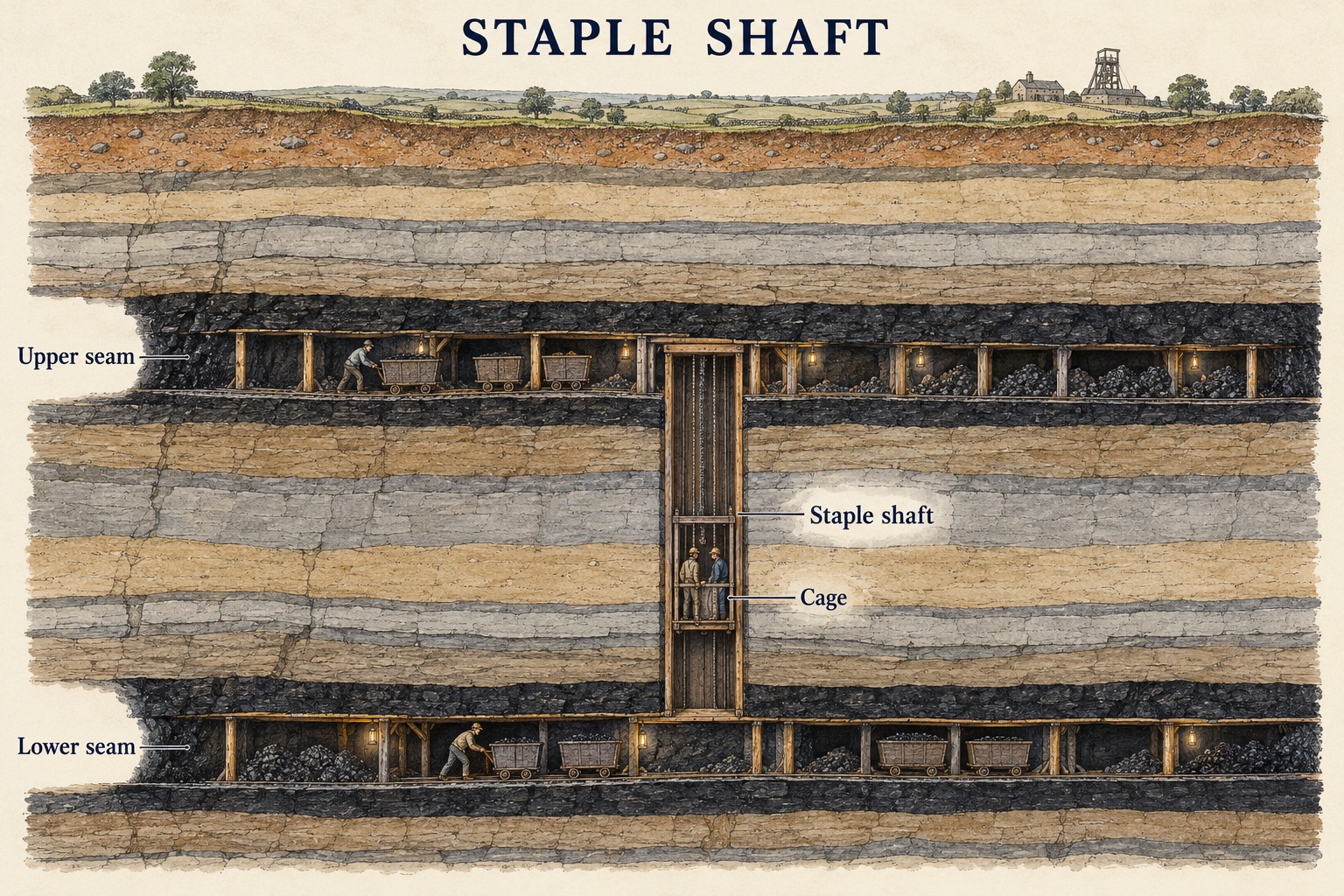
A shaft sunk underground from one seam to another, or from a seam to a level above or below it, that does not reach the surface. Staples carried coal, men, air, water and steam pipes between the seams of a colliery that worked several from one pair of shafts.
Historical usage
Staple is a northern word of obscure origin, spelt stapple in Scotland. John Adley's verse on the coal trade in 1818 already rhymed sinking staples with driving drifts. Greenwell's glossary of the coal trade in 1849 defined a staple as a small pit sunk upwards or downwards from one seam to another underground, and Gresley in 1883 as a shallow shaft within a mine; The Times in 1862 explained one to its readers as a narrow shaft communicating with the upper seam, and the Engineering Magazine noted in 1900 that electricity was by then hoisting trams up small staple pits from one seam to another.
How it worked
At Wingate Grange in County Durham in 1906 two shafts served five seams and the staples between them did much of the work. A staple ten feet across between the Main Coal and the Harvey seams, twenty-five yards from the downcast, acted as the upcast for the Harvey and Hutton seams and had a steam winding engine at its head in the Main Coal, by which men rode in a kibble between any two of the four seams. A second, between the Low Main and Harvey with a steam winch, carried no air and was called the dumb staple. A third, by the main haulage road, lowered Five Quarter coal from the Main Coal to the Low Main in two cages each holding a tub, the full tub drawing up the empty. Water feeders of 650 gallons a minute in the upper seams ran down the staples to the Hutton, where the colliery's main pumping engine lifted them to the surface.
Why it was used
Sinking a staple is cheaper than deepening a shaft, and it lets a colliery open a lower seam from an upper one, bring its coal to the landing of the main shaft and ventilate it as part of the same circuit. In the Durham coalfield, where one pair of shafts might serve the Five Quarter, Main, Low Main, Hutton and Harvey, staples joined the seams into one mine.
Risks & limitations
A staple is a shaft with all a shaft's hazards and none of its daylight. Men rode them in kibbles without guides; the drop staple at Wingate carried air that the undermanager described as on the balance, moving up or down as the pressures changed; and after the 1906 explosion wrecked the steam pipes, the men alive in the Hutton and Harvey seams had to wait until the staple engines could be worked again before they were brought out. Two sinkers at work in a staple were among the dead.
Regional variation
Staple and staple pit are words of the Northumberland and Durham coalfield, and stapple the Scottish form. Glossaries of the Midland and Lancashire coalfields define a staple pit simply as an underground shaft, and a staple shaft as one connecting two or more levels of a mine without reaching the surface.
Related terminology
Coal Seam, Downcast Shaft and Upcast Shaft, Inset, Shaft, Shaft Sinking, Winding Engine
Mines associated with this term
5 examples chosen from 30 linked records — the term page is not an index.
- Eastern United Colliery — Forest of Dean (well documented example)
Named in this record’s summary: “A Forest of Dean drift mine at Staple Edge near Ruspidge, worked into the hillside by two sloping…” - Little Garth Mine — Cardiff (well documented example)
Named twice in this record, first in the summary: “…ore until they had to be linked underground by a maze of caverns and staple shafts, one cavern about 200 ft long, 100 ft wide and 70 ft high with no…” - Sheriff Hill Colliery — Tyne and Wear (well documented example)
Named in this record’s workings: “…Dolly, Edge, Fanny, George, King, Bradley, Doll, Isabella, Kells, Stapple and Hope, the Isabella and Fanny the principal winding shafts. In…” - Blaendare Colliery — Torfaen (well documented example)
Named twice in this record, first in the history: “…steam coal from the New Vein. On 28 February 1901 masons walling a staple pit from the New Vein to the lower seams, working on staging a few yards…” - Clifton Colliery, Great Clifton — Cumbria (well documented example)
Named in this record’s history: “…provided a reading room at Chapel Brow by 1903. Coking coal was the staple throughout, with fireclay and, in 1910, ironstone. Employment rose…”
Disasters associated with this term
5 examples chosen from 10 linked records, most direct relationship first.
- Bamfurlong Colliery fire, 1892 (contextual relationship)
Named in this record’s contributing factors: “…the air doors to guide men, and a hanging chain lamp obstructed the staple pit on the return.” - Blaendare Colliery explosion, 1901 (contextual relationship)
Named 4 times in this record, first in the summary: “Two masons walling an unventilated staple pit at Blaendare, near Pontypool, were killed on 28 February 1901 when…” - Dean Lane Colliery explosion, 1886 (contextual relationship)
Named in this record’s narrative: “…Gas Coal seam, two feet eight inches thick, was reached by a 50-yard staple called the tip, a level and a 300-yard incline. It gave off little…” - Dinas Colliery explosion, 1879 (contextual relationship)
Named twice in this record, first in the rescue and recovery: “…and found a heavy fall had completely blocked the eighty-yard staple, and the doors to the upcast blown down so that the air was…” - Newbury Colliery explosion, 1869 (contextual relationship)
Named in this record’s narrative: “…drifts were being driven and little coal was being got near the staple. The men were descending for the day when a report was heard miles…”
Sources
- (secondary) Glossary of mining and geological terms — Tatham History Society
- (secondary) Pit Terminology — Healey Hero
- (secondary) Staple sb.4 (Murray's New English Dictionary) — World English Historical Dictionary
- (secondary) Wingate Grange Colliery Explosion – Wingate – 1906 — Northern Mine Research Society
Record created: 18 October 2026 · Last researched: 18 October 2026