 MineArchive
Eastern United Colliery
| Also known as | Eastern United |
|---|---|
| Location | Staple Edge, near Ruspidge and Cinderford, Forest of Dean — 51.8000, -2.5103 (approximate) |
| Commodity | Coal |
| Type | Coal |
| Worked | 1910–30 January 1959 |
| Maximum depth | Not a shaft mine — the workings were reached by inclined dipples driven into the hillside, and no depth figure applies. The coal face was about 200 yards down the dipple when first reached. |
| Operators | Henry Crawshay & Co. Ltd (1907–1947), National Coal Board (1947–1959) |
Overview
A Forest of Dean drift mine at Staple Edge near Ruspidge, worked into the hillside by two sloping 'dipples' rather than a shaft. Its gale was one of the seven created by the Dean Forest (Mines) Act of 1904 and held some 41 million tons of coal — enough, it was hoped, for two hundred years. It lasted fifty: geology, water and cost closed it on 30 January 1959, one of the last deep mines in Dean.
History
The Eastern United gale — the No. 4 Group, comprising United Deep No. 2, Emperor, Extension and part of Central — was one of seven areas into which the coalfield's deep measures were split after the Dean Forest (Mines) Act of 1904. It was granted on 19 March 1906 to James Riley Brown and others, a committee of Free Miners. Henry Crawshay & Company was offered it in October 1907 and completed the purchase on 24 December that year, knowing that the reserves at its own Lightmoor Colliery would not last ten years, let alone the twenty predicted.
Two sloping dipples were driven into the hillside from 1909 — a north dipple eight feet by seven for travelling, and a south dipple ten feet by seven for the main haulage, worked by endless rope, about twenty-five yards apart. They struck the old roadway of Walmers Colliery, which gave a ready-made emergency way out. Railway sidings connecting to the Great Western Railway's Forest of Dean Branch were built from 1908, though the facilities were basic — a two-lever ground frame, with no signal box until late 1913 — and the first coal was sold in 1910.
It was not the success hoped for. In early 1914 it was announced that the western part of the gale could not be worked because of its geological condition: monoclinal folding had lost the seams in the main headings, and they were only recovered by driving long cross dipples. By 1916 the coal had levelled out, and by April 1919 output was 250 tons a day, but the colliery ran at a loss until 1923 apart from a small profit in 1919. Money went into boilers, electricity, pumping and wagons: twenty 12-ton wagons were bought from the Gloucester Railway Carriage and Wagon Company in 1914 at £16 5s 6d each, alongside thirty 10-ton wagons previously rented and then bought at £8 16s each.
Output then climbed hard — 58,038 tons in 1920, 239,747 in 1930 and a peak of 283,666 in 1937. The colliery was nationalised in 1947 into the NCB's South Western Division. Thereafter costs rose as production fell away, to 112,187 tons by 1955, against continuing geological difficulty and water. It closed on 30 January 1959, one of the main Dean collieries to go that year; Cannop followed in 1960, Princess Royal in 1962, and Norchard Drift and Northern United in 1965, when deep mining in the Forest ended.
Geology
The gale contained six seams estimated at 41 million tons of coal. The principal one was the Coleford High Delf, a steam coal much in demand and reputed to be five feet thick. The obstacle was structure rather than quantity: monoclinal folding of the strata lost the seams in the main headings, and they had to be picked up again by driving lengthy cross dipples — the reason the western part of the gale was declared unworkable in 1914.
Geological setting: Anticlines and Synclines (well documented example), Faults and Fractures (well documented example), Sedimentary Beds and Seams (well documented example)
Workings
A drift mine rather than a shaft pit. Two dipples were driven into the hillside about twenty-five yards apart: the north one, eight feet wide and seven high, for travelling and incidental work, and the south, ten by seven, for the main haulage by endless rope. The dipples struck the old roadway of Walmers Colliery, which served as an emergency exit. Sidings ran to the Great Western Railway's Forest of Dean Branch, and the surface plant included pit-head baths.
Closure
Closed on 30 January 1959 as costs rose against falling output — 112,187 tons in 1955 against a 1937 peak of 283,666 — with continuing geological difficulty and water ingress. It was one of the main Forest of Dean collieries to close that year, and deep mining in the Forest ended altogether in 1965.
What remains
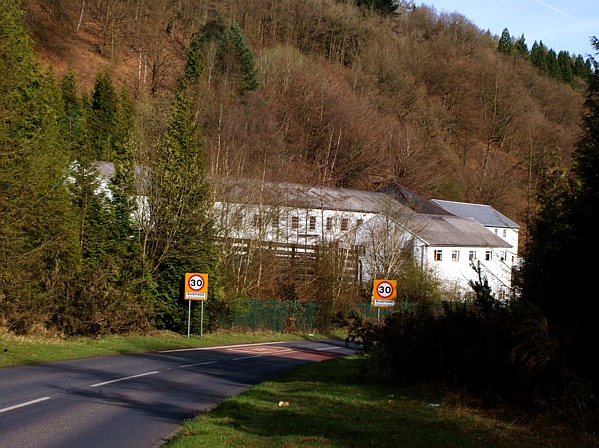
A small industrial estate was established on the colliery site after closure. Some of the colliery buildings, including the pit-head baths, survived into the 21st century and have been photographed; the pit-head complex itself was demolished in the mid-1960s.
Colliery buildings including the former pit-head baths, within and around the small industrial estate that occupies the site.
Redevelopment
A small industrial estate was established at Eastern United after the colliery closed.
Nearby mines
- Foxes Bridge Colliery — 1.5 miles (2.4 km) NW, Gloucestershire
- New Fancy Colliery — 1.7 miles (2.8 km) SW, Gloucestershire
- Dog Delf Colliery — 2.1 miles (3.3 km) SW, Gloucestershire
- Haywood Colliery — 2.0 miles (3.3 km) N, Gloucestershire
- Northern United Colliery — 2.0 miles (3.3 km) N, Gloucestershire
Straight-line distance, within 9 miles (15 km). Show on the map.
Recorded claims
Individual factual claims, each attached to the source(s) that support it below. Where sources disagree, both are kept.
- The Eastern United gale was one of seven areas into which the coalfield's deep measures were split after the Dean Forest (Mines) Act of 1904, and was granted on 19 March 1906 to James Riley Brown and others, a committee of Free Miners. 1,2
- Henry Crawshay & Company was offered the gale in October 1907 and completed the purchase on 24 December 1907, aware that reserves at its Lightmoor Colliery would not last ten years. 1
- The gale contained six seams estimated to hold 41 million tons of coal, hoped to give a working life of about 200 years at 200,000 tons a year; the principal seam was the Coleford High Delf, reputed five feet thick. 1,2
- Two dipples were driven about twenty-five yards apart — the north eight feet by seven for travelling, the south ten by seven for main haulage by endless rope — and struck the old roadway of Walmers Colliery, which served as an emergency exit. 2
- In early 1914 it was announced that the western portion of the gale could not be exploited because of its geological condition; the seams had been lost in the main headings to monoclinal folding and were only relocated by driving lengthy cross dipples, the difficulty not being overcome until 1916. 3,1
- Output rose from 58,038 tons in 1920 to 239,747 in 1930 and a peak of 283,666 tons in 1937, falling to 112,187 tons by 1955. 3,2
- The colliery closed on 30 January 1959, one of the main Forest of Dean pits to shut that year; deep mining in the Forest ended in 1965. 3,1
Photographs & further reading
The parish history's account of Dean coal, with Eastern United's output figures and its place in the sequence of closures that ended deep mining in the Forest.
View sourceThe fullest account of the colliery — how the gale was assembled from four older ones, the dimensions and purpose of each dipple, and the year-by-year struggle with the folded strata.
View sourceSources
- (secondary) Eastern United Colliery — Wikipedia
- (secondary) Eastern United (Forest of Dean Coal Mining) — Lightmoor Press
- (secondary) A History of the County of Gloucester: Volume 5, Bledisloe Hundred, St Briavels Hundred, the Forest of Dean — Industry — Victoria County History / British History Online
- (secondary) Eastern United Colliery — Forest of Dean Local History Society
Record created: 3 September 2026 · Last researched: 3 September 2026