 MineArchive
Free Miner
| Also known as | Freeminer (Forest of Dean), Freemining (The practice), Free Mining (The practice, spelled open) |
|---|---|
| Dialect | Forest of Dean |
| Category | Law & Custom |
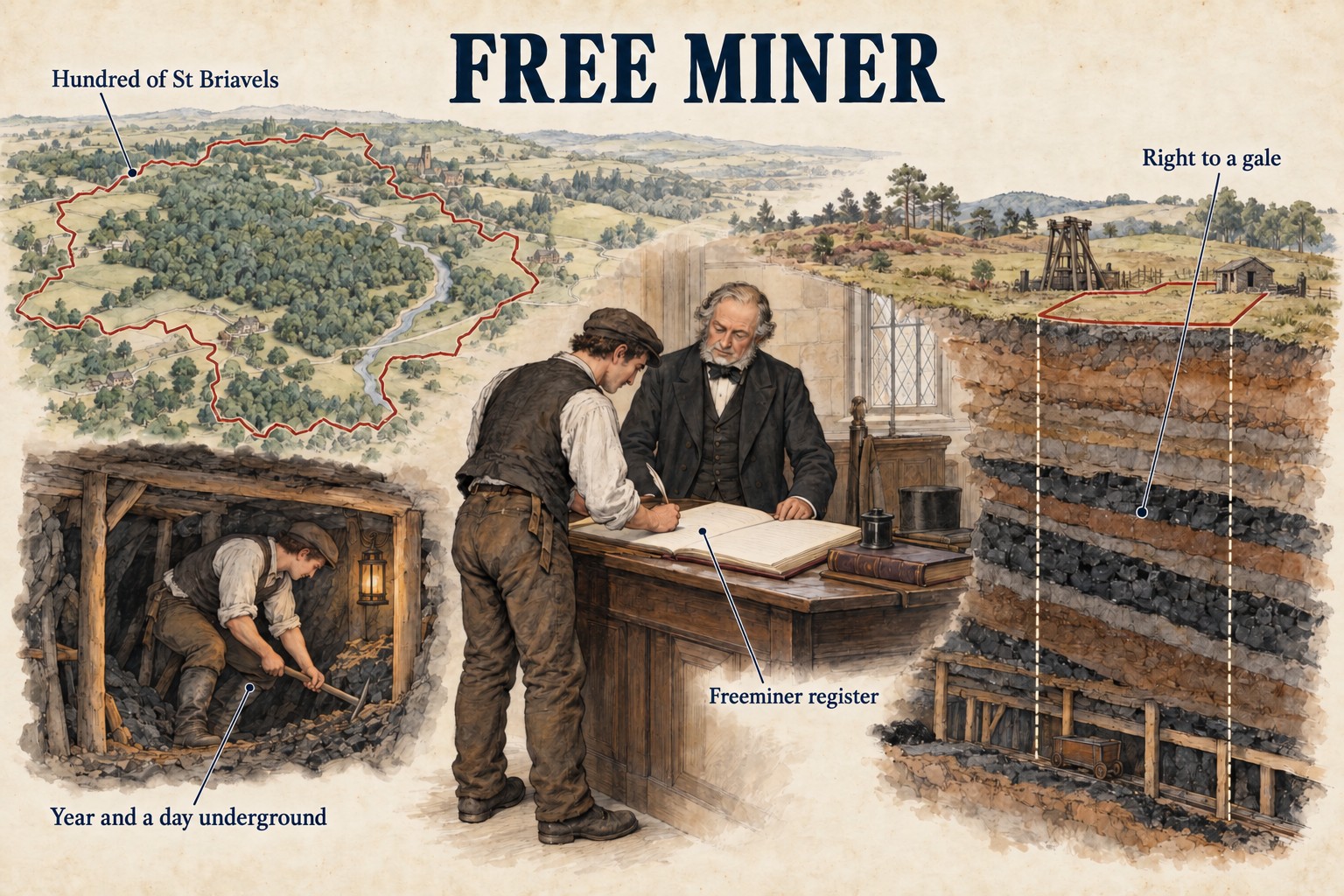
The holder of an ancient customary right, unique to the Forest of Dean, to open and work a mine of one's own within the Hundred of St Briavels — earned by birth and by a year and a day underground, not bought.
Historical usage
The right is old enough that its origin is traditional rather than documented: freeminers themselves date it to Edward I, and it is said to have been granted in recognition of the miners' military service — their skill at undermining walls made them valuable at a siege, and Sir John Greyndour, Constable of St Briavels Castle, indentured 120 Dean miners for the Agincourt campaign in 1415. The custom was written down as the Dean Miners' Laws and Privileges in 1610, and enforced by the miners themselves through their own Mine Law Court, held from the 12th century at St Briavels Castle and Clearwell Court and later at the Speech House, built in the Forest in the 1670s. In 1777 the court's records were stolen from the locked box in which they were kept, and it never functioned properly again. After some fifty years without a court, Parliament codified the custom as the Dean Forest (Mines) Act 1838, under which freemining still operates.
How it worked
The 1838 Act set the qualification: a person born and living within the Hundred of St Briavels, aged twenty-one or over, who had worked a year and a day in a coal or iron mine there. A qualifying person registers as a freeminer and may then apply for a gale — a defined plot of ground, historically a radius of twelve yards around a designated spot — which is granted by the Crown's officer, the Gaveller, in practice by the Deputy Gaveller. That office still exists: the Deputy Gaveller registers freeminers, grants gales, collects royalties and enforces the rules of the custom, today on behalf of the Forestry Commissioners.
Why it was used
Almost everywhere else in Britain the minerals under your feet belonged to the Crown or to the landowner, and a working miner could only ever be somebody's employee or somebody's tenant. Freemining is the conspicuous exception: in a royal forest, of all places, the right to open a mine was vested in the people who actually worked underground, and could be neither bought into nor inherited by anyone who had not served the same year and a day.
Risks & limitations
The 1838 Act preserved the custom but also broke its central protection: for the first time a freeminer could sell a gale to somebody who was not a freeminer, which was exactly what the Mine Law Court had spent centuries preventing, and outside capital moved into the Forest. The qualification is also self-limiting in an obvious way — it requires a working mine in which to serve the year and a day, so as the Dean collieries closed the supply of new freeminers closed with them. Around a hundred freeminers are alive today, but only a handful of mines still work, several of them surviving on visitors and on ochre rather than on coal.
Regional variation
Freemining is peculiar to the Forest of Dean and has no true equivalent elsewhere, though Britain had several other customary mining laws that solved the same problem differently — Derbyshire's Barmote courts granting meers, the stannaries' setts in Devon and Cornwall, and the Crown's own claim through the Mines Royal. Beware a false cousin: medieval records from the 1350s describe the "free miners of Englefield" working ground on Halkyn Mountain in Flintshire for dues, which was a separate Welsh custom altogether and not this institution under another name.
Related terminology
Barmote Court, Gale and Gaveller, Liberty, Meer, Mines Royal, Purbeck Marblers, Sett (Mining Lease)
Mines associated with this term
5 examples chosen from 15 linked records — the term page is not an index.
- Clearwell Caves — Gloucestershire (surviving physical example)
Still worked today by one of the last practising Free Miners — a living example of the right rather than a historical reference to it. - Eastern United Colliery — Forest of Dean (well documented example)
Named in this record’s history: “…on 19 March 1906 to James Riley Brown and others, a committee of Free Miners. Henry Crawshay & Company was offered it in October 1907 and…” - Addis Hill Colliery — Gloucestershire (well documented example)
Named twice in this record, first in the summary: “…the eastern side of the coalfield near Cinderford, confirmed to the free miner James Cowmeadow by the awards of 1841 although he had been working…” - Halkyn Mountain — Flintshire (well documented example)
Named in this record’s history: “…was found in 1950. Medieval records from the 1350s describe the "free miners of Englefield" working plots of ground in exchange for dues to the…” - Lightmoor Colliery — Forest of Dean (well documented example)
Named in this record’s summary: “…worked from about 1832 by the ironmaster William Crawshay and the free miner Moses Teague to supply coal and ore to the Cinderford ironworks,…”
Sources
- (primary) Dean Forest (Mines) Act 1838 — legislation.gov.uk
- (primary) Freemining — Hopewell Colliery — Hopewell Colliery
- (secondary) Freeminer — Wikipedia
- (secondary) History — Royal Forest of Dean Freeminers Association — Royal Forest of Dean Freeminers Association
- (secondary) Woman wins right to be Forest of Dean freeminer — BBC News
Record created: 24 August 2026 · Last researched: 24 August 2026