 MineArchive
Sett (Mining Lease)
| Category | Law & Custom |
|---|
The legal boundary — and the licence to work within it — granted to miners under Devon and Cornwall's own stannary mining law, the Cornish counterpart to Derbyshire's Barmote system.
Historical usage
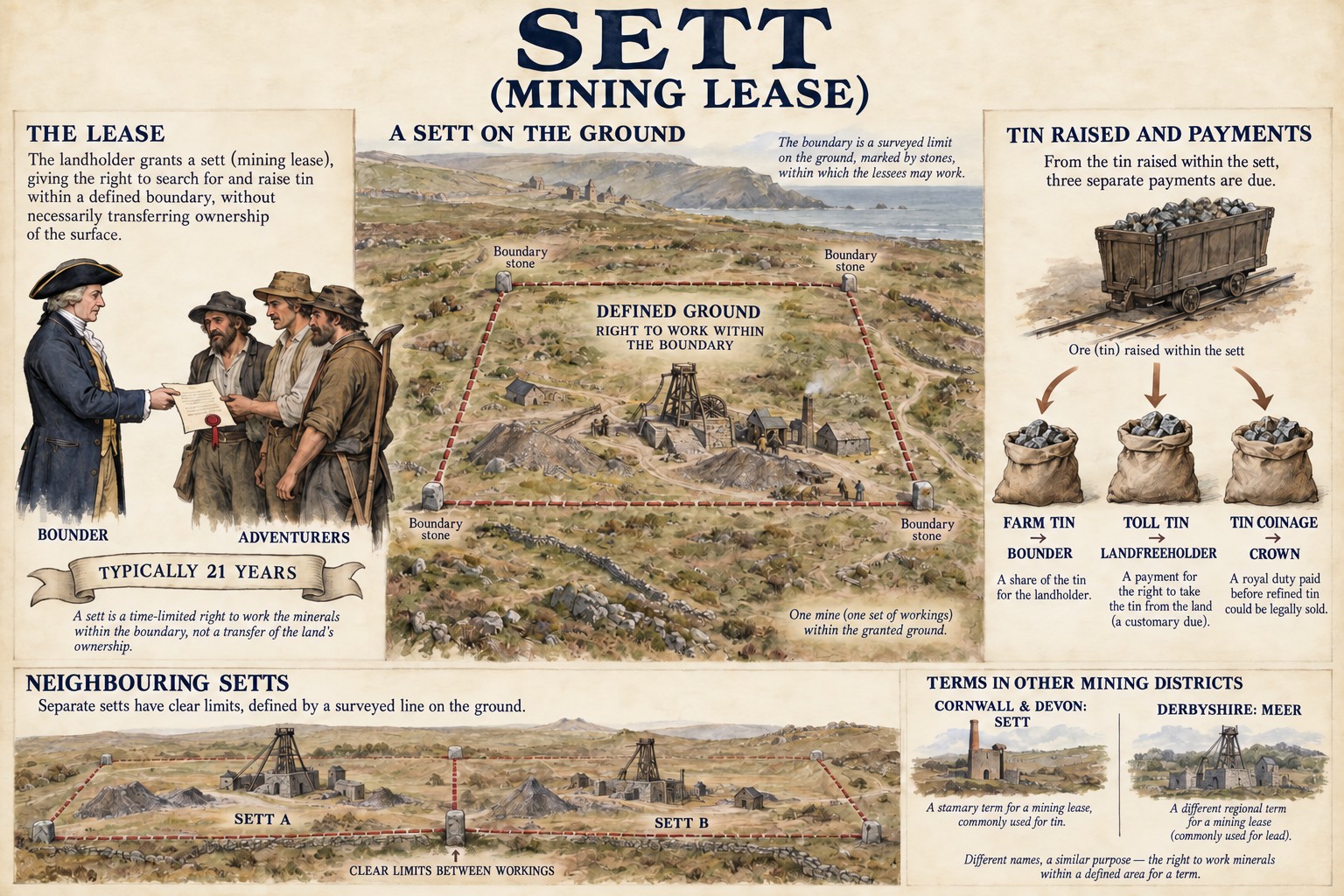
Setts were a foundational part of Cornish and Devon stannary law, used from at least the early 18th century onward to license groups of miners, known as adventurers, to work tin — and later other minerals, including copper, lead, china clay and slate — within a defined area, typically for a 21-year term.
How it worked
A landholder, known as a bounder, granted a sett to a group of adventurers, usually subject to conditions requiring the ground actually be worked and often limited to a specified depth. In return, the adventurers paid the bounder a share of the tin raised ('farm tin'), plus separate 'toll tin' to the landfreeholder and a royal 'tin coinage' duty before any refined tin could be legally sold.
Why it was used
A sett gave miners a clear, legally defined right to work a specific area without disputing boundaries with neighbouring operations — the Cornish equivalent of the 'meer' granted under Derbyshire's Barmote court system, adapted to a landowner-rights framework rather than a free-mining one.
Regional variation
Setts were specific to Devon and Cornwall's stannary law (and also used on the Isle of Man); Derbyshire's parallel system, granting a 'meer' under Barmote court jurisdiction, worked on different legal principles — see Barmote Court for that comparison.
Related terminology
Free Miner, Gale and Gaveller, Stannary
Mines associated with this term
5 examples chosen from 40 linked records — the term page is not an index.
- South Wheal Frances — Cornwall (well documented example)
Named in this record’s history: “…of hemp or chains, and in 1879, when part of the old Wheal Basset sett was allowed to flood, the first cast-iron underground dam in…” - Wheal Fortune — Cornwall (well documented example)
Named 3 times in this record, first in the history: “…engines in the mine's southern section were put up for sale, but the sett continued to be worked on a reduced scale under different companies…” - Bedford United Mine — Devon (well documented example)
South Bedford proved too remote to manage as part of the combined sett and was separated out again in 1850 as its own mine. - Brimpts Tin Mine — Devon (well documented example)
Named twice in this record, first in the summary: “A Dartmoor tin sett on the southern slopes of Laughter Tor, west of Dartmeet, worked in…” - Eaglebrook Mine — Ceredigion (well documented example)
Named twice in this record, first in the history: “…Shaft, and work in the 1870s concentrated on the eastern end of the sett before final closure in 1874 at a depth of 50 fathoms. Output…”
Sources
- (secondary) 1856 Mines in Devon and Cornwall — Grace's Guide
- (secondary) Mining sett — Wikipedia
Record created: 22 August 2026 · Last researched: 22 August 2026