 MineArchive
Ochre
| Category | Commodities |
|---|---|
| Commodity page | Ochre → |
A soft, iron-oxide-rich earth pigment, dug or washed from weathered iron-bearing deposits and refined by settling and drying — mined in Britain for at least 4,500 years and, at Clearwell Caves in the Forest of Dean, still worked by hand today.
Historical usage
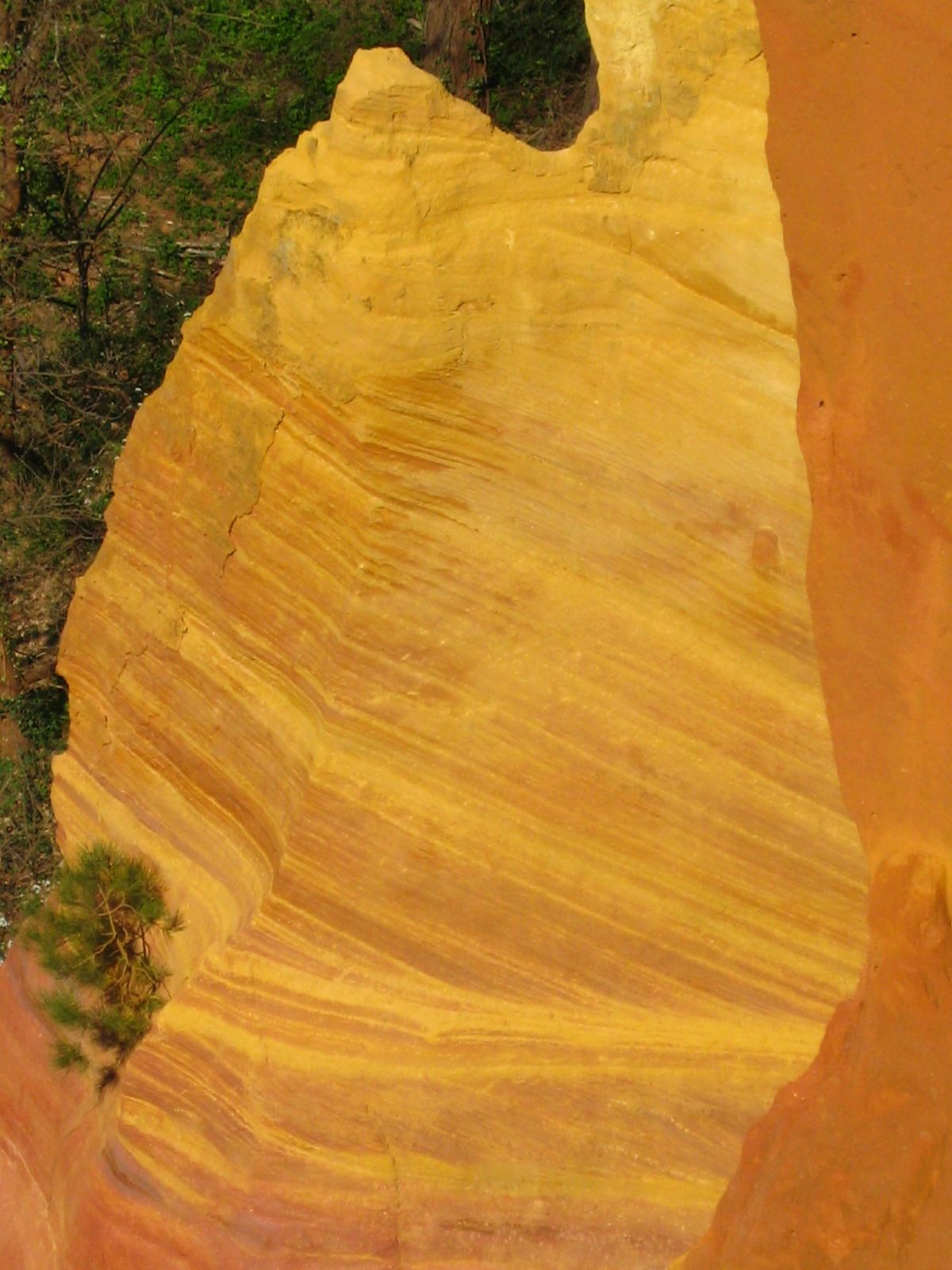
Ochre extraction in the Forest of Dean dates to the Stone Age, with tools recovered from Clearwell Caves at least 4,500 years old. From ancient times until the 1930s, several Forest of Dean mines were internationally known for the quality and range of their ochre colours, particularly rare purples and rich reds, with pigment exported for use in art and industry; large-scale commercial mining there ceased in 1945. South Terras Mine in Cornwall was worked for iron ore and ochre from 1870 before its ore body's radioactive character was discovered, and umber — a related iron-manganese ochre — was worked at Roughten Gill in Cumbria once its metal veins were exhausted. Today, Clearwell remains Britain's last working ochre mine, worked by Jonathan Wright, a registered Free Miner, using largely traditional methods.
How it worked
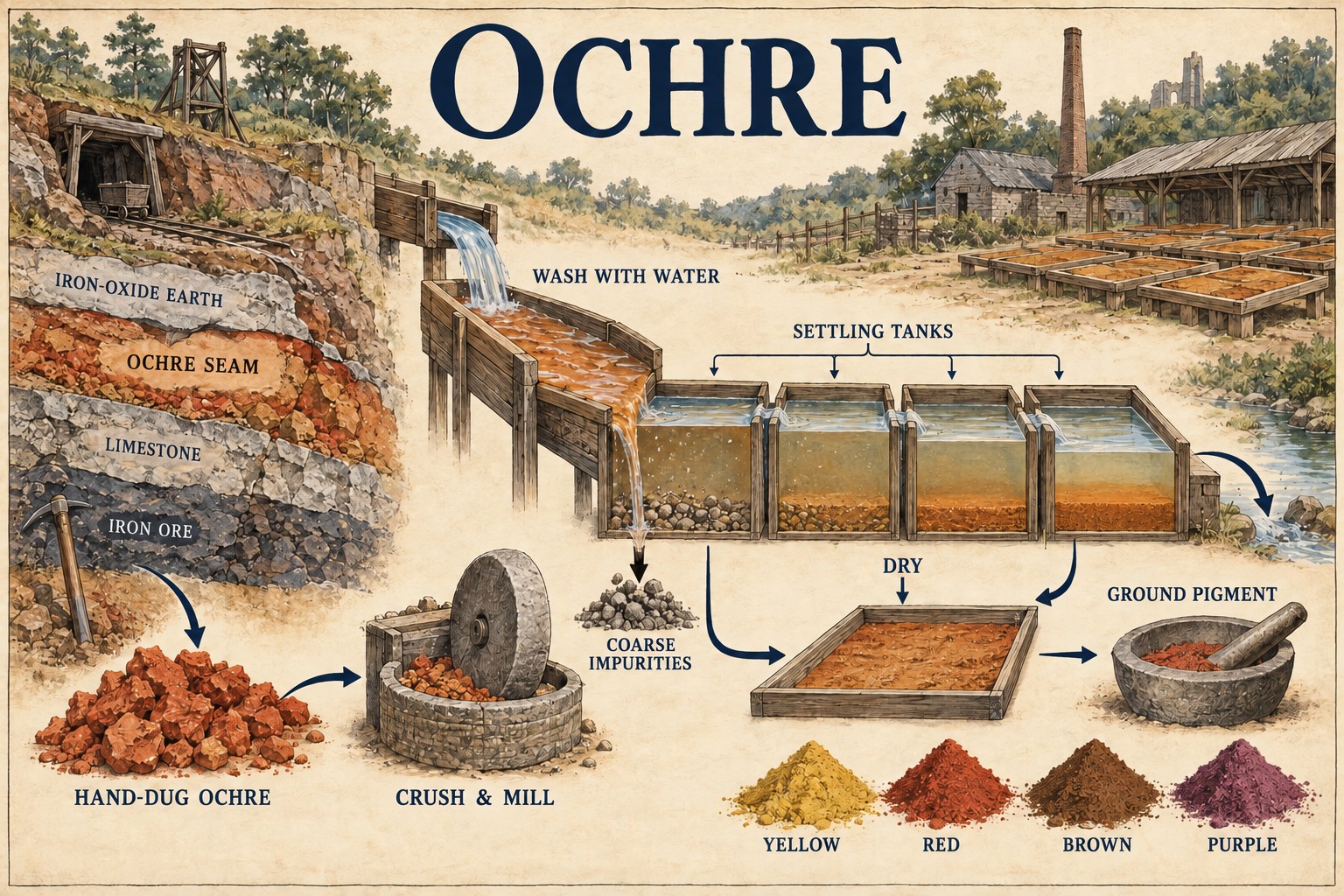
Ochre was dug as a soft, clayey deposit, often mixed with harder crystalline iron ore and limestone that had to be separated out, then processed by milling, washing to remove impurities, and drying before sale as pigment.
Why it was used
Ochre's range of natural earth colours — yellow, red, brown, purple — combined with excellent lightfastness and low cost made it one of humanity's oldest and most durable pigments, used from prehistoric cave art through to industrial paints, dyes and fillers.
Value over time
Forest of Dean ochre commanded a genuine export trade and international reputation for quality into the early 20th century, but demand collapsed as cheap, chemically consistent synthetic iron-oxide pigments became widely available from the 19th century onward, and large-scale Forest of Dean production ended in 1945. What survives today at Clearwell is a small artisanal trade selling directly to artists and conservators who specifically want a genuine natural pigment rather than a synthetic equivalent — value now resting on authenticity rather than industrial-scale demand.
Hazards & challenges
Ochre itself, being essentially fine iron oxide clay, poses a broadly similar and generally mild respiratory profile to haematite dust, with no strong documented history of severe occupational lung disease specific to ochre miners — unlike the silica-bearing rock often worked alongside it at sites like South Terras and Roughten Gill, where the greater hazard came from the associated metal ores rather than the ochre itself.
Risks & limitations
As a soft, low-value bulk material, ochre mining was only ever viable where good-quality seams lay close to the surface or were cheap to reach underground; once synthetic iron-oxide pigments became available from the 19th century onward, natural ochre could no longer compete on cost or consistency for most industrial paint markets.
Regional variation
The Forest of Dean (Gloucestershire) is Britain's principal historic and only current source; South Terras (Cornwall) and Roughten Gill (Cumbria) both produced ochre or the related pigment umber as secondary products once their primary ore bodies were exhausted.
Related terminology
Mines associated with this term
5 examples chosen from 6 linked records — the term page is not an index.
- Little Garth Mine — Cardiff (well documented example)
Named 4 times in this record, first in the history: “…below tunnel level, together with some 265 tons of high-grade ochre, prepared at Melingriffith for sale to paint manufacturers in…” - Ballacorkish Mine — Isle of Man (well documented example)
An early phase of working here and at neighbouring Bradda is recorded as having extracted yellow ochre among other minerals, long abandoned by 1819. - Clearwell Caves — Gloucestershire (well documented example)
Britain's last working ochre mine, still worked by a registered Free Miner using largely traditional methods. - Wheal Maid — Cornwall (well documented example)
The mine's own recorded surface remains explicitly describe the tailings lagoons' distinctive ochre colouring. - Wick Ochre Mines — South Gloucestershire (well documented example)
Named 12 times in this record, first in the summary: “Ochre workings in the Golden Valley at Wick, east of Bristol, found while…”
See every mine that worked ochre →
Disasters associated with this term
Included only where MineArchive's own research gives a reasonable evidential basis, with the nature of the relationship stated — not every disaster where this term might plausibly apply.
- Wheal Jane acid mine water discharge, 1992 (contextual relationship)
Ochre here was the pollution, not the product: iron oxide precipitating out of the acid mine water stained the Carnon River and the Fal estuary ochre-yellow, and the site is still treated decades on.
Sources
- (observational) Mining for Ochre at Clearwell Caves — Toni Watts Art Studio
- (secondary) About Us — Clearwell Caves
- (secondary) Ochre — Wikipedia
Record created: 22 August 2026 · Last researched: 22 August 2026