 MineArchive
Clearwell Caves
| Location | Clearwell, near Coleford, Gloucestershire — 51.7711, -2.6143 (exact) |
|---|---|
| Commodities | Iron, Ochre |
| Type | Metal |
| Worked | from Bronze Age |
| Operators | Ray Wright (1968–2015), Jonathan Wright (1984–?) |
Overview
Clearwell Caves, in the Forest of Dean, have been mined for iron ore and ochre for over 4,500 years — worked today by one of the last practising Free Miners under an ancient birthright that predates the Norman Conquest.
History
Ochre mining at Clearwell is believed to have begun during the Bronze Age, making it one of the oldest continuously exploited mineral sites in Britain. What is now the show cave is one of five distinct workings at Clearwell Meend — Clearwell, Old Ham, Lambsquay, Old Bow and New Dun — together covering around 230 acres; the modern visitor attraction developed from the former Old Ham ore mine. In 1838 the Birmingham ironmaster G. E. Jackson sank a further mine, Old Sling, into earlier workings nearby; by the mid-1860s it alone employed close to 100 men. The site sits within the ancient tradition of Free Mining in the Royal Forest of Dean, formally recognised by a Royal Charter granted by Edward I; local Free Miners are recorded fighting at Crécy in 1346 and Agincourt in 1415. The Forest's own Mine Law Court, which had governed mining custom for centuries, lost its effective authority once its records went missing from the Speech House — recorded as a theft in 1777 by the Freeminers Association, and as papers that simply 'disappeared' in 1775 by the Victoria County History — after which assemblies of Free Miners grew increasingly infrequent through the 1820s. The Dean Forest (Mines) Act of 1838 eventually replaced the customary court with statute, defining a Free Miner as any man born and living within the Hundred of St Briavels who has worked a year and a day in a Forest coal or iron mine, and placing day-to-day administration in the hands of the Deputy Gaveller — a Crown office recorded since 1464 — who registers Free Miners, issues gales and collects royalties on the Crown's behalf. Large-scale ochre production at Clearwell — prized internationally for its pigment quality — continued into the 1930s; sources differ on exactly when the last large-scale iron-ore extraction in the area ended, giving dates as early as around 1930, as cheap Spanish ore imports undercut the Forest's mines, and as late as shortly after the Second World War. Ray Wright reopened the caverns to the public as a show cave in 1968; Jonathan Wright registered as a Free Miner in 1981, joined the operation full-time in 1984, and completed his Mine Deputy Certificate at the Forest of Dean college in 1986–87, continuing to work the mine after Ray Wright's death in 2015.
Geology
Iron ore and ochre of the Forest of Dean, worked for over 4,500 years; the visitor attraction grew out of the former Old Ham ore mine.
Geological setting: Iron Replacement Deposits (well documented example)
Workings
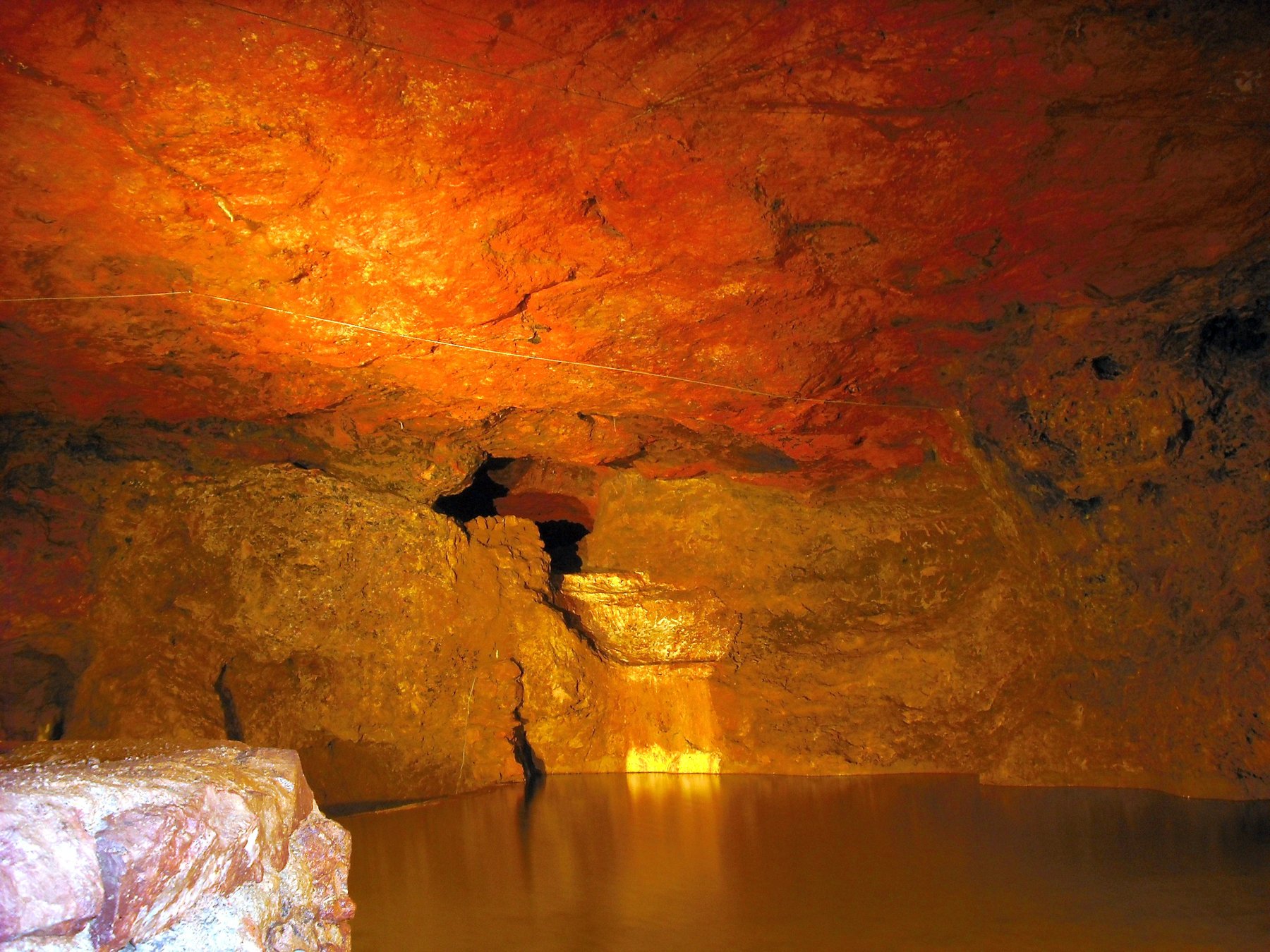
The workings lie in Carboniferous Limestone — known locally as the Crease Limestone — a karst cave system later infilled with iron: an unusually pure haematite ore, reported at over 80% iron, occurring in pockets within both the ore body and the surrounding rock, intermingled with the ochre still worked today. Ten of the chambers are lit and open to casual visitors on a self-guided route; the deeper workings beyond are accessible only with an experienced guide and caving equipment.
Closure
Unknown.
What remains
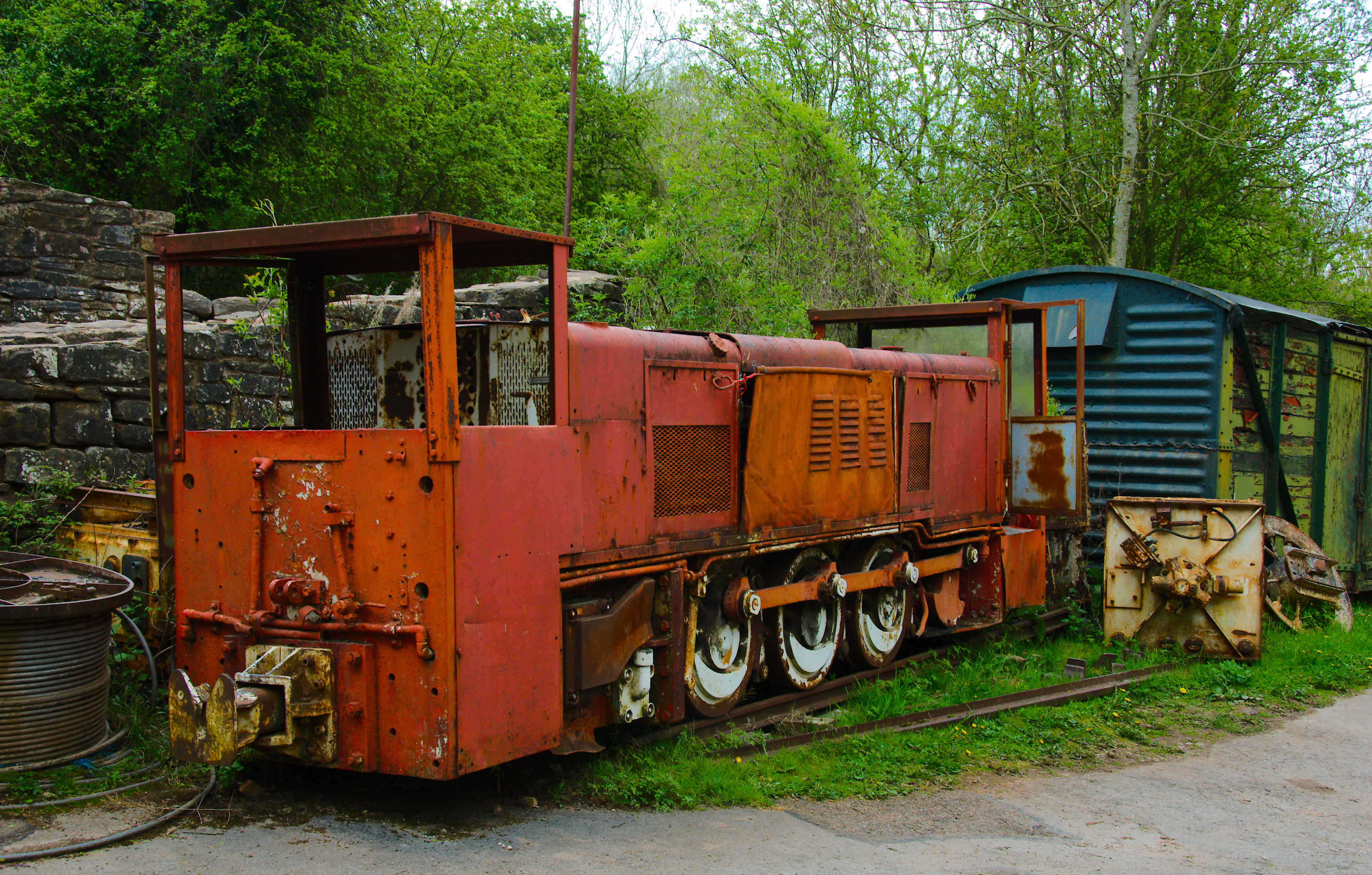
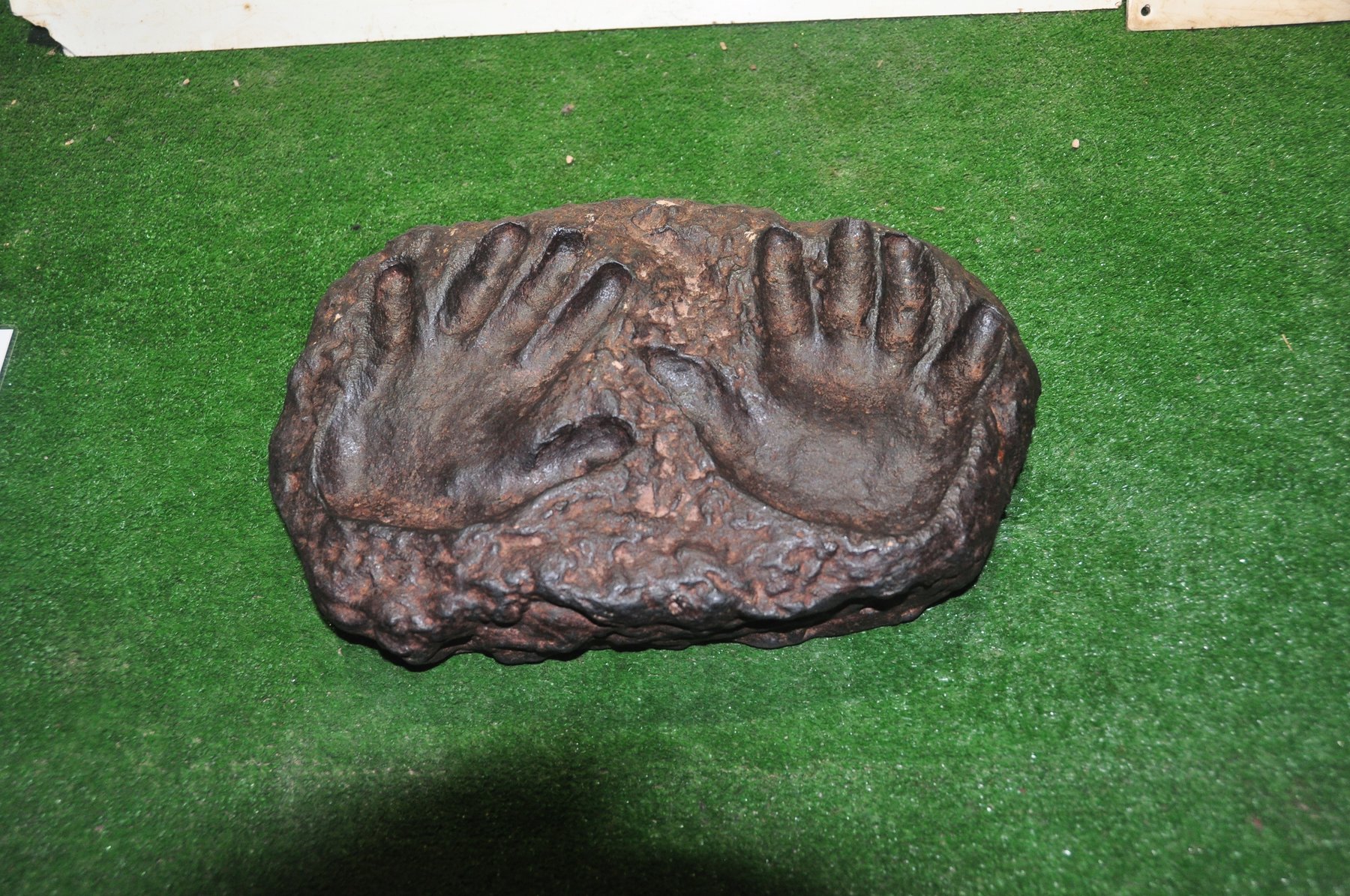
Clearwell remains Britain's last working ochre mine, still producing the pigment in its natural yellow, brown, red and purple varieties under Jonathan Wright's traditional Free Mining rights, hand-scraped from the walls at a rate of some three to four tonnes a year. The caves hold a constant year-round temperature of around 10°C and support a Site of Special Scientific Interest / Special Area of Conservation colony of lesser horseshoe bats. An independent visitor account from 2019 describes the public route passing a disused narrow-gauge mine railway and museum displays covering the site's former use of child labour underground, curtailed by 19th-century mines legislation restricting underground work by young children. The site has also been used as a filming location for productions including Willow (2022), The Winter King (2023) and The Change (2023).
Nearby mines
- Saint Vincent's Colliery — 1.0 miles (1.6 km) E, Forest of Dean
- Dark Hill Colliery — 1.0 miles (1.7 km) NE
- Whitecliff Ironworks — 1.3 miles (2.1 km) NW
- Gentlemen Colliers — 1.8 miles (3.0 km) N
- Brookall Ditches Colliery — 2.5 miles (4.0 km) E
Straight-line distance, within 9 miles (15 km). Show on the map.
What's uncertain
Points where sources disagree or the record could not be settled; both accounts are kept. All open questions in the archive.
- In 1838 the Birmingham ironmaster G. E. Jackson sank the Old Sling ore mine into earlier workings at Clearwell Meend; by the mid-1860s it alone employed close to 100 men. Sources differ on when large-scale iron-ore extraction in the area finally ended — as early as around 1930, as cheap Spanish ore imports undercut the Forest's mines, or as late as shortly after the Second World War. (disputed) 2,4,5
- Sources differ on the exact date and cause of the Mine Law Court's collapse: the Royal Forest of Dean Freeminers Association records its papers as stolen from the Speech House in 1777, while the Victoria County History records them as having simply 'disappeared' from the Speech House in 1775 — after which assemblies of Free Miners grew increasingly infrequent through the 1820s, before the Dean Forest (Mines) Act 1838 placed the custom on a statutory footing. (disputed) 6,2
Recorded claims
Individual factual claims, each attached to the source(s) that support it below. Where sources disagree, both are kept.
- Local Free Miners from the Forest of Dean are recorded fighting at the Battle of Crécy in 1346 and the Battle of Agincourt in 1415. 1
- The Forest of Dean's Mine Law Court, which had governed mining custom for centuries, collapsed after its records were stolen in 1777; the Dean Forest (Mines) Act of 1838 replaced the traditional law with statute. 1
- Clearwell remains Britain's last working ochre mine, with Jonathan Wright — who registered as a Free Miner in 1981 — continuing traditional extraction and processing of the pigment in its natural yellow, brown, red and purple varieties. 1
- The show cave is one of five distinct workings at Clearwell Meend — Clearwell, Old Ham, Lambsquay, Old Bow and New Dun — together covering around 230 acres; the modern visitor attraction developed from the former Old Ham ore mine. 2,3
- In 1838 the Birmingham ironmaster G. E. Jackson sank the Old Sling ore mine into earlier workings at Clearwell Meend; by the mid-1860s it alone employed close to 100 men. Sources differ on when large-scale iron-ore extraction in the area finally ended — as early as around 1930, as cheap Spanish ore imports undercut the Forest's mines, or as late as shortly after the Second World War. (disputed) 2,4,5
- Sources differ on the exact date and cause of the Mine Law Court's collapse: the Royal Forest of Dean Freeminers Association records its papers as stolen from the Speech House in 1777, while the Victoria County History records them as having simply 'disappeared' from the Speech House in 1775 — after which assemblies of Free Miners grew increasingly infrequent through the 1820s, before the Dean Forest (Mines) Act 1838 placed the custom on a statutory footing. (disputed) 6,2
- The custom is administered on the Crown's behalf by the Deputy Gaveller, an office recorded since 1464 and made a statutory position by the 1838 Act; the Deputy Gaveller registers Free Miners, issues gales and collects royalties, and reports on mineral interests to HM Verderers' Court each quarter. 6,7,2
- The workings lie in Carboniferous Limestone — known locally as the Crease Limestone — a karst cave system later infilled with an unusually pure haematite iron ore, reported at over 80% iron, occurring in pockets within both the ore body and the surrounding rock and intermingled with the ochre still worked today. 4
- Site founder Ray Wright, who first opened part of the workings to the public in 1968, ran Clearwell Caves until his death in 2015; his son Jonathan Wright — registered as a Free Miner in 1981 — has continued to operate the mine and its show-cave attraction since. 5
- An independent visitor account from November 2019 describes the self-guided public route passing a disused narrow-gauge mine railway and museum displays covering the site's former use of child labour underground, a practice curtailed by 19th-century mines legislation restricting underground work by young children. 5
- The BGS/Mining Remediation Authority's national mine-plans catalogue holds an abandonment plan for “Clearwell Meend Gales” (iron), catalogue no. 18081 — the formal record of iron-mining gales registered in the immediate Clearwell area. 8
Sources
- (secondary) About Us — Clearwell Caves
- (secondary) A History of the County of Gloucester: Volume 5, Bledisloe Hundred, St Briavels Hundred, the Forest of Dean — Industry — Victoria County History / British History Online
- (secondary) Clearwell Caves — Wikipedia
- (secondary) Show Mines of Great Britain: Clearwell Caves — showcaves.com
- (observational) The Travels of a Curious Old Man: Coleford and Around: Forest of Dean Part 2 — The Travels of a Curious Old Man (independent visitor blog)
- (secondary) History — Royal Forest of Dean Freeminers Association — Royal Forest of Dean Freeminers Association
- (secondary) The Deputy Gaveller and his role in Forestry England — Forest of Dean Heritage Open Days
- (primary) BGS/Mining Remediation Authority mine plan: Clearwell Meend Gales (iron) — British Geological Survey / Mining Remediation Authority
Record created: 20 August 2026 · Last researched: 29 August 2026