 MineArchive
Dark Hill Colliery
| Also known as | Darkhill Colliery, Dark Hill Level |
|---|---|
| Location | Gorsty Knoll, near Coleford, Gloucestershire — 51.7823, -2.5985 (approximate) |
| Commodity | Coal |
| Type | Coal |
| Worked | By 1813–c. 1914 |
| Maximum depth | A level worked into the six-foot Coleford High Delf Seam; no shaft depth is recorded. |
| Operators | David Mushet (1841–1847), R. Thomas and Co. (1880–?), Thomas Bennett Brain (1899–1914) |
Overview
A small Forest of Dean level near Coleford, working the six-foot Coleford High Delf Seam. There was a colliery at Dark Hill by 1813, when it was sold to John Hawkins, and the gale was confirmed to the Scottish metallurgist David Mushet in 1841; by 1847 he had the neighbouring Shutcastle gale as well. Mushet had built his experimental furnace at Darkhill in 1818–19 and the colliery existed largely to supply it. On his death in 1847 the colliery, the Darkhill Ironworks and Shutcastle were put up for auction together, failed to sell, and passed to his three sons. Dark Hill was worked only intermittently thereafter — 4,206 tons in 1880 — and little seems to have been done after Thomas Bennett Brain, who bought it in 1899, died in 1914.
History
A colliery existed at Dark Hill by 1813, when it was sold to John Hawkins. Its later history belongs to the Mushets. David Mushet, a Scottish metallurgist, came to the Forest of Dean in February 1810 to manage the Whitecliff Ironworks at Coleford, and in 1818–19 built a coke-fired experimental furnace at Darkhill. Most of what he did there was research rather than production, though he sold iron in quantity. The Dark Hill gale was confirmed to him in 1841 and by 1847 he had also obtained the neighbouring Shutcastle gale.
Mushet died in 1847. The colliery, the Darkhill Ironworks and Shutcastle Colliery were put up for auction together, did not sell, and passed to his three sons, soon being held by David Mushet junior alone. His brother Robert Forester Mushet, who had taken over management of the ironworks in 1845, moved in 1848 to the newly built Forest Steel Works on the edge of the Darkhill site, where he carried out more than ten thousand experiments in ten years before moving on to the Titanic Steelworks in 1862; the world’s first tungsten steel was made on this ground.
The colliery itself was worked only intermittently. It lay close to the Severn and Wye Railway’s Milkwall — later Coleford — branch and after about 1875 was served by Fetterhill Sidings, but produced only 4,206 tons of coal in 1880, the year it appears in the official list of collieries at work. Thomas Bennett Brain bought it in 1899; little work seems to have been done after his death in 1914, although the gale continued to be worked from several adjoining gales. The ironworks had been sold before 1874 to the Severn & Wye Railway, which threw an embankment across the east end of the site to carry the Coleford line.
Geology
Dark Hill worked the Coleford High Delf Seam, six feet thick, at the base of the Pennant Group in the middle Upper Coal Measures — the seam that underlies most of the western side of the Forest of Dean basin and the one the free miners had been taking by level for centuries. The neighbouring Dark Hill Endeavour level worked both the Coleford High Delf and the Trenchard Seams.
Geological setting: Sedimentary Beds and Seams (well documented example)
Workings
A level rather than a shaft, driven into the seam in the ordinary Forest of Dean way. Its position and the Severn and Wye connection mattered more than its size: the Milkwall branch ran close by, and from about 1875 Fetterhill Sidings gave it a rail outlet. The whole operation was subordinate to the ironworks on the same ground, which is why the tonnages are so small — 4,206 tons in 1880 for a colliery returned among the working pits of the Forest.
Closure
Dark Hill was worked intermittently for most of its life and never at a scale that would have sustained it on its own. Thomas Bennett Brain bought it in 1899 and little work seems to have been done after he died in 1914, though the gale itself continued to be worked from several adjoining gales.
What remains
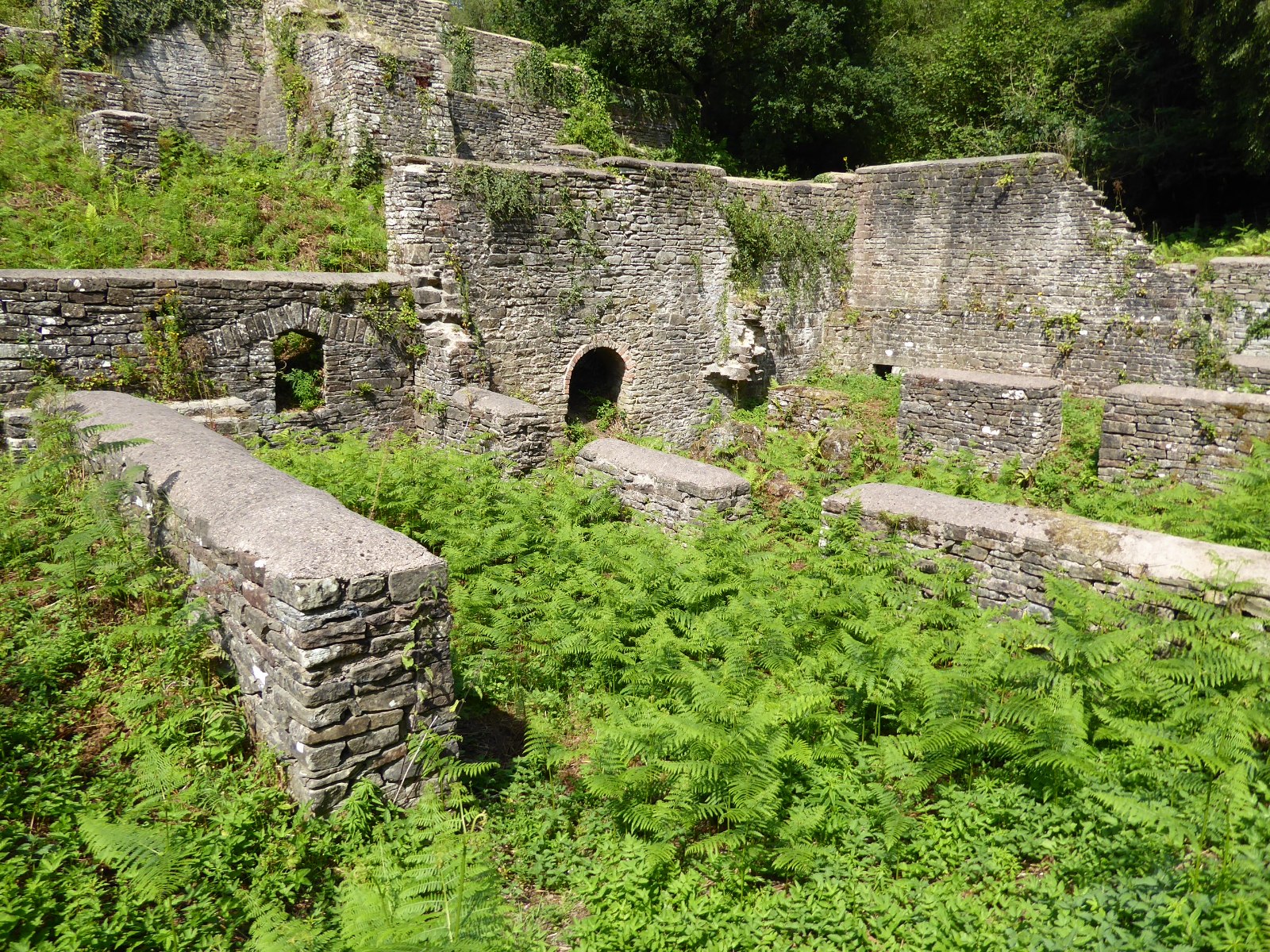
The colliery site was surveyed by the Forest of Dean Local History Society in December 2002 and found heavily overgrown: the only evidence that this was a mine at all is some hummocky ground and a few lumps of masonry that may survive from the original foundations. The concrete foundations just to the west, alongside the Milkwall–Parkend road, are probably part of the Darkhill Brickworks rather than the colliery.
Hummocky ground and a few lumps of masonry at the level’s site. The neighbouring Darkhill Ironworks and Titanic Steelworks, by contrast, survive as internationally important industrial remains in the care of Forestry England, with the blast furnace, blowing engine house, charging incline, smiths’ shop and brick drying sheds and kilns all traceable.
Nearby mines
- Saint Vincent's Colliery — 0.8 miles (1.2 km) SE, Forest of Dean
- Gentlemen Colliers — 1.0 miles (1.6 km) N
- Clearwell Caves — 1.0 miles (1.7 km) SW
- Whitecliff Ironworks — 1.3 miles (2.1 km) W
- Hopewell Colliery — 1.5 miles (2.4 km) NE
Straight-line distance, within 9 miles (15 km). Show on the map.
Recorded claims
Individual factual claims, each attached to the source(s) that support it below. Where sources disagree, both are kept.
- A colliery existed at Dark Hill by 1813, when it was sold to John Hawkins; the gale was confirmed as awarded to David Mushet in 1841, and by 1847 he had also obtained the neighbouring Shutcastle gale. 1,2
- Dark Hill worked the Coleford High Delf Seam, six feet thick, at the base of the Pennant Group of the middle Upper Coal Measures. 2
- On Mushet’s death in 1847 the colliery, the Darkhill Ironworks and Shutcastle Colliery were put up for auction together, did not sell, and passed to his three sons, soon being held by David Mushet junior alone. 1,2
- Only 4,206 tons of coal were produced at Dark Hill in 1880. 1,2
- Thomas Bennett Brain bought the colliery in 1899; little work seems to have been done after his death in 1914, although the gale continued to be worked from several adjoining gales. 2
- David Mushet built a coke-fired experimental furnace at Darkhill in 1818–19; his son Robert took over management in 1845, moved to the adjoining Forest Steel Works in 1848 and to the Titanic Steelworks in 1862, and the world’s first tungsten steel was produced on this ground. 3,4
- Two men are recorded killed at Dark Hill Level: William Morris, a collier aged 20, crushed by a fall of earth and rock in a stall on 3 February 1875; and Stephen Adams, aged 51, who died on 12 February 1903 of heart exhaustion after straining an intercostal muscle trying to lift a heavy weight of dirt that had fallen on Thomas Morgan on 31 January. 1
- The official list of collieries at work in 1880 returns "Darkhill, Coleford, R. Thomas and Co." — so the gale was in other hands by then, the Mushet interest having lapsed after 1847. The same Gloucestershire section separately returns "Dark Hill coal and brick, Coleford, Wanklyn and Gundell", a second and distinct working. 5
Photographs & further reading
The society’s site record: the gale’s descent from John Hawkins through David Mushet to Thomas Bennett Brain, the seam worked, the rail connection at Fetterhill Sidings, and a December 2002 field note on what little survives.
View sourceThe visitor information for the ironworks and Titanic Steelworks on the same ground, which is where the significance of this site really lies: the standing remains of the blast furnace, blowing engine house and charging incline are freely accessible.
View sourceSources
- (primary) Miners Memorial Project: Fatalities in Coal Mines — Forest of Dean Local History Society
- (secondary) Dark Hill Colliery — Forest of Dean Local History Society
- (secondary) Darkhill Ironworks — Wikipedia
- (secondary) Darkhill Ironworks — Forestry England
- (secondary) List of coal mines UK 1880 — Coalmining History Resource Centre
- (observational) Darkhill Ironworks (photographed 21 July 2021) — Philip Halling, Geograph Britain and Ireland
Record created: 6 September 2026 · Last researched: 6 September 2026