 MineArchive
Whitecliff Ironworks
| Also known as | Whitecliff Furnace |
|---|---|
| Location | Coleford, Forest of Dean, Gloucestershire — 51.7883, -2.6272 (exact) |
| Commodity | Iron |
| Type | Iron |
| Worked | 1798-1801–By 1816 (production) |
Overview
A short-lived coke-fired blast furnace built beneath a limestone cliff at Coleford in the Forest of Dean, ruined financially within fifteen years of construction but historically significant as the site of some of David Mushet's earliest steelmaking experiments.
History
Whitecliff was built between 1798 and 1801 by a partnership formed around the coal owner and ironmaster Teague — named as James Teague by the Forest of Dean Local History Society and as Moses Teague by Grace's Guide, a discrepancy this record has not been able to resolve — together with the Quaker ironmaster Samuel Botham and John Bishton, later joined by William Phillips. The site was chosen against a limestone cliff so that raw materials could be tipped directly into the furnace from above. Construction was badly set back by flooding from the nearby stream, which destroyed what had already been built — dated to the winter of 1797-98 by one source and to 1799 by the other — forcing Botham (and, in one account, Phillips) to withdraw from the scheme. Thomas Halford, a London stockbroker, joined the enterprise to see the works completed, and the furnace was finally blown in during 1801 or 1802 — the second of three coke-fired blast furnaces built in the Forest of Dean, alongside those at Cinderford and Parkend.
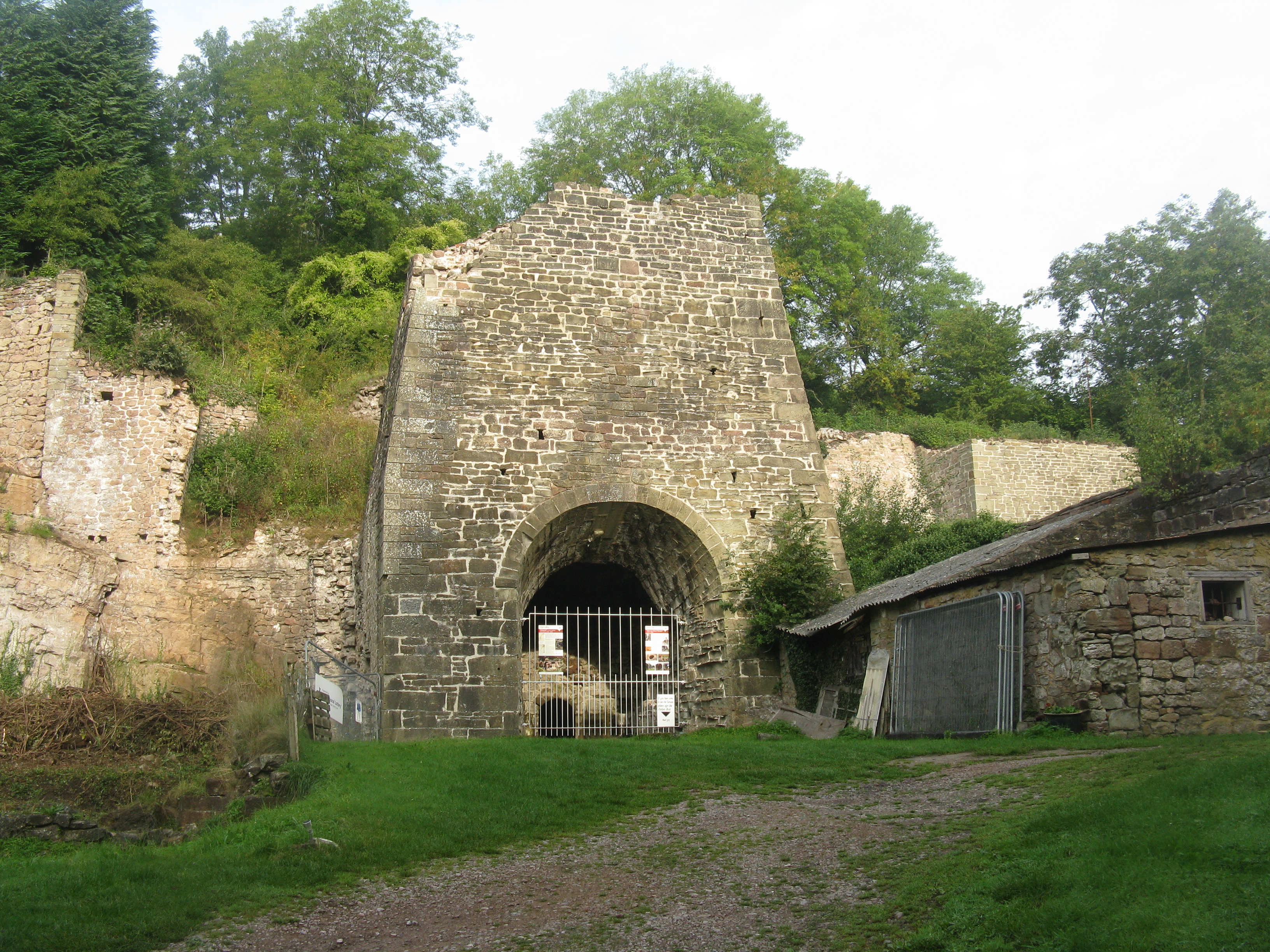
The furnace struggled from the outset to smelt Forest iron ore efficiently using coke made from local coal, and the partnership was reorganised more than once: by 1802 it comprised Teague, Halford, Isaiah Birt and Wickenden. In 1806 a second furnace was built just north of the first — this is the structure that still stands today and is known as Whitecliff Furnace. Around 1809-10 Halford brought in the Scottish metallurgist David Mushet to manage the works and take a partnership share; Mushet conducted some of his earliest experiments in steel production at Whitecliff during this period, but withdrew from the partnership after only a few months. Halford continued alone until he was declared bankrupt in 1816, after which the ironworks was largely dismantled — except for the furnace itself — with parts, including the blast equipment, moved to Cinderford furnace. Iron production at Whitecliff had ceased completely by 1816, and possibly as early as 1812; there is no evidence iron was ever made at the site again.
Geology
Not a mine: a coke-fired blast furnace set against a limestone cliff at Coleford, so that raw materials could be tipped straight into it from above.
Workings
A coke-fired blast furnace built into a limestone cliff face so that ore, coke and flux could be charged directly from above; a second furnace was added immediately north of the first in 1806 and is the structure that survives today.
Closure
The works never overcame the technical and financial difficulties of smelting Forest ore with local coke; Thomas Halford's bankruptcy in 1816 brought iron production at the site to a permanent end.
What remains
The 1806 furnace survives as a scheduled monument, described as the only surviving example of its kind in southern England. It is of particular technological and historical importance for its association with David Mushet's early steelmaking experiments.
Nearby mines
- Gentlemen Colliers — 1.2 miles (2.0 km) NE
- Clearwell Caves — 1.3 miles (2.1 km) SE
- Dark Hill Colliery — 1.3 miles (2.1 km) E
- Cross Knave Colliery — 1.6 miles (2.6 km) NE
- Saint Vincent's Colliery — 1.9 miles (3.1 km) SE, Forest of Dean
Straight-line distance, within 9 miles (15 km). Show on the map.
What's uncertain
Points where sources disagree or the record could not be settled; both accounts are kept. All open questions in the archive.
- The ironworks was built between 1798 and 1801 by a partnership including Teague (named James by one source, Moses by another), Samuel Botham and John Bishton, later joined by William Phillips; flooding (dated to winter 1797-98 by one source, 1799 by the other) destroyed the partly-completed works and forced Botham to withdraw. (disputed) 1,2
- David Mushet was brought in by Thomas Halford (in 1810 per the Forest of Dean Local History Society, 1809 per Grace's Guide) to manage the works and take a partnership share, conducting some of his earliest steelmaking experiments there before withdrawing after a few months. (disputed) 1,2
Recorded claims
Individual factual claims, each attached to the source(s) that support it below. Where sources disagree, both are kept.
- The ironworks was built between 1798 and 1801 by a partnership including Teague (named James by one source, Moses by another), Samuel Botham and John Bishton, later joined by William Phillips; flooding (dated to winter 1797-98 by one source, 1799 by the other) destroyed the partly-completed works and forced Botham to withdraw. (disputed) 1,2
- The furnace was blown in during 1801 or 1802, the second of three coke-fired blast furnaces built in the Forest of Dean. 1
- A second furnace was built north of the first in 1806; this is the structure that survives today as Whitecliff Furnace. 1
- David Mushet was brought in by Thomas Halford (in 1810 per the Forest of Dean Local History Society, 1809 per Grace's Guide) to manage the works and take a partnership share, conducting some of his earliest steelmaking experiments there before withdrawing after a few months. (disputed) 1,2
- Halford continued alone until his 1816 bankruptcy, after which the ironworks was largely dismantled, with parts including the blast equipment moved to Cinderford furnace; iron production at Whitecliff had ceased completely by 1816, possibly as early as 1812. 1,2
Sources
- (secondary) Whitecliff Furnace — Forest of Dean Local History Society
- (secondary) Whitecliff Furnace — Grace's Guide to British Industrial History
Record created: 26 August 2026 · Last researched: 26 August 2026