 MineArchive
Engine House
| Also known as | Beam engine house, Engine Houses (Plural form, used where a mine had more than one — added to stop this exact mismatch recurring across future mine records) |
|---|---|
| Category | Structures & Machinery |
The building erected over a mine's steam engine — in Cornwall and west Devon most often a beam engine, and elsewhere a beam, rotative or horizontal engine — used to pump water, wind ore and men up a shaft, or crush ore ahead of dressing.
Historical usage
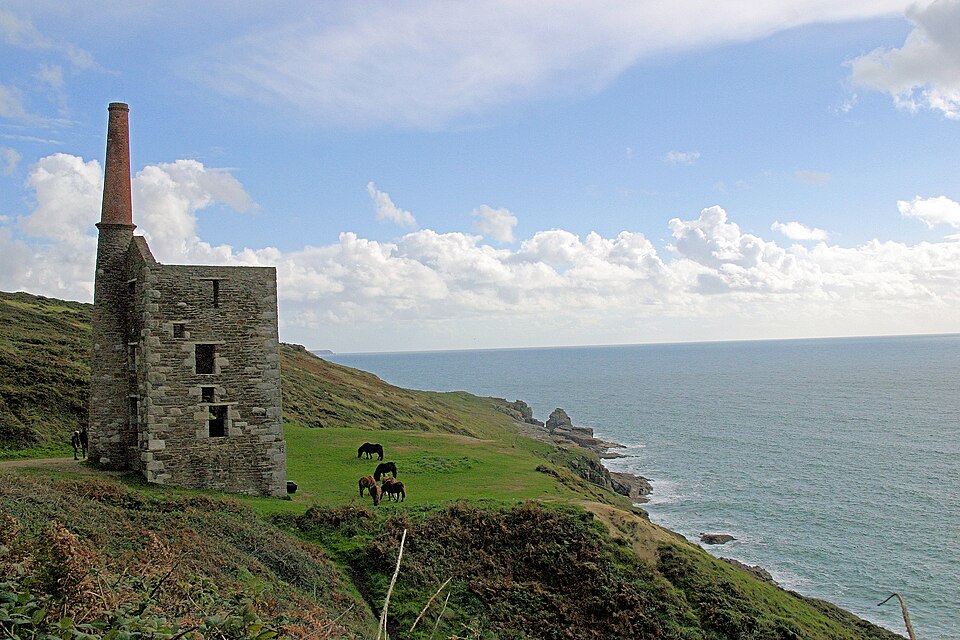
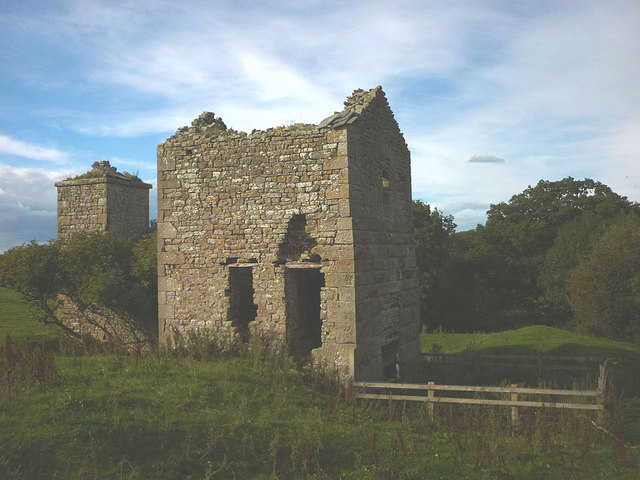
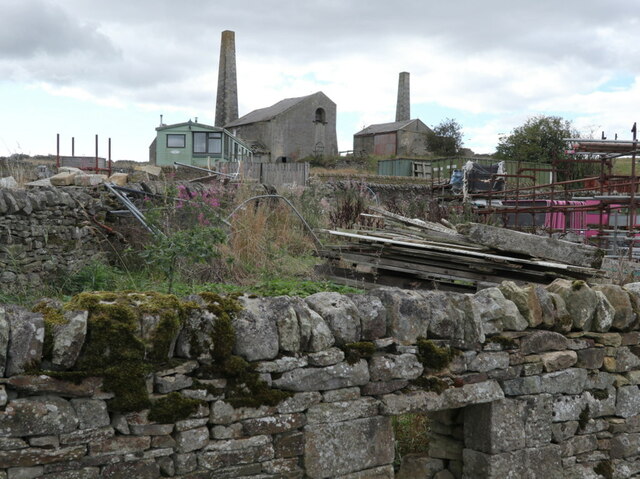
The basic form was set by Newcomen's atmospheric engine in the early 18th century: a house that was as much the engine's frame as its shelter. The Cornish beam engine, a high-pressure design pioneered by Richard Trevithick, let Cornwall and west Devon's mines keep pace with deepening workings through the 18th and 19th centuries, and more beam engines were installed there than in any other mining region of the world; around 3,000 engine houses are thought to have been built to hold them. More than 300 engine house sites survive in Cornwall and west Devon, about 200 of them within the Cornwall and West Devon Mining Landscape World Heritage Site — 'the greatest concentration anywhere on earth'. The engine house was never a Cornish monopoly. Collieries and lead mines across Britain built them as soon as they had an engine to house: at Stublick in Northumberland a small upland colliery put up a beam engine house, boiler house and chimney in 1838 to drain deeper coal, a group now listed at Grade II* as the finest early 19th-century colliery buildings in the region, and at Clintsfield in the Lune valley a sandstone house built in the early 19th century held a five-horsepower pumping engine while horse gins went on winding the coal.
How it worked
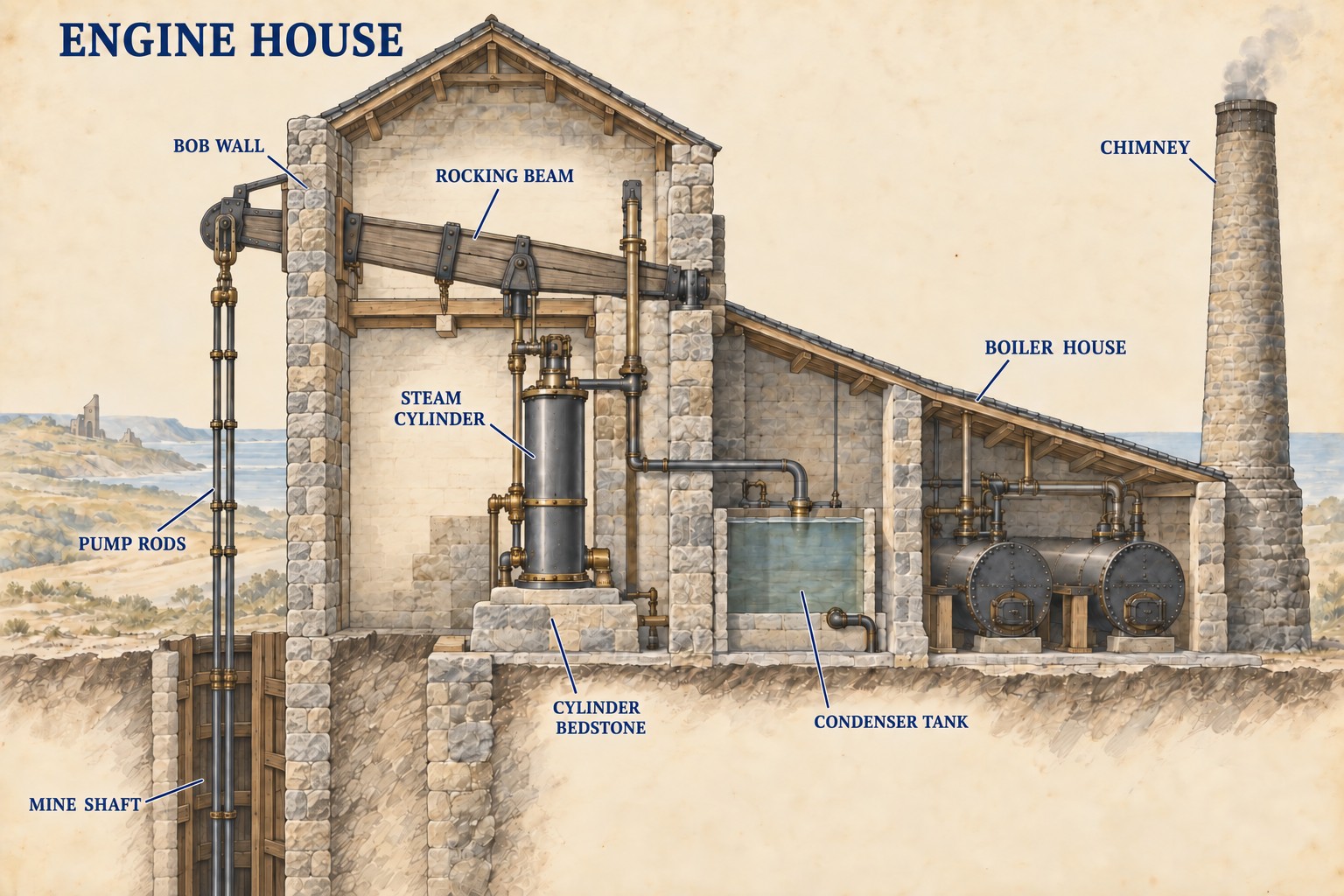
A large steam cylinder, set vertically, stood inside the house and drove a massive rocking beam (the 'bob'). For pumping, the bob transmitted its motion through the bob wall — the engine house's reinforced front elevation, built to withstand loads exceeding 50 tons on the largest engines — to pump rods running down the adjacent shaft. For winding or ore-crushing, the bob instead drove a flywheel and crank mounted on a platform beside the bob wall. A condenser, housed in a tank of cold water immediately in front of the bob wall, condensed the exhaust steam to create a vacuum and improve the engine's efficiency. The other walls braced the bob wall and took some of the working stresses; the rear wall, usually gabled, carried the opening through which the cylinder was brought in, and a granite bedstone carried the cylinder itself. A lightly-built boiler house, usually attached as a lean-to, held the horizontal boilers, with the chimney either built into one corner of the engine house or raised as its own stack. On a colliery house the beam was as likely to project through a round-headed aperture in the wall over the shaft, as at Clintsfield, where the partly blocked opening still shows where the arm came out.
Why it was used
Engine houses made it possible to keep working a mine once it went deeper than an adit or sough could drain by gravity alone — without mechanical pumping, Cornish and Devon lodes would have flooded far sooner. The same engine design, adapted, could also wind ore and men up a shaft or drive ore-crushing machinery, making it the general-purpose power source for a deep metal mine.
Risks & limitations
Running a beam engine was expensive — coal had to be shipped into Cornwall, which has no coalfield of its own — so an engine house was only viable while a mine's ore output could cover the fuel bill. Most of the surviving engine houses on the Cornish coast stand roofless and empty not because the engines failed, but because the mine itself became unprofitable to run once its most accessible ore was worked out, at which point the engine was usually the most valuable thing on site and was sold on or scrapped.
Regional variation
The rectangular engine house with a granite bob wall is specifically a Cornish and west Devon form. Local stone was used throughout, with cut granite favoured for the cylinder bedstone, the bob wall and the corners ('quoins'), and gable roofs covered in Cornish slate. Engine houses elsewhere in Britain took the local stone and the local engine: squared sandstone with ashlar dressings and Welsh slate at Stublick, where the round-headed openings for the winding gear and a cart entrance mark a house that wound as well as pumped, and coursed sandstone at Clintsfield. The Cornish design travelled with emigrant Cornish miners and mining engineers to other coalfields and metal-mining regions overseas, so broadly similar engine houses also survive outside the United Kingdom.
Related terminology
Atmospheric Engine, Boiler House, Drumhouse, Heapstead, Pumping Engine, Winding Engine
Mines associated with this term
5 examples chosen from 117 linked records — the term page is not an index.
- Auchenharvie Colliery — North Ayrshire (well documented example)
An engine house was built in 1719 to hold a Newcomen atmospheric engine — one of the earliest steam pumping installations at any colliery anywhere. - Burrow Farm Mine — Somerset (well documented example)
Named 8 times in this record, first in the summary: “An iron mine on the Brendon Hills whose engine house — built in 1879 from stone carted three kilometres across the hills…” - Califat Coal Mine — Leicestershire (well documented example)
Named 8 times in this record, first in the history: “…Trust. The site has been dug over ever since. There are two engine house complexes at Califat, of which the easterly is called Alabama —…” - Chislehurst Caves — Kent (well documented example)
The 1862-63 Ordnance Survey marks the site as a chalk pit with kilns and an engine house, fitting a phase of lime burning in the mid-19th century. - Dunaskin Ironworks — South Ayrshire (well documented example)
Named 5 times in this record, first in the history: “…early 1930s, leaving only the workshops, two chimneys, the blowing engine houses and the power station standing. In 1928 a brickworks was established…”
Disasters associated with this term
5 examples chosen from 18 linked records, most direct relationship first.
- Altofts Colliery explosion, 1886 (contextual relationship)
Named in this record’s narrative: “…gas piped from the surface lighting the pit porch, an underground engine house and the roads near the shafts.” - Bamfurlong Colliery fire, 1892 (contextual relationship)
Named twice in this record, first in the summary: “…1892 a paraffin torch set fire to a timber-floored compressed-air engine house on the main intake of Bamfurlong Colliery, near Wigan, and the…” - Bickershaw Colliery shaft accident, 1932 (contextual relationship)
Named in this record’s narrative: “…'bell platform' as its winding rope detached and crashed through the engine house roof.” - Califat Colliery Inundation, 1863 (contextual relationship)
Named twice in this record, first in the summary: “…and Jeremiah Rose. A memorial to them stands near the Alabama engine house complex on the mine site.” - Cowpen Colliery shaft accident, 1841 (contextual relationship)
Named in this record’s narrative: “…and new lessees were preparing to work it again. A new engine and engine-house had been built, masons were walling the shaft, and pitmen and…”
Sources
- (primary) Clintsfield Colliery, Tatham (List entry 1018920) — Historic England
- (primary) Earthwork and buried remains of Stublick Colliery, immediately south east of Stublick, Haydon (List entry 1021259) — Historic England
- (secondary) A Cornish mining glossary — Cornish Mining World Heritage Site (UNESCO)
- (secondary) Engine Houses — Cornish Mining World Heritage Site (UNESCO)
Record created: 20 August 2026 · Last researched: 22 September 2026