 MineArchive
Dunaskin Ironworks
| Location | Waterside, near Patna, South Ayrshire — 55.3447, -4.4588 (exact) |
|---|---|
| Commodity | Iron |
| Type | Iron |
| Worked | 1840s–1921 (closure) |
| Operators | Dalmellington Iron Company (1840–1921), Bairds & Dalmellington Ltd (1928–1976) |
Overview
An Ayrshire ironworks founded by the Houldsworth family to exploit the Doon Valley's coal, blackband ironstone and limestone, whose eight blast furnaces once ran day and night before closing in 1921 — the surviving works reborn first as a brickworks and later, briefly, as one of Scotland's best-preserved Victorian ironworks heritage sites.
History
The Dalmellington Iron Company was founded by Henry Houldsworth (1770-1853), a Glasgow cotton mill owner, in the early 1840s to exploit the Doon Valley's coal, blackband ironstone and limestone. The ironworks at Dunaskin, near Dalmellington, was completed by 1850, with the first iron made there in September 1848; the site was later served by Waterside railway station. The furnaces ran around the clock, and at their late-19th-century peak eight were in blast together, with the company employing around 1,400 people.
As local supplies of blackband ironstone were worked out, the company turned to imported Spanish ore to keep the furnaces supplied, but the works became increasingly uneconomic and closed in 1921 during a strike. Coal mining under the same company's successors continued after the ironworks itself shut, and much of the original plant was demolished in the early 1930s, leaving only the workshops, two chimneys, the blowing engine houses and the power station standing. In 1928 a brickworks was established on the site by Bairds and Dalmellington Ltd, an amalgamation of the coal interests of the Dalmellington and Eglinton iron companies, converting the 1847 blowing engine house to house brickmaking machinery; the National Coal Board took over the associated coal operations in 1947. Brickmaking continued until 1976, when collapsing demand — 2.5 million bricks were left stockpiled on site — finally ended production.
In the late 1990s a heritage centre opened at Dunaskin, telling the story of Doon Valley industry through the surviving ironworks and brickworks structures, including a Hoffman kiln, the beam engine house and a simulated mine experience; rated four stars by the Scottish Tourist Board, it was, at the time, considered Europe's best-preserved Victorian ironworks. The local authority withdrew funding and the heritage centre closed in 2005. The site today hosts the Doon Valley Railway and the Scottish Industrial Railway Centre.
Geology
The Doon Valley sits on part of the Ayrshire Coalfield, where seams of coal occur alongside blackband ironstone — a carbonate ironstone rich enough in coaly matter to help fuel its own smelting — and beds of limestone: the three raw materials a 19th-century ironworks needed side by side.
Workings
Ore, coal and limestone were worked from pits and mines across the Doon Valley and brought to Dunaskin's furnace bank, where a row of blast furnaces smelted the ore continuously; once local blackband ironstone ran short, the works turned to imported Spanish ore to keep the furnaces supplied.
Closure
The blast furnaces closed in 1921, no longer able to compete once cheap local ironstone was exhausted; coal mining continued under successor companies, and most of the original ironworks plant was demolished in the early 1930s to make way for a brickworks, which itself closed in 1976.
What remains
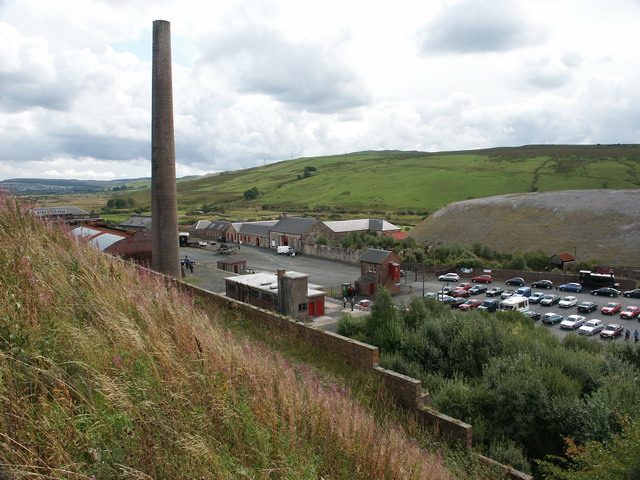
The former blowing engine house, two chimneys and other ironworks- and brickworks-era structures survive at Waterside; the site briefly operated as an award-winning industrial heritage centre (closed 2005) and now forms part of the Doon Valley Railway heritage attraction.
Workshops, two chimneys, blowing engine houses and the power station survive from the ironworks era, alongside Hoffman kilns and other structures from the later brickworks.
Nearby mines
- Dalmellington Iron Works — 0.1 miles (0.2 km) E, East Ayrshire
- Waterside Colliery — 1.6 miles (2.6 km) SE, East Ayrshire
- Houldsworth Colliery — 1.9 miles (3.1 km) W, East Ayrshire
- Rankinston Colliery — 3.1 miles (5.0 km) N, East Ayrshire
- Pennyvenie Colliery — 3.4 miles (5.5 km) E, East Ayrshire
Straight-line distance, within 9 miles (15 km). Show on the map.
Recorded claims
Individual factual claims, each attached to the source(s) that support it below. Where sources disagree, both are kept.
- The Dalmellington Iron Company was founded by Henry Houldsworth in the early 1840s to exploit the Doon Valley's coal, blackband ironstone and limestone, with the first iron made at Dunaskin in September 1848. 1,2
- At its late-19th-century peak the ironworks ran eight blast furnaces around the clock and employed around 1,400 people, before local blackband ironstone ran short and imported Spanish ore had to be used instead. 2
- The blast furnaces closed in 1921; a brickworks was established on the site from 1928, converting the former blowing engine house, and operated until 1976. 3,2
- A heritage centre opened at Dunaskin in the late 1990s, rated four stars by the Scottish Tourist Board and considered one of Europe's best-preserved Victorian ironworks, before closing in 2005 when local authority funding was withdrawn. 3,2
Sources
- (secondary) Dalmellington Iron Works — RAILSCOT
- (secondary) Dunaskin Open Air Museum — Subterranea Britannica / Showcaves
- (secondary) Dunaskin — Future Museum
Record created: 27 August 2026 · Last researched: 27 August 2026