 MineArchive
Blackband Ironstone
| Category | Commodities |
|---|
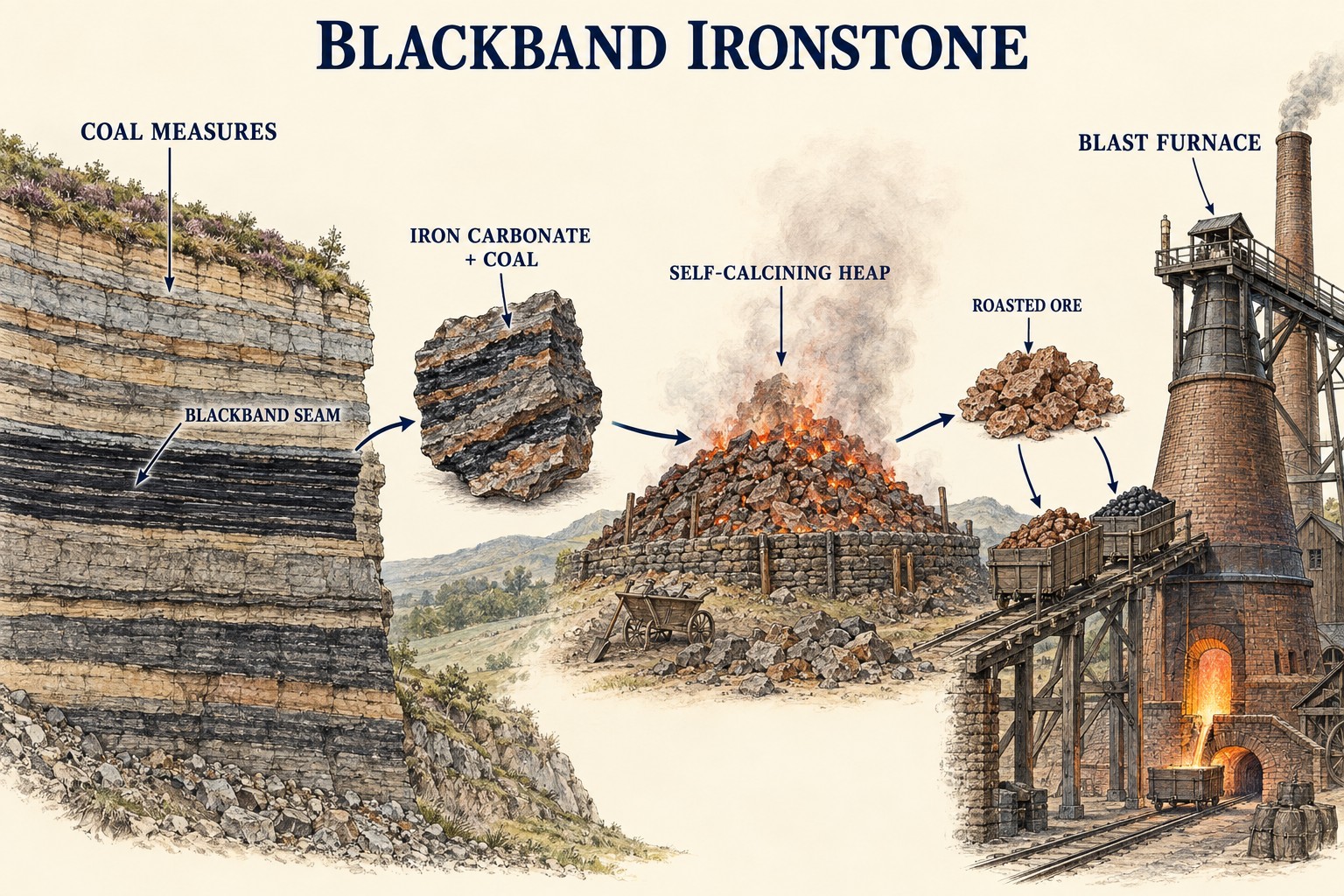
A dark, carbon-rich variety of ironstone containing enough coaly matter to smelt itself, requiring little or no additional fuel to calcine.
Historical usage
Blackband ironstone was discovered in the Scottish coal measures at the start of the 19th century, considerably later than the plainer clayband ironstone that had supplied Scotland's ironworks since the Carron Ironworks was founded in 1760. Once recognised, blackband transformed the Scottish iron industry: it needed less added coal, smelted more easily than clayband, and let furnaces produce roughly half as much again per week. Scottish pig-iron output rose from under 1,500 tons a year in the Carron Ironworks' early decades to 18,640 tons by the early 19th century and 75,000 tons by 1836, once the hot-blast process was combined with blackband ironstone.
How it worked
A good blackband deposit carried around two to eight per cent coal naturally mixed through it, as a carbonate of iron laminated with coal; heaped and lit with only a little extra fuel, it calcined using its own carbon content rather than requiring separate coal to be added, as the Government Inspector of Mines Ralph Moore described it. Where the coal content ran too high, above about twenty per cent, the ironstone became commercially worthless on its own and had to be blended with clayband instead.
Why it was used
Blackband's self-calcining property made it cheaper and quicker to process than clayband ironstone, needing less imported fuel and yielding a higher-iron metallic coke once roasted.
Value over time
For a generation after David Mushet found it in the bed of the North Calder in 1801, blackband was worth almost nothing: its use was confined to the Calder ironworks, where Mushet was manager, mixed with other ironstones, and the trade regarded it with prejudice. What made it valuable was James Beaumont Neilson's hot blast, patented in 1828 and first applied at Calder in 1829. The figures from Clyde ironworks show what the combination did: pig iron that cost £8 a ton to make in 1811, on ten tons of coal to the ton, cost £4 12s in 1828 and £2 12s 8d in 1832 on two and a half tons of coal. Between 1830 and 1847 Scottish iron output rose from 37,500 tons a year to 540,000, more than a quarter of Britain's, and Coatbridge and the Monklands became the centre of it, three-quarters of the iron going down the Clyde to England and abroad. Mushet himself gained nothing from the discovery. The seams were never persistent, and as they were worked out the Scottish industry turned to imported ore in the later nineteenth century.
Hazards & challenges
Blackband is worked in the Coal Measures, often as bands within or beside coal, so its hazards were a colliery's: firedamp, roof falls and haulage. Its own peculiarity was on the surface, where it was calcined in open heaps that burned on their own coal, giving off the smoke and sulphurous fumes that hung over the Monklands ironworks districts.
Risks & limitations
Blackband seams were notoriously inconsistent — neither persistent in position nor even in quality — sometimes thinning to nothing or running too rich in coal to be workable alone, which limited how far ironmasters could rely on it without a supply of ordinary clayband ironstone to blend it with.
Regional variation
Most strongly associated with the Scottish coalfields, where its discovery drove the industry's early-19th-century expansion; comparable self-fluxing or self-calcining ironstones occur elsewhere in Britain's Coal Measures, including at Dunaskin in Ayrshire.
Operator record
David Mushet — Mushet found blackband ironstone in the bed of the North Calder in 1801 while manager of the Calder ironworks, the first works to use it.
Related terminology
Mines associated with this term
5 examples chosen from 29 linked records — the term page is not an index.
- Dunaskin Ironworks — South Ayrshire (well documented example)
Named 5 times in this record, first in the summary: “…founded by the Houldsworth family to exploit the Doon Valley's coal, blackband ironstone and limestone, whose eight blast furnaces once ran day and night…” - Lassodie Colliery — Fife (well documented example)
Named in this record’s geology: “…was exhausted. Nineteenth-century accounts of the ground also note blackband ironstone associated with a thin 'wild' coal that could be worked at moderate…” - Benbain Colliery — East Ayrshire (well documented example)
Named in this record’s geology: “…the Dalmellington Iron Company's furnaces with both coal and blackband ironstone. The measures here lie in high moorland country, much of which has…” - Beoch Colliery — East Ayrshire (well documented example)
Named in this record’s geology: “…Feet, and the High and Low Coking seams, with the Dalmellington Blackband ironstone, which was also quarried near the old ironstone pit.” - Berry Hill Colliery — Staffordshire (well documented example)
Named in this record’s geology: “North Staffordshire Coal Measures with blackband ironstone, worked for both; the Peacock seam outcropped at the marl hole…”
Sources
- (secondary) David Mushet — Wikipedia
- (secondary) Dixon's Blazes: a family of ironmasters — CultureNL Museums
- (secondary) Encyclopædia Britannica, Ninth Edition, v.13 (Iron) — Encyclopædia Britannica, 9th ed. (1875-89), via Wikisource
- (secondary) History of Iron and Steel in Scotland (Clydebridge) — Clydebridge
- (secondary) Industries of Scotland - Manufacture of Iron — ElectricScotland
Record created: 27 August 2026 · Last researched: 8 September 2026