 MineArchive
Haulage
| Also known as | Rope Haulage, Main and Tail (The two-rope system, main rope out and tail rope back.), Main and Tail Haulage, Tail Rope, Horse Haulage, Jig Brow, Underground Haulage |
|---|---|
| Category | Structures & Machinery |
The movement of coal, ore, materials and men along the roadways of a mine, as distinct from winding them up and down the shaft. Barrowman's 1886 glossary defines it simply as the transit of mineral by horses or by mechanical means; a later definition makes the distinction plainer, calling haulage the transport of men, materials or ore from one point to another in a broadly horizontal direction, against hoisting for the vertical.
Historical usage
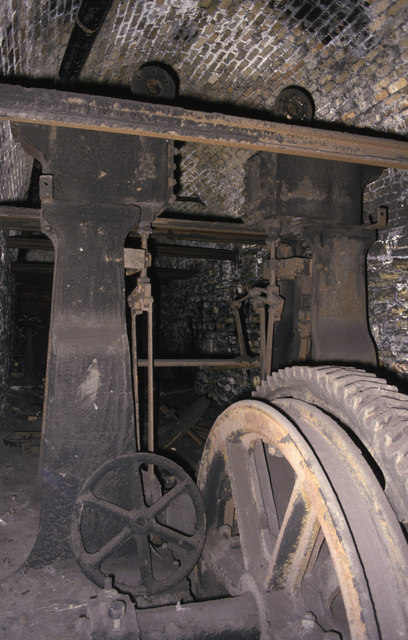
Haulage grew with the size of workings. While faces were close to the shaft, men and boys pushed or dragged the tubs themselves and horses did the rest. As takes extended a mile and more from the pit bottom, rope haulage driven by a stationary engine became the only practical answer, and the engine houses, drums and rope roads became a permanent part of the mine's layout. Whole grades of labour grew up around it: the haulage boy of thirteen to eighteen who clipped and unclipped tubs on the moving rope of a main road or pit bottom; the older lad working supplies in and empties out along the panel gates; the driver in charge of a pony. From the mid twentieth century the National Coal Board's reorganisation schemes replaced rope haulage on the main roads with trunk conveyor systems and battery locomotives, and the rope roads survived mainly for supplies and men.
How it worked
Three broad systems carried the work, and most collieries used all three at once on different roads.
Horse and pony haulage worked the branch roads and the gate ends, where the loads were small and the routes changed as the faces advanced. A driver took a set of tubs from the face to the landing and brought the empties back.
Self-acting or gravity haulage needed no power at all. On a jig brow — an inclined track — the weight of the full tubs running down lowered them and drew the empties up on the same rope over a drum at the top.
Engine haulage took the main roads. In the main and tail system two drums on one engine worked two ropes: the main rope pulled the loaded set one way and the tail rope pulled the empties back, so the set travelled out and in on the same single track. On a steep grade the same arrangement could be worked by the descending fulls alone. In endless haulage a single rope ran continuously in one direction around a driving wheel and back, carried on rollers set in the floor or hung from the roof, and tubs were clipped to it in gangs as they came up and unclipped at the far end; an earlier version used an endless chain instead of a rope. Because the rope never stopped, an endless road could take a steady stream of traffic where a main and tail road had to wait for each set to complete its journey.
Why it was used
A shaft can only wind what the roadways bring to it. Rope haulage let a colliery work ground far beyond the reach of horses, at a speed and in quantities a horse road could not match, using one engine on the surface or at the pit bottom rather than power at every point of the system. Self-acting inclines went further still and worked for nothing, using the weight of the coal itself.
Risks & limitations
Haulage roads were among the most dangerous places in a mine, and the colliery fatality lists are full of men and boys crushed between tubs, run over by runaway sets, struck by a broken rope or caught by a coupling that parted on a brow. The hazards were structural: a moving rope in a low roadway that men had to walk beside, sets travelling faster than a man could get out of their way, and manholes set too far apart to reach. Ropes stretched and frayed, clips slipped, and a set that broke away on an incline ran until it hit something. Rope haulage also fixed a mine's layout in place: the roads had to be kept straight, graded and open, and moving a haulage engine was a major undertaking.
Regional variation
The vocabulary is strongly regional. A set of tubs coupled together is a race or rake in Scotland, a journey in South Wales and the north east, and a gang or a set elsewhere; the vehicles themselves are hutches in Scotland, tubs or trams in England and drams in South Wales. An inclined haulage road is a brae in Scotland and a brow or a jig in England. The systems themselves were general across the coalfields.
Mines associated with this term
5 examples chosen from 105 linked records — the term page is not an index.
- Abercynon Colliery — Rhondda Cynon Taf (well documented example)
Named in this record’s history: “…9 September 1895 (see Disasters, below). Five more were killed in an underground haulage accident on 28 April 1906. The pit passed to Guest, Keen and…” - Bank Hall Colliery — Lancashire (well documented example)
Named twice in this record, first in the history: “…colliery over on 1 January 1947 and invested substantially, making haulage roads for battery locomotives hauling five-ton mine cars and…” - Calverton Colliery — Nottinghamshire (well documented example)
Named in this record’s workings: “…on to the High Hazles, served by locomotive, rope and trapped-rail haulage and manriding conveyors. A coal preparation plant of 450 tons an…” - De Lank Quarries — Cornwall (well documented example)
Named in this record’s workings: “…open granite quarry taking dimension stone in large blocks. Internal haulage was by a 2 ft gauge line to the head of a rope-worked incline, which…” - Eastern United Colliery — Forest of Dean (well documented example)
Named twice in this record, first in the history: “…for travelling, and a south dipple ten feet by seven for the main haulage, worked by endless rope, about twenty-five yards apart. They struck…”
Disasters associated with this term
5 examples chosen from 26 linked records, most direct relationship first.
- Exhall Colliery fire (contextual relationship)
Named 3 times in this record, first in the summary: “An oiler at Exhall set his paraffin torch down on a beam beside the haulage wheels at the top of the downcast shaft, and it fell five feet into…” - Felinfran Colliery Explosion, 1947 (contextual relationship)
Named 3 times in this record, first in the summary: “…in breathing apparatus to help bring out the injured along a damaged haulage road.” - Felling Colliery explosion, 1847 (contextual relationship)
Named 3 times in this record, first in the summary: “…injuries, and eighteen horses. It began not in the coal but at an underground haulage engine, whose fire had been banked with the damper shut so that it…” - Garswood Hall No. 9 Colliery explosion, 1932 (contextual relationship)
Named in this record’s investigation: “…ventilation, shotfiring, stonedusting, lighting, searching and haulage, the story of the explosion, the rescue operations, the…” - Glencraig Colliery Haulage Accident 1933 (contextual relationship)
Named 3 times in this record, first in the summary: “A Glencraig repairer named English was crushed to death by a rake of haulage hutches in 1933 while trying to escape unexpectedly restarted…”
Sources
- (primary) Glossary of Mining and Geordie Words — Durham Mining Museum
- (primary) Glossary of Scotch Mining Terms — James Barrowman (1886), via Scottish Mining Website
- (secondary) Pit Terminology — Healey Hero
Record created: 29 September 2026 · Last researched: 29 September 2026