 MineArchive
Bank Hall Colliery
| Location | Burnley, near the Leeds and Liverpool Canal, Lancashire — 53.7980, -2.2350 (exact) |
|---|---|
| Commodity | Coal |
| Type | Coal |
| Worked | 1869–17 April 1971 |
| Maximum depth | 1,500 feet (about 457 m) at No. 4 shaft, the deepest in the Burnley coalfield. |
| Operators | Executors of John Hargreaves (1865–1947), National Coal Board (1947–1971) |
Overview
Burnley's largest and deepest pit, sunk on the Hargreaves family's Bank Hall estate between 1865 and 1869 and worked for more than a century. Its fourth shaft, at 1,500 feet, was the deepest in the Burnley coalfield. It closed in 1971 for an unusually specific reason: the Union mine was gassy, and the mechanised cutter picks kept striking iron pyrites nodules in coal balls and sparking ignitions of firedamp.
History
The Reverend John Hargreaves had bought the Bank Hall estate — previously Bank Top — by 1796, having entered the local coal industry through marriage in 1755, and in 1797 acquired the leaseholds for most of the mineral rights in the area. After his death the company traded as 'The Executors of John Hargreaves'. His nephew Colonel John Hargreaves carried it on to his own death in 1834; his son having died young, the property was divided between two daughters. The younger, Charlotte Anne, married General Sir James Yorke Scarlett, a hero of Balaclava, but they had no children; the elder, Eleanor Mary, married the Reverend William Thursby, and so the company passed to the Thursby family.
The first shafts were sunk to the Arley mine at 287 yards by the Executors of John Hargreaves between 1865 and 1869, and that four-foot seam was worked until 1925. The King mine was worked from 1905 to 1925 and the Dandy, or Upper Arley, from 1910 to 1935; No. 3 shaft was sunk to the Dandy in 1903 and became known as the Dandy Pit. No. 4 shaft went down to the Union mine — formed by the merger of the Upper Foot and the true Lower Mountain mines — which came into production in 1915 and became the pit's principal source of coal. At 1,500 feet, No. 4 was the deepest shaft in the coalfield.
The winding plant was substantial: a twin horizontal engine with 26-inch cylinders built by Worsley Mesnes Ironworks of Wigan for No. 1 shaft in 1912, its 18-foot drum able to wind 1,554 feet; a cross-compound horizontal engine by Yates & Thom of Blackburn for No. 4 in 1914, with 38-inch and 60-inch cylinders and a 19-foot drum winding to 1,464 feet; and a steam fan engine from Walker Brothers of Wigan.
The National Coal Board took the colliery over on 1 January 1947 and invested substantially, making haulage roads for battery locomotives hauling five-ton mine cars and modernising the pit bottom at No. 4 shaft.
Geology
The colliery worked the Burnley coalfield, taking in turn the Arley mine at 287 yards — a seam four feet thick — then the King, the Dandy or Upper Arley, and finally the Union, itself formed by the merger of the Upper Foot and true Lower Mountain mines. It was a peculiarity of the Union measures that finished the pit: they were gassy, and the coal carried coal balls containing nodules of iron pyrites, which struck sparks when mechanised cutter picks hit them.
Geological setting: Sedimentary Beds and Seams (well documented example)
Workings
Four shafts, the first pair sunk 1865–69 to the Arley mine at 287 yards, No. 3 to the Dandy in 1903 and No. 4 to the Union at 1,500 feet — the deepest in the Burnley coalfield. Winding was by large horizontal steam engines from Worsley Mesnes (1912) and Yates & Thom (1914), with a Walker Brothers steam fan engine for ventilation. Under the NCB the haulage roads were rebuilt for battery locomotives pulling five-ton mine cars.
Closure
The Union mine proved gassy, and ignitions of firedamp were caused by sparks made when mechanised cutter picks struck coal balls containing nodules of iron pyrites. The National Coal Board stopped the last coal face working in January 1971 and closed the pit on 17 April; salvage was completed and the site cleared in 1972.
What remains
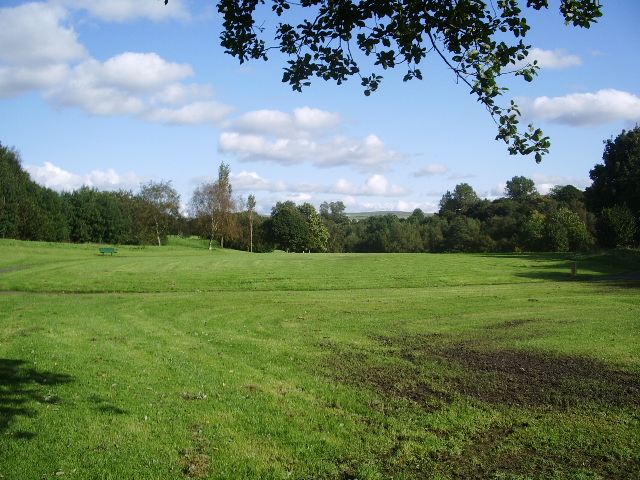
Nothing of the colliery survives; demolition of the surface buildings began in 1971 and the site was cleared by 1972. The ground is now grassed and forms part of Brun Valley Forest Park, with a monument in Bank Hall Park. A memorial opened in 1990 commemorates all of Burnley's coal mines. The wider Bank Hall estate grounds on the River Brun make up part of Thompson Park, and Queen's Park south-east of the mine was given to Burnley Corporation by Sir John Hardy Thursby in 1888 as the town's first public park.
None of the colliery itself; a monument stands in Bank Hall Park and a 1990 memorial commemorates all Burnley's pits.
Redevelopment
The site is now grassed parkland within Brun Valley Forest Park.
Related mines
- Gannow Colliery — Both Hargreaves executors' pits in Burnley; Bank Hall was the firm's largest.
- Reedley Colliery — Linked underground before 1893; Reedley's coal went to the Bank Hall washery.
Nearby mines
- Reedley Colliery — 0.8 miles (1.2 km) NW
- Towneley Colliery — 1.7 miles (2.7 km) S
- Gannow Colliery — 1.8 miles (2.9 km) W
- Salterford Drift Mine — 2.1 miles (3.3 km) SE
- Habergham Colliery — 2.3 miles (3.8 km) W
Straight-line distance, within 9 miles (15 km). Show on the map.
Recorded claims
Individual factual claims, each attached to the source(s) that support it below. Where sources disagree, both are kept.
- The Reverend John Hargreaves had bought the Bank Hall estate by 1796 and in 1797 acquired the leaseholds for most of the mineral rights in the area; the business later passed by marriage to the Thursby family. 1
- The first shafts were sunk to the Arley mine at 287 yards between 1865 and 1869; the four-foot seam was worked until 1925. 1
- No. 4 shaft, sunk to the Union mine, was 1,500 feet deep — the deepest in the Burnley coalfield. 1
- Worsley Mesnes Ironworks of Wigan built a twin horizontal winding engine with 26-inch cylinders for No. 1 shaft in 1912, and Yates & Thom of Blackburn a cross-compound horizontal engine for No. 4 in 1914 with 38-inch and 60-inch cylinders and a 19-foot drum. 1
- The Union mine was gassy and ignitions of firedamp were caused by sparks made when mechanised cutter picks struck coal balls containing nodules of iron pyrites; the NCB stopped the last face in January 1971 and closed the pit on 17 April. 1
- Salvage was completed and the site cleared in 1972; the ground now forms part of Brun Valley Forest Park, and a memorial opened in 1990 commemorates all of Burnley's coal mines. 1
Photographs & further reading
The colliery seam by seam and shaft by shaft, with the Hargreaves and Thursby family history behind it and the pyrites problem that ended it.
View sourceSources
- (secondary) Bank Hall Colliery — Wikipedia
- (observational) Bank Hall — Buddlepit Mine Database
Record created: 3 September 2026 · Last researched: 3 September 2026