 MineArchive
Eston Ironstone Mines
| Also known as | Eston Mines, Eston Ironstone Mine, Upsall Pit, Chaloner Pit |
|---|---|
| Location | Eston, near Middlesbrough, North Yorkshire — 54.5592, -1.1246 (approximate) |
| Commodity | Iron |
| Type | Ironstone |
| Worked | From August 1850–September 1949 |
| Maximum depth | Upsall shafts 556 ft (about 170 m); the drifts were driven level into the hillside |
| Operators | Bolckow, Vaughan and Company (1850–1929), Dorman, Long and Company (1929–1949) |
Overview
In June 1850 the mining engineer John Marley and the Middlesbrough ironmaster John Vaughan found an outcrop of ironstone in the Eston Hills, on the south side of the Tees. Trial quarrying began that August; within five years half a million tons a year were coming out, and over the next ninety-nine years the Eston mines produced something like 63 million tons — the most prolific of all the Cleveland ironstone mines, and for a time the largest ironstone mine in the world. Middlesbrough grew from a village to an iron town on the back of it. The last drift closed in September 1949.
History
Bolckow and Vaughan already had ironworks at Middlesbrough and were buying their ore from Whitby and further afield when Vaughan and Marley, walking the Eston Hills, came upon the ironstone outcrop in June 1850. Trial quarrying near Eston followed in August. The Upsall pit opened in 1851 and was the first Cleveland mine to be worked on a really large scale.
The workings began as drifts driven straight into the northern escarpment and spread from there. Three drifts on the Eston Hills were linked by gravity-worked tramways that all converged at a point which the miners named California — an ironic nod to the American gold rush of the year before — and a shanty settlement of that name grew up to house them. By the 1870s the workings had been driven right through the hills to connect underground with the Upsall and Chaloner pits on the south side, making one enormous mine of what had started as separate ventures.
Bolckow, Vaughan and Company held Eston until 1929, when Dorman, Long and Company took over on 1 November. Employment tells the story of the decline plainly: 1,610 in 1883, 1,087 by 1900, 703 in 1925, 295 in 1935 when working was discontinued in October of that year, and 86 in 1950, the year after abandonment. Cleveland ore was lean — around 30 per cent iron — and once imported high-grade ore could be landed cheaply on the Tees there was no case for digging it.
Geology
The Cleveland ironstone is a bedded marine deposit in the Lower Jurassic, laid down as ooliths and shelly debris rich in iron carbonate in a shallow sea, and later hardened into a workable stone. It occurs in several seams, of which the Cleveland Main — the "Main" or "Thick" seam — was by far the most important and was the one Eston worked to the end. Because the beds dip gently and outcrop along the escarpment of the hills, they could be reached by driving level drifts straight in from the hillside rather than by sinking, which is why Cleveland ironstone mining looks so different from the shaft-and-cage coal mining a few miles north.
Geological setting: Sedimentary Beds and Seams (well documented example), Sedimentary Ironstones (well documented example)
Workings
The mine was worked by pillar and stall, leaving squared blocks of ironstone standing to hold the roof while the rest was taken out. Haulage was by rope, worked by stationary steam engines, and the tramways from the drift mouths ran down by gravity. Ventilation was by Guibal fan; one installed in 1869 was 37 feet in diameter, and the fan house that survives on the hill — known locally as the SS Castle, for the S-shaped steel ties in its walls — is the most conspicuous thing left of the whole undertaking.
At Upsall there were two shafts 556 feet deep, one serving as upcast and the other for pumping and winding men; both Upsall and Chaloner were otherwise worked by adits. Water was a constant problem, handled at Upsall by two three-stage turbine pumps at the pit bottom, each capable of 1,000 gallons a minute against a 300-foot head through a 14-inch rising main. Plans of the Cleveland ironstone workings, including a 1:10,000 sheet of the northern area with an accompanying report, are catalogued at the British Geological Survey.
Closure
Working was discontinued in October 1935 and the labour force fell to under 300. The mine worked on at a reduced scale through the war, and the Cleveland Main seam was abandoned in September 1949 — the last Eston drift, and effectively the end of ironstone mining on this side of the Cleveland field. Eighty-six people were still on the books in 1950, winding the operation up.
What remains
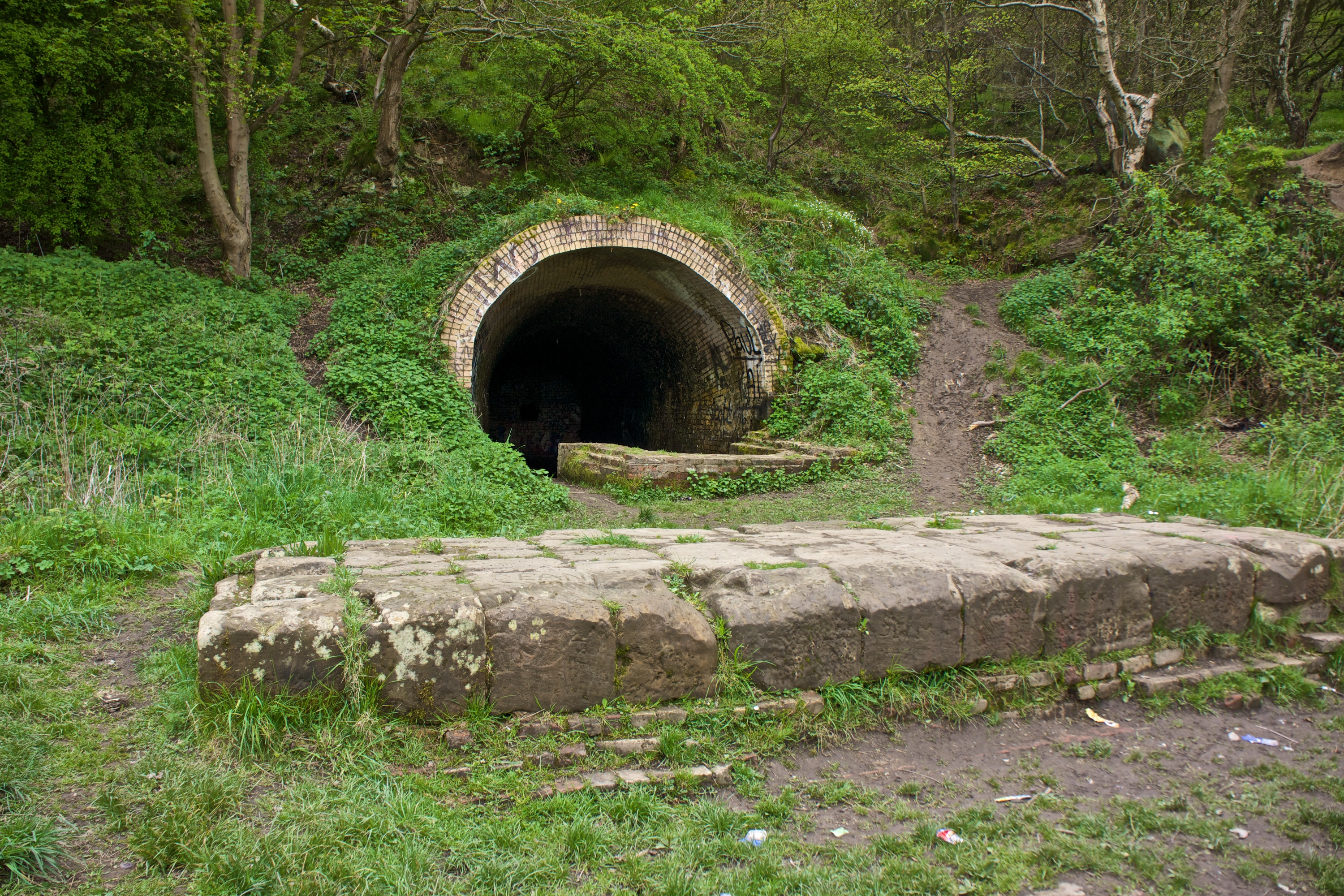
The site is unenclosed hillside above Teesside, crossed by footpaths and easily walked past without noticing. The Cleveland Mining Heritage Society describes it as overgrown and easily overlooked, and suffering from vandalism and neglect. A June 2024 visit report found the mine entrance it reached thoroughly blocked up, and the Grade II listed fan house standing but heavily graffitied and worn from use as a drinking spot.
More survives than the casual walker realises. The Guibal fan house of about 1871 — the SS Castle — still stands, Grade II listed and in private ownership. There are the foundations of the 1851 engine house, modified between the 1880s and 1910; the foundations of the rope haulage engine at the New Incline; concrete structures from the haulage system; a railway bridge dated 1871; and the access steps and boiler settings. New Bank Drift and Old Bank Drift can still be made out on the escarpment, and Trustee Drifts lie to the west.
Related mines
- Chaloner Ironstone Mine — Chaloner was worked as one of Bolckow Vaughan's Eston mines: its employment was returned with Eston's, and from 1915 its stone crossed the hill by narrow-gauge railway to Eston's New Bank incline and screens.
- Upleatham Ironstone Mine — Upleatham was opened soon after, and in consequence of, the discovery of ironstone on the Eston hills, and worked the same Main seam.
Nearby mines
- Chaloner Ironstone Mine — 2.4 miles (3.8 km) E
- Kirkleatham Ironstone Mine — 2.5 miles (4.0 km) E
- Upleatham Ironstone Mine — 3.8 miles (6.1 km) E
- Waterfall Mine — 3.8 miles (6.1 km) E
- Belmont Mine — 4.0 miles (6.4 km) SE
Straight-line distance, within 9 miles (15 km). Show on the map.
Disasters & major incidents
-
Eston Ironstone Mines roof fall, 1897
27 August 1897 · Collapse / Roof Fall · 2 fatalities
Two ironstone miners at Eston were killed on 27 August 1897 by a large fall of roof as they brought down stone loosened by a shot.
Recorded claims
Individual factual claims, each attached to the source(s) that support it below. Where sources disagree, both are kept.
- John Marley and John Vaughan found the ironstone outcrop in the Eston Hills in June 1850; trial quarrying near Eston began that August. 1,2
- The Eston mines produced around 63 million tons of ironstone over ninety-nine years, the largest output of any mine in the Cleveland field. 2
- Employment fell from 1,610 in 1883 to 1,087 in 1900, 703 in 1925, 295 in 1935 and 86 in 1950. 1
- Upsall had two shafts 556 feet deep, one upcast and the other for pumping and winding men, with two three-stage turbine pumps at the pit bottom each delivering 1,000 gallons a minute against a 300-foot head. 1
- The Cleveland Main seam was abandoned in September 1949; working had been discontinued in October 1935 and only resumed at reduced scale. 1
- Ventilation was by Guibal fan, one of them installed in 1869 and 37 feet in diameter. 2
- A visit report of 25 June 2024 found the Grade II listed fan house standing but heavily graffitied, and the mine entrance reached thoroughly blocked up. 3
- Plans of the Cleveland ironstone workings, including a 1:10,000 sheet of the northern area with a report held in the library, are catalogued at BGS Keyworth as KP11978. 4
Sources
- (primary) Durham Mining Museum: Eston (Ironstone) — Durham Mining Museum
- (secondary) Cleveland Mining Heritage Society: Eston — Cleveland Mining Heritage Society
- (observational) Eston Fan House / SS Castle / Eston Mines, Cleveland Hills — 25 June 2024 — 28DaysLater Urban Exploring Forums
- (primary) BGS mine plans catalogue: CLEVELAND IRONSTONE MINES — British Geological Survey
Record created: 26 August 2026 · Last researched: 26 August 2026