 MineArchive
Sedimentary Ironstones
| Also known as | Bedded Ironstones, Oolitic Ironstones |
|---|---|
| Category | Deposit Types |
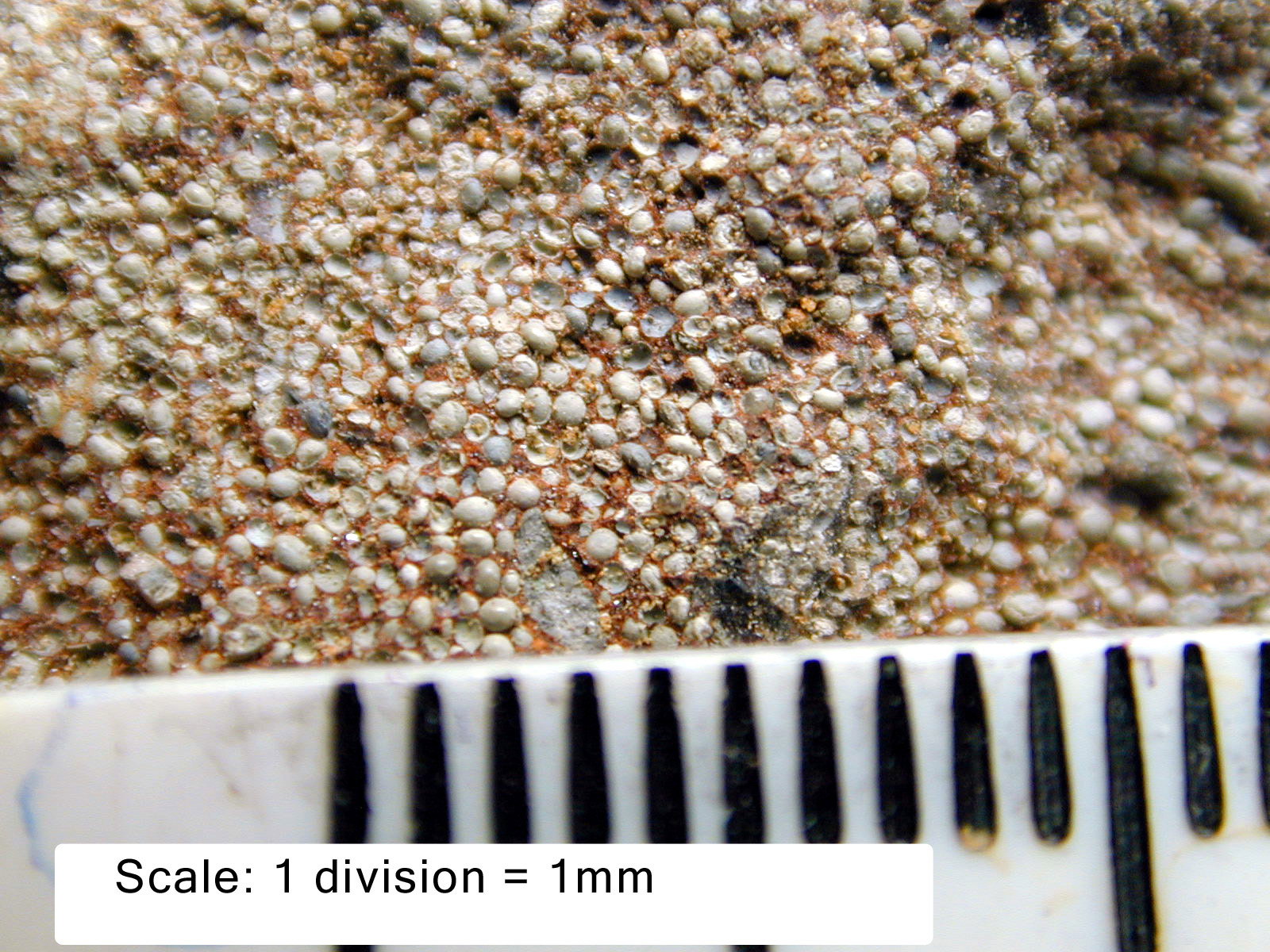
Sedimentary ironstones are iron ores laid down as sediment: iron-rich beds and bands of nodules lying within an ordinary sequence of shales, sandstones or coal seams. Britain worked two kinds. The oolitic ironstones of the Jurassic, among them the Cleveland ironstone and the Northampton Sand, formed on the floors of shallow seas. The clayband and blackband ironstones of the Coal Measures formed in and around the coal swamps. Most are low in iron, but the beds are extensive, and historically most British iron came from them.
How it forms
Oolitic ironstones are beds rich in iron silicate, carbonate and oxide minerals, built of small rounded grains called ooids. They were deposited in shallow water close to shore, typically at the top of a cycle in which mud gives way upward to silt and sand as the sea shallowed. The Cleveland Ironstone Formation was laid down over about two million years, some 185 to 183 million years ago, on the floor of a shallow arm of the Tethys Ocean, as five such cycles each capped by a seam of ironstone; its iron minerals are siderite and berthierine. The sea held no more iron when the ironstones formed than when the shales did. What changed was the supply of mud: when it slackened, the same iron was concentrated in less sediment. Coal Measures ironstones formed differently. Clayband ironstone is a mixture of clay and siderite; blackband ironstone has coaly matter besides. Blackbands are interpreted as fossil bog iron ores, the iron precipitated in the surface waters of the peat swamp and turned to siderite in the carbon-rich mud just beneath.
Why minerals concentrate here
Position in the sequence is the first control: three-quarters of oolitic ironstone deposits sit at the top of a shallowing cycle. The second, for the early miner, was weathering. Near the surface the carbonate is removed and the iron silicates turn to iron oxides, so that the Northampton ironstone, greenish-grey when fresh, weathers to a brown limonitic stone. Many older workings took only this weathered ore and went less than thirty metres in from the outcrop.
Typical shape of the deposit
Thin, flat and wide. A typical oolitic ironstone is a sheet 2 to 5 metres thick and 2 to 10 kilometres across. Near Eston, on the northern edge of the Cleveland field, the Main Seam is 3.66 metres thick and rests directly on the 1.23-metre Pecten Seam; southward, shale partings come in and thicken at the expense of the ore, and the formation as a whole is about 70 per cent shale to 30 per cent ironstone. Coal Measures ironstones are thinner still. Blackbands are about 75 centimetres thick, and in Ayrshire the ironstones lie either as continuous beds up to half a metre thick or as nodules in the mudstone.
What this means for mining
Bedded ironstone was mined like coal, not like a metal lode. The Cleveland ore carried up to 33 per cent iron and paid only above about 27, so it had to be won in bulk: the Eston workings began at the surface in 1850, followed the seam into the hill by drifts and ended as deep mines, and most Main Seam mines worked by pillar and bord. Where the bed lies shallow, as the Northampton Sand does around Corby, it was quarried opencast. Coal Measures ironstones were raised at collieries along with the coal, and blackband carried enough carbon to calcine itself. Oolitic ironstones were an important source of iron from 1850 to 1945 and then gave way to the banded iron formations of the Precambrian.
Associated commodities
Iron (Historically most British iron came from bedded ironstones.), Ironstone (Bedded Jurassic and Coal Measures ironstones.)
Related geology
Iron Replacement Deposits, Sedimentary Beds and Seams
Related Mining Terms & Methods
Blackband Ironstone (The carbonaceous Coal Measures ironstone that calcines itself.), Ironstone (The rock itself, as a mining term.), Opencast Working (Shallow beds such as the Northampton Sand ironstone were quarried opencast.), Room and Pillar (Most Cleveland Main Seam mines worked the ironstone by pillar and bord.)
Images
MineArchive examples
Included only where MineArchive's own research gives a reasonable evidential basis — not every mine where this geology might plausibly apply. Showing the 10 strongest examples of 19 linked mines.
- Eston Ironstone Mines — North Yorkshire (well documented example)
Worked the Cleveland ironstone, a bedded marine deposit of ooliths and shelly debris rich in iron carbonate, chiefly in the Main Seam. - Carnbroe Colliery — North Lanarkshire (well documented example)
Worked the Airdrie Blackband Ironstone at 98 fathoms along with the Splint Coal. - Claxby Ironstone Mine — Lincolnshire (well documented example)
The ore is made up of small oolitic grains and yields between 28 and 33 per cent iron. - Corby Ironstone Quarries — Northamptonshire (well documented example)
A shallow, laterally extensive bed worked by opencast quarrying over a very large area. - Frodingham Ironstone Mines — Lincolnshire (well documented example)
The Frodingham Ironstone of the Lower Lias averages about 25 per cent iron and was worked because it lay shallow and in bulk. - Grosmont Ironstone Mines — North Yorkshire (well documented example)
Worked the Pecten seam of the Cleveland ironstone, exposed by a railway cutting in 1836. - Irthlingborough Ironstone Mine — Northamptonshire (well documented example)
Worked the Northampton Sand Ironstone, a Middle Jurassic bed of ooidal ironstone. - Blairhall Colliery — Fife (historical documentary reference)
Begun in the 1870s for blackband ironstone as much as for coal. - Boothen Colliery — Staffordshire (historical documentary reference)
Coal seams alternate with the blackband and clayband ironstones that fed the Shelton furnaces. - Fauldhouse Colliery — West Lothian (historical documentary reference)
Thin coals are interleaved with clayband and blackband ironstones.
See all 19 linked mines.
Sources
- (primary) Descriptive model of oolitic ironstones (Bulletin 2004) — U.S. Geological Survey
- (primary) Geology of the Irvine district: memoir for 1:50 000 geological sheet 22W and part of sheet 21E (Scotland) — British Geological Survey
- (secondary) Cleveland Ironstone Formation — Wikipedia
- (secondary) Ironstone — Wikipedia
- (secondary) Ironstone mining in Cleveland and North Yorkshire — Wikipedia
- (secondary) Northampton Sand Formation — Wikipedia
- (secondary) The genesis of coal measure blackband ironstones (PhD thesis, 1981) — Aston University
Record created: 1 October 2026 · Last researched: 1 October 2026