 MineArchive
Blairhall Colliery
| Also known as | Lord Bruce Pit, Lady Veronica Pit |
|---|---|
| Location | East Grange, near Culross, west Fife — 56.0786, -3.6008 (exact) |
| Commodities | Coal, Ironstone |
| Type | Coal |
| Worked | 1870s–May 1969 |
| Maximum depth | Unknown. The 1873 No. 3 pit had downcast and upcast shafts of 216 feet. |
| Operators | Carron Company (1870–1880), Lochgelly Iron Company (1880–?), Coltness Iron Company (1897–1947), National Coal Board (1947–1969) |
Overview
A west Fife colliery north of Valleyfield, begun in the 1870s by the Carron Company for blackband ironstone as much as for coal, and passed through the Lochgelly and Coltness iron companies before nationalisation. Its early shallow pits were replaced from 1906 by two deep shafts, the Lord Bruce and the Lady Veronica, sunk against water coming in at 201 gallons a minute; the new pit opened in 1911. It employed over a thousand at its height and closed in May 1969.
History
Blairhall began as an ironstone concern. The early pits were sunk in the 1870s by the Carron Company, which worked them for about seven or eight years and then sold them to the Lochgelly Iron Company, who in turn sold them to the Coltness Iron Company; in the early days the colliery worked ironstone as well as coal, and the returns for 1902 still list "manufacturing and steam coals, and ironstone". The No. 3 pit, newly sunk in 1873 under the manager James Clelland, had downcast and upcast shafts of 216 feet, and employed 40 underground and 6 on the surface the following year. The shallow pits were replaced at the turn of the century by two new, deeper shafts, sunk in 1906 and named the Lord Bruce and the Lady Veronica. Sinking them was severely hampered by water — 201 gallons a minute — requiring large pumps to hold it back. The new part of the pit opened in 1911. Under Coltness in 1902 the colliery employed 210 underground and 48 above; the workforce eventually reached 1,058. Blairhall passed to the National Coal Board in 1947, and through the 1950s worked the Main, Jersey and Five Feet seams for coking, gas, household and steam coals, employing 724 underground and 251 on the surface in 1951 and 920 and 141 in 1957. A modernisation was planned around locomotive haulage and mine cars, with all the necessary surface and underground work scheduled for completion by July 1956, and a virgin area of coal about two miles west of the shaft to be opened by long stone mines, worked by diesel locomotives on the level and balanced rope haulage from the dip, for an ultimate output of about 2,000 tons a day. Some of it slipped: the mechanisation schemes proposed for Valleyfield and Blairhall failed to materialise in one year because of very extended delivery periods from the manufacturers. The colliery closed in May 1969.
Geology
The west Fife coalfield around Culross, where coal and blackband ironstone occur together — which is why three ironmasters in succession owned this colliery. The nineteenth-century workings were shallow and much disturbed by faulting: an account of the early pits describes a dyke struck a short way into the south level throwing the coal down three and a half fathoms, lying south-east to north-west so that a practised eye could see it would have to be cut twice before a pit-bottom stoop could be formed and the ventilation properly regulated. Under the National Coal Board the colliery worked the Main, Jersey and Five Feet seams.
Geological setting: Sedimentary Ironstones (historical documentary reference)
Workings
Shallow pits from the 1870s worked on the long-wall system, with a north level driven through from the ironstone pit which relieved the coal pit of water. From 1906 two deep shafts, the Lord Bruce (downcast, and used for pumping) and the Lady Veronica (upcast), both winding men and coal, sunk against an inflow of 201 gallons a minute. The National Coal Board’s post-war scheme was for locomotive haulage and mine cars, with the cars controlled at the shaft mouth, all of it due to be complete by July 1956; a virgin area two miles west of the shaft was to be reached by long stone mines, with diesel locomotives moving cars on the level and balanced rope haulage bringing coal up from the dip workings.
Closure
The colliery closed in May 1969, having worked in one form or another for close on a century — the last of it under a modernisation scheme intended to lift output to 2,000 tons a day.
What remains
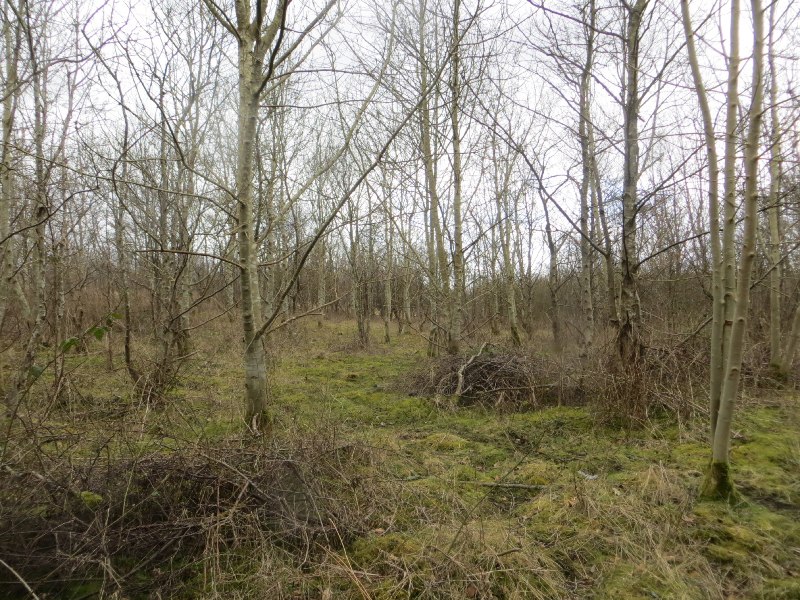
The colliery site at East Grange has been reclaimed and is largely woodland. Historic Environment Scotland holds photographs of the pithead and bings, and of a bing machine, taken before clearance.
No surviving colliery structure is recorded; the site is now woodland.
Related mines
- Comrie Colliery — Blairhall was in the NCB's Comrie Group under a group manager at Comrie from 1958, and the Jenny Pate boring of 1954 for Comrie's planned drift was two miles west of Blairhall.
- Duntilland Colliery — Coltness Iron Company collieries.
- Hassockrigg Colliery — Both worked by the Coltness Iron Company.
- Milnwood Colliery — Both were Coltness Iron Company pits, and men moved between them: Charles Russell left the management of Blairhall in 1897 to manage the company’s pits at Milnwood, Bellshill.
- Oakley Colliery — Both worked the Blairhall Main Coal and the blackband ironstone above it, the deposits that made the Oakley ironstone field Fife's principal source of iron.
- Overtown Colliery — Collieries of the Coltness Iron Company.
- Pirnhall Colliery — Both worked by the Carron Company.
- Valleyfield Colliery — Blairhall lay just north of Valleyfield, and the two were treated as a pair by the National Coal Board: the mechanisation schemes proposed for Valleyfield and Blairhall failed to materialise in the same year, for the same reason — extended delivery periods from the manufacturers.
Nearby mines
- Torry Mine — 1.0 miles (1.6 km) SE
- Valleyfield Colliery — 1.3 miles (2.1 km) S
- Comrie Colliery — 1.6 miles (2.5 km) N
- Preston Island Colliery — 1.7 miles (2.8 km) S
- Castlehill Mine — 1.9 miles (3.1 km) NW
Straight-line distance, within 9 miles (15 km). Show on the map.
Recorded claims
Individual factual claims, each attached to the source(s) that support it below. Where sources disagree, both are kept.
- The various pits of Blairhall Colliery had four owners in its lifetime. The early pits were sunk in the 1870s by the Carron Iron Company, who worked them for about seven or eight years then sold them to the Lochgelly Iron Company, who in turn sold them to the Coltness Iron Company; Blairhall was taken over by the National Coal Board in 1947. 1
- In the early days the colliery worked ironstone as well as coal, and the 1902 return under the Coltness Iron Company lists manufacturing and steam coals, and ironstone. 1
- No. 3 pit was newly sunk in 1873 under the manager James Clelland, with downcast and upcast shafts of 216 feet; in 1874 it employed 40 underground and 6 above ground. 1
- The early coal pits were replaced at the turn of the twentieth century by two new, deeper shafts sunk in 1906, the Lord Bruce and the Lady Veronica. Sinking the main shafts was severely hampered by water problems — 201 gallons a minute — requiring the use of large pumps to keep it at bay. The new part of the pit opened in 1911. 1
- Under the Coltness Iron Company in 1902 the colliery employed 210 underground and 48 above ground. The number of persons employed was eventually to reach 1,058. Under the National Coal Board it employed 724 underground and 251 on the surface in 1951, and 920 and 141 in 1957. 1
- Through the 1950s the colliery worked the Main, Jersey and Five Feet seams, producing coking, gas, household and steam coals. 1
- All surface and underground work necessary for the introduction of locomotive haulage and mine cars was scheduled to be completed by July 1956, and a virgin area of coal about two miles west of the shaft was to be developed with long stone mines driven to contact the seams, diesel locomotives moving coal in mine cars on the level and balanced rope haulage dealing with coal from the dip workings, for an ultimate output in the region of 2,000 tons daily. In one year the mechanisation schemes proposed for Valleyfield and Blairhall failed to materialise because of very extended delivery periods from the manufacturers. 1
- Blairhall Colliery finally closed in May 1969. 1
- Historic Environment Scotland records Blairhall Colliery at NT 0036 8846 in the parish of Culross, Fife, with photographs of the pithead and bings and of a bing machine. 2
Photographs & further reading
A very full compilation for this one colliery: the four owners, the 1906 shafts and the water that fought them, year-by-year managers, workforce and seams from 1873 to closure, the post-war mechanisation scheme, and decades of Dunfermline Press reports of accidents and wages disputes.
View sourceThe national monuments record: the site’s location and parish, and four photographs of the pithead, the bings and a bing machine taken before the ground was cleared.
View sourceSources
- (secondary) Blairhall Colliery, East Grange — Fife Pits & Pit Villages
- (primary) Blairhall Colliery (NRHE 131017) — Historic Environment Scotland, National Record of the Historic Environment
- (primary) BGS mine plans catalogue: Blairhall — British Geological Survey
Record created: 7 September 2026 · Last researched: 7 September 2026