 MineArchive
Valleyfield Colliery
| Also known as | Valleyfield (Newmills), Kinneil-Valleyfield |
|---|---|
| Location | Newmills, Culross, near Dunfermline, Fife — 56.0603, -3.5919 (approximate) |
| Commodity | Coal |
| Type | Coal |
| Worked | 1908–1978 |
| Operators | Fife Coal Company (1908–1947), National Coal Board (1947–1978) |
Overview
A Fife Coal Company pit on the north shore of the Forth, remembered for the explosion that killed 35 men in the second month of the Second World War — and, later, for being joined underground to a colliery in another county on the far side of the firth.
History
Two shafts were sunk at Valleyfield in about 1908, at Newmills in the parish of Culross, five miles west of Dunfermline. It became one of the fourteen collieries of the Fife Coal Company, the dominant coal owner in the county, and was raising some 850 tons a day. On the night of 28 October 1939 an explosion in Dodd's Heading in the Culross District killed 35 men and spread more than 1,500 yards through the workings — the disaster for which the pit is chiefly remembered. It passed to the National Coal Board on nationalisation in 1947. In 1965 the workings were driven through to meet those of Kinneil Colliery at Bo'ness, on the Lothian shore, and thereafter Valleyfield's coal travelled underground beneath the Firth of Forth to be processed on the other side. It worked on for another thirteen years before closing in 1978.
Geology
Valleyfield worked the Carboniferous coals of the Fife coalfield — part of the same sequence, running unbroken beneath the Firth of Forth, that made the undersea link with Kinneil possible. The 1939 inquiry's findings turn on two hazards inherent to these coals: firedamp released as the seam is cut, and coal dust lying in the roadways, which is what turned an ignition at one heading into an explosion that reached three-quarters of a mile away.
Geological setting: Sedimentary Beds and Seams (well documented example)
Workings
Two shafts from about 1908. From 1965 the colliery formed a single system with Kinneil, the two pitheads 5,700 m apart with a connecting roadway 15 ft by 10 ft running beneath the Firth of Forth, and coal from the Fife side wound and processed at Bo'ness.
Closure
Valleyfield closed in 1978, four years before Kinneil at the other end of the tunnel; the joint Valleyfield/Kinneil spoil heap was abandoned in 1979.
What remains
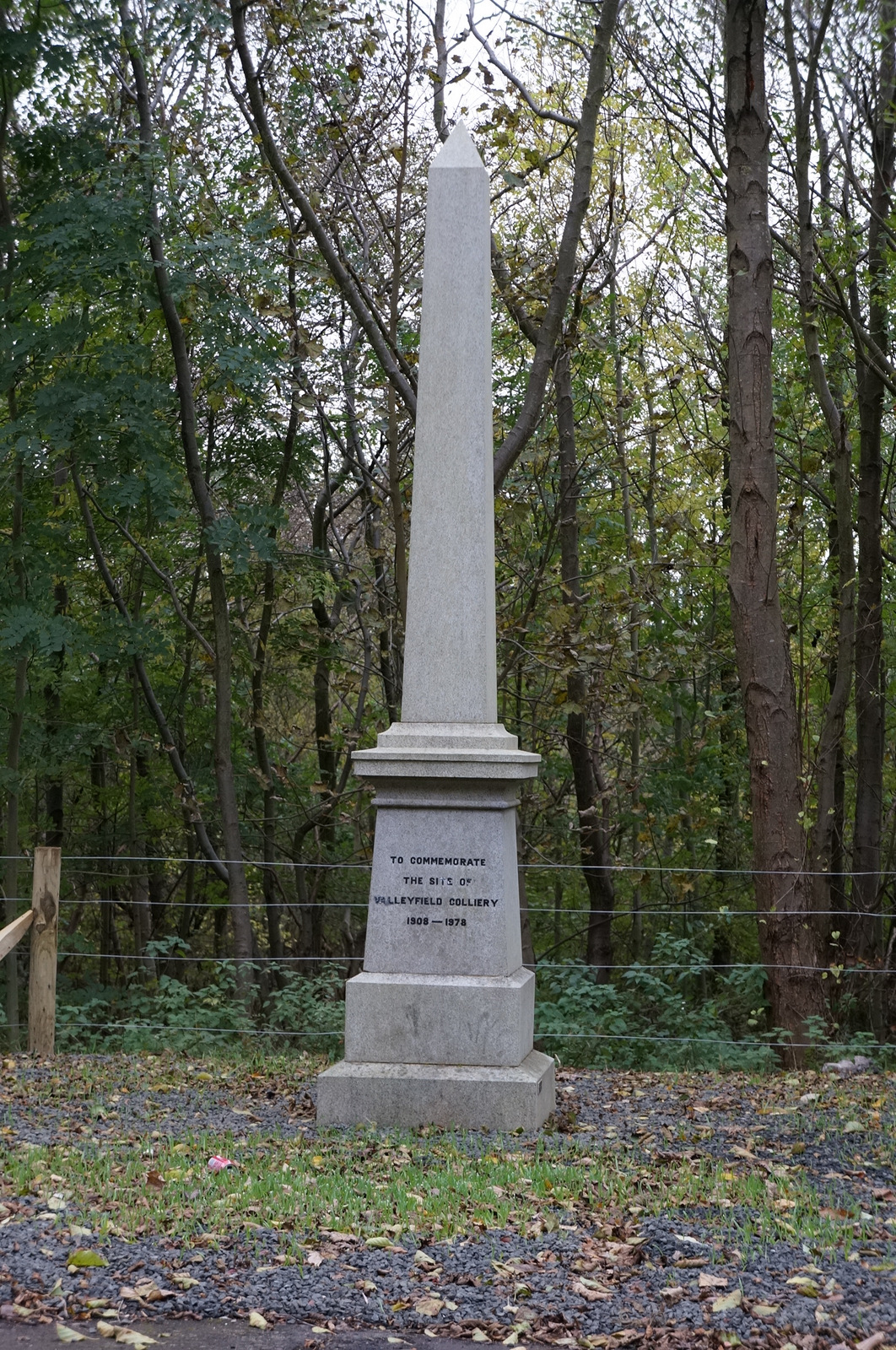
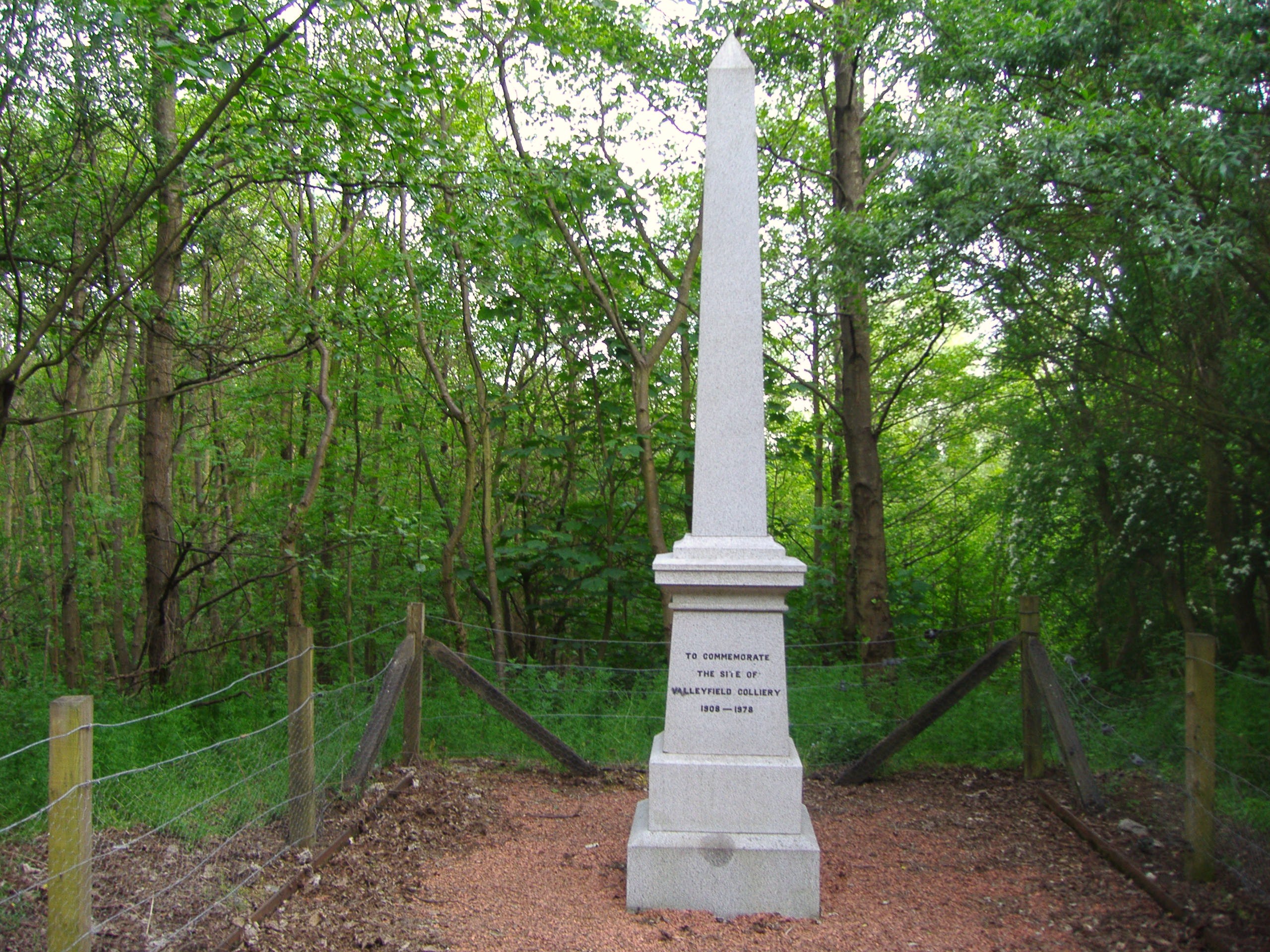
The colliery has gone entirely. The site at High Valleyfield carries a memorial to the pit and to the men killed there. A roadside memorial is all that marks the site, now overgrown by woodland within the Valleyfield ash lagoons ground.
Nothing of the working colliery; a memorial marks the site and commemorates Valleyfield Colliery 1908-1978.
Redevelopment
The ground has been cleared and returned to open and village use.
Related mines
- Blairhall Colliery — Blairhall lay just north of Valleyfield, and the two were treated as a pair by the National Coal Board: the mechanisation schemes proposed for Valleyfield and Blairhall failed to materialise in the same year, for the same reason — extended delivery periods from the manufacturers.
- Kinneil Colliery — Workings driven from opposite shores met beneath the Firth of Forth in 1965, joining the two collieries underground.
- Torry Mine — Torry's coal ran by tunnelled railway to Valleyfield for screening and washing.
Nearby mines
- Torry Mine — 0.4 miles (0.7 km) N
- Preston Island Colliery — 0.6 miles (0.9 km) SW
- Blairhall Colliery — 1.3 miles (2.1 km) N
- The Moat Pit — 1.6 miles (2.5 km) W
- Comrie Colliery — 2.6 miles (4.3 km) N
Straight-line distance, within 9 miles (15 km). Show on the map.
Disasters & major incidents
-
Valleyfield Colliery explosion, 1939
28 October 1939 · Explosion · 35 fatalities
An explosion in Dodd's Heading at Valleyfield Colliery on the night of 28 October 1939 killed 35 men and travelled more than 1,500 yards through the workings. The inquiry found it began as an ignition of firedamp during shot firing, and was carried by coal dust that should not have been there.
Recorded claims
Individual factual claims, each attached to the source(s) that support it below. Where sources disagree, both are kept.
- Two shafts were sunk at Valleyfield in about 1908, at Newmills in the parish of Culross, five miles west of Dunfermline. 1
- The colliery was one of fourteen owned by the Fife Coal Company. 1
- Output was around 850 tons a day. 1
- An explosion on the night of 28 October 1939, in Dodd's Heading in the Culross District, killed 35 men and spread more than 1,500 yards through the workings. 1
- In 1965 the workings were connected to Kinneil Colliery at Bo'ness by a roadway beneath the Firth of Forth, the two pitheads 5,700 m apart, and Valleyfield's coal was thereafter processed on the Lothian shore. 2
- Valleyfield closed in 1978, four years before Kinneil; the joint spoil heap was abandoned in 1979. 3,2
Photographs & further reading
The society that records and commemorates Fife's collieries and the men who worked them.
View sourceSources
- (primary) Valleyfield Colliery Explosion, Culross, 1939 — Northern Mine Research Society
- (secondary) Valleyfield / Kinneil mine workings — Scottish Cave and Mine Database
- (primary) Mine plans S2564, S2473, S2565, S3151 and others: Prestongrange — British Geological Survey / Mining Remediation Authority mine plans catalogue
- (secondary) The forgotten tunnel that crosses the River Forth — Scottish Field
Record created: 24 August 2026 · Last researched: 24 August 2026