 MineArchive
Valleyfield Colliery explosion, 1939
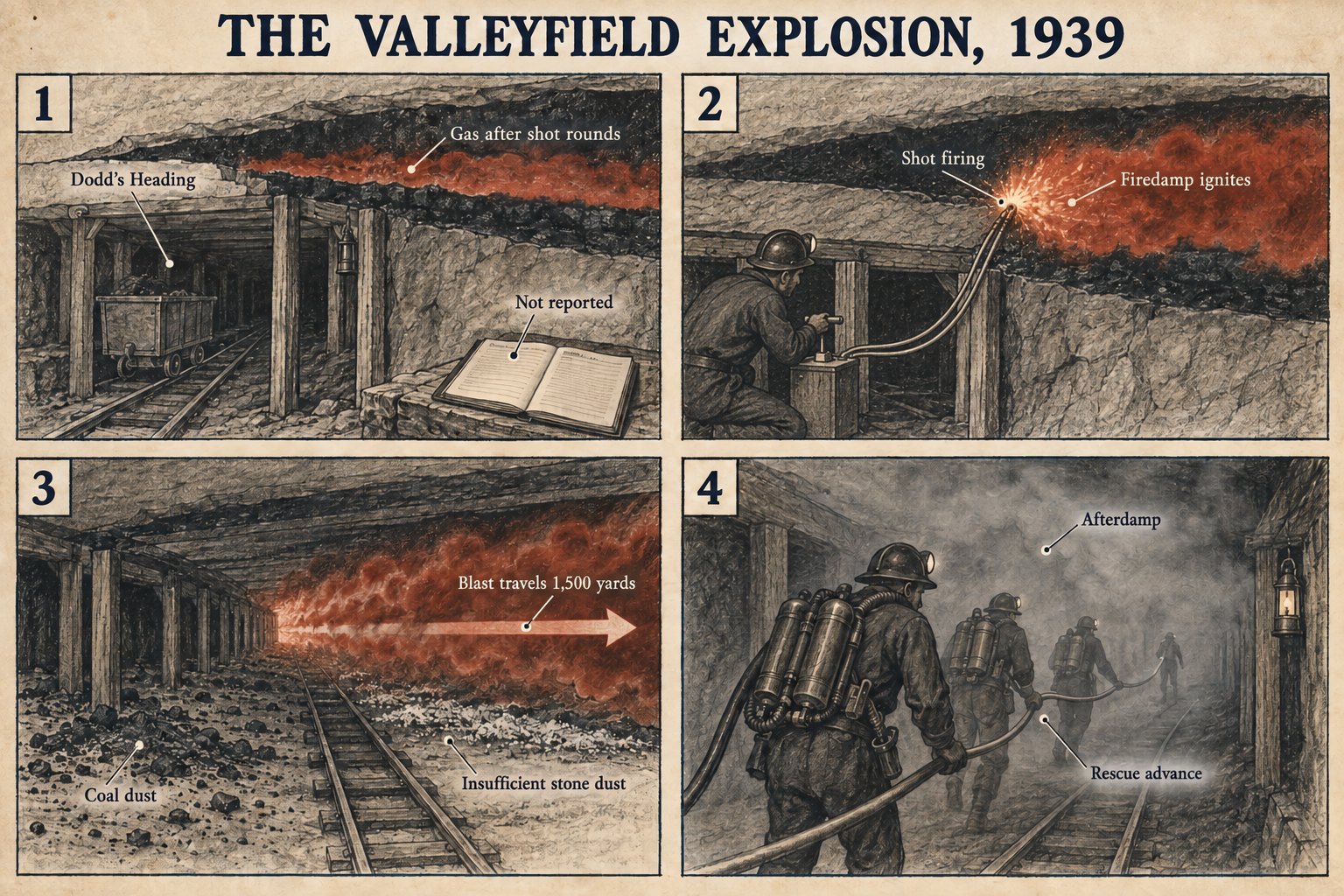
An explosion in Dodd's Heading at Valleyfield Colliery on the night of 28 October 1939 killed 35 men and travelled more than 1,500 yards through the workings. The inquiry found it began as an ignition of firedamp during shot firing, and was carried by coal dust that should not have been there.
| Date | 28 October 1939 |
|---|---|
| Mine | Valleyfield Colliery |
| Region | Fife |
| Primary type | Explosion |
| Associated types | Gas / Asphyxiation |
| Fatalities | 35 (Thirty-three men were killed outright and two more died later in hospital, 35 in all. A further 24 were affected by afterdamp.) |
| Injuries | Two men were seriously injured; 24 more were affected by afterdamp. |
| Context | During active mining (A night-shift explosion at a working colliery, six weeks into the Second World War.) |
Cause
The inquiry found the initial cause was an ignition of firedamp during the firing of a shot in the top coal.
Contributing factors
Coal dust had been allowed to accumulate in some roads, and stone dusting along the paths the explosion took was insufficient to stop it. The inquiry also found that gas had been discovered after almost every round of shots and had not been reported.
What happened
The explosion began during the night shift of 28 October 1939 in Dodd's Heading, in the Culross District of Valleyfield Colliery. It started as an ignition of firedamp while a shot was being fired in the top coal, and it did not stay where it started: coal dust lying in the roadways carried it outward for more than 1,500 yards, well beyond the district where it began. Thirty-three men were killed outright, two more died afterwards in hospital, and another twenty-four were affected by afterdamp. It was six weeks into the Second World War, at a pit raising 850 tons a day for a country that had just started needing every ton of it.
Rescue & recovery
Rescue work had to contend with afterdamp through workings the explosion had reached far from its seat, and two of the injured brought out died later in hospital.
Investigation & inquiry
A formal inquiry under R. P. Morison, K.C., with Sir Henry Walker, C.B.E., LL.D. as technical assessor, sat in Parliament House, Edinburgh from January to early March 1940 and reported on 2 August 1940. It concluded that the explosion began with firedamp ignited during shot firing, and was propagated by coal dust in roads where stone dusting had been inadequate. Its most pointed finding was that gas had been found after almost every round of shots and had not been reported — had it been, 'steps might have been taken which would have prevented the explosion'.
Changes to practice & legislation
The inquiry's findings bore on the two long-standing controls for exactly this chain of events: reporting gas found after shot firing, and stone dusting roadways so that an ignition cannot be carried onward by coal dust.
Memorials & commemoration
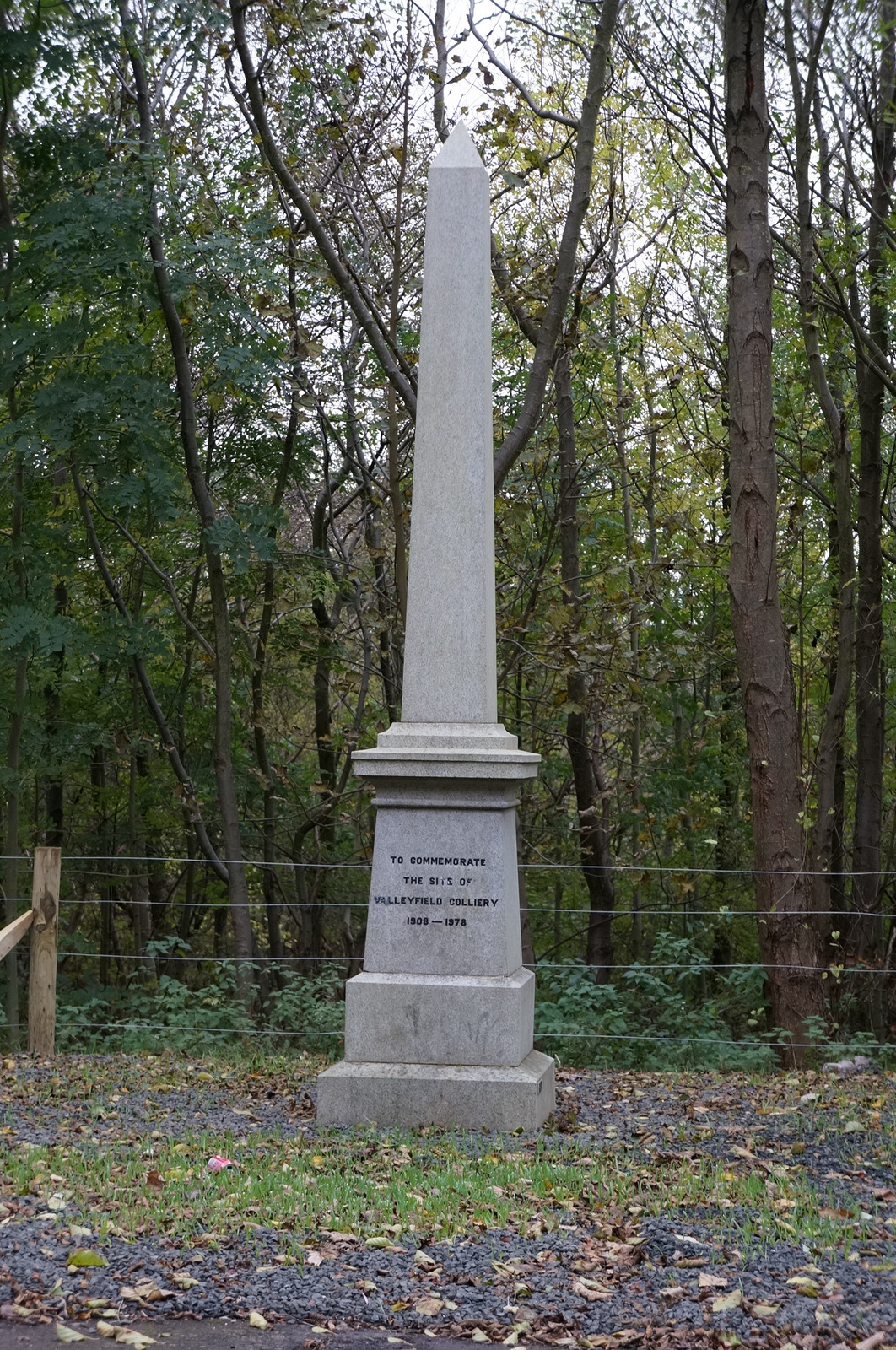
A memorial at High Valleyfield commemorates the colliery and the men who died there.
Recorded claims
Individual factual claims, each attached to the source(s) that support it below. Where sources disagree, both are kept.
- The inquiry found the initial cause was an ignition of firedamp during the firing of a shot in the top coal, in Dodd's Heading in the Culross District. 1
- Thirty-three men were killed outright and two died later in hospital, 35 in all; a further 24 were affected by afterdamp. 1
- The explosion travelled more than 1,500 yards through the workings, carried beyond its seat by coal dust lying in the roads. 1
- The inquiry, under R. P. Morison K.C. with Sir Henry Walker as technical assessor, sat in Parliament House, Edinburgh from January to early March 1940 and reported on 2 August 1940. It found coal dust accumulation and insufficient stone dusting along the explosion's path, and that gas found after almost every round of shots had gone unreported. 1
Related terminology
Mining terms this disaster is structurally linked to, with the nature of the relationship.
- Afterdamp (hazard involved)
Twenty-four men beyond those killed outright were affected by afterdamp as it spread through the workings. - Coal (contextual relationship)
The inquiry found the explosion was carried more than 1,500 yards by coal dust that should not have been allowed to lie there in the first place. - Firedamp (direct cause)
The inquiry found the explosion began as an ignition of firedamp during the firing of a shot in the top coal. - Shot-firing (contextual relationship)
It began as an ignition of firedamp during shot firing — and the inquiry found gas had been discovered after almost every round of shots and never reported. - Stone Dusting (contextual relationship)
Stone dusting along the roads the explosion travelled was insufficient to stop it, and coal dust had been left to accumulate — the defence that should have contained the blast had not been kept up.
Sources
- (primary) Valleyfield Colliery Explosion, Culross, 1939 — Northern Mine Research Society
- (secondary) Valleyfield / Kinneil mine workings — Scottish Cave and Mine Database
Record created: 24 August 2026 · Last researched: 24 August 2026