 MineArchive
Kinneil Colliery
| Also known as | Furnace Yard Pit, Kinneil-Valleyfield |
|---|---|
| Location | Bo'ness, Falkirk — 56.0084, -3.6358 (approximate) |
| Commodity | Coal |
| Type | Coal |
| Worked | 1892 (Furnace Yard Pit)–1982 |
| Maximum depth | The combined Kinneil-Valleyfield workings span a vertical range of about 686 m |
| Operators | National Coal Board (1947–1982) |
Overview
Bo'ness's last colliery, and half of one of the strangest workings in Britain: in 1965 a five-kilometre tunnel joined it to Valleyfield in Fife, so that four months before the Forth Road Bridge opened you could already walk from the Lothians to Fife — underground, beneath the firth.
History
The first shaft of what was known as the Furnace Yard Pit was sunk at Kinneil in 1892, on ground that had been worked for coal far longer. The National Coal Board rebuilt the colliery wholesale after nationalisation, starting new pit buildings in 1951 and completing them in 1956, and at its peak Kinneil employed around 1,200 people and was designed to handle 3,000 tons of coal a day. The most remarkable thing about it came next. Through the early 1960s a winding tunnel 15 ft by 10 ft was driven out under the Firth of Forth, and in 1965 it met the workings of Valleyfield colliery on the Fife shore — some five kilometres of hot, dark roadway joining two counties beneath the sea, completed four months before the Forth Road Bridge was officially opened above. Valleyfield closed in 1978. By 1982 Kinneil was down to 300 men and the Coal Board announced closure on grounds of geological difficulty; the workforce fought it, including a Christmas sit-in hundreds of feet underground, and lost.
Geology
The workings took coals of the Limestone Coal Formation and the Scottish Lower Coal Measures — the Dunfermline Splint, Kelty Main, Milton Main, Seven Foot and Lochgelly Splint among them — in the Carboniferous sequence that underlies the Forth valley and continues uninterrupted beneath the firth itself. That continuity is the whole reason the undersea link was possible: the coal does not stop at the shoreline, and neither, in the end, did the mine.
Geological setting: Sedimentary Beds and Seams (well documented example)
Workings
Shaft mining from 1892, comprehensively reconstructed by the NCB in the 1950s with No. 2 Pit deepened in that programme. From 1965 the colliery formed one system with Valleyfield, the two pitheads 5,700 m apart with the connecting roadway running beneath the Firth of Forth, and the combined workings covering a vertical range of about 686 m.
Closure
Kinneil closed in 1982 and was formally abandoned in 1983 — the last colliery at Bo'ness, and the end of an industry that had defined the burgh. The site was cleared during the 1990s.
What remains
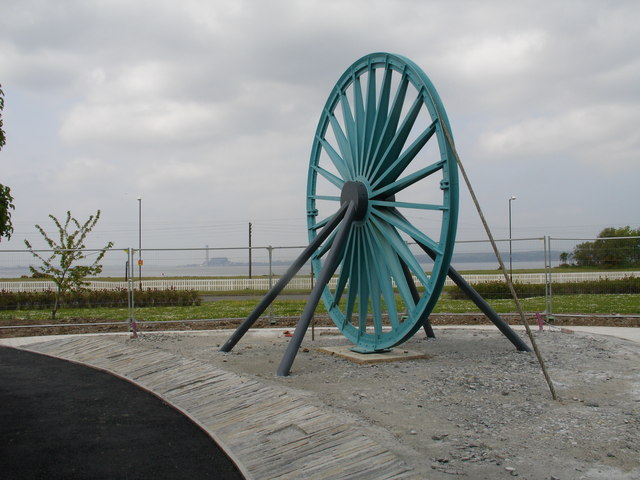
Nothing of the colliery remains standing; the ground is now part of the Kinneil foreshore and nature reserve. The pithead site can now be picked out only as a circular concreted area in parkland; the shafts into the Forth tunnel were filled and capped with concrete, and the tunnel itself is believed to have flooded or collapsed in places.
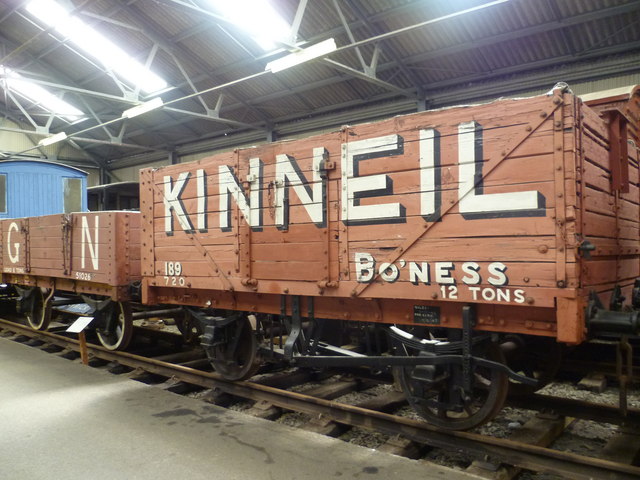
A colliery pit wheel, preserved and landscaped into an ornamental garden, and a Kinneil Colliery coal wagon kept at the Scottish Railway Exhibition at Bo'ness.
Redevelopment
Cleared in the 1990s and returned to open ground and nature reserve on the Forth shore.
Related mines
- Valleyfield Colliery — Workings driven from opposite shores met beneath the Firth of Forth in 1965, joining the two collieries underground.
Nearby mines
- Carriden Colliery — 1.7 miles (2.8 km) NE
- Bridgeness Colliery — 2.3 miles (3.7 km) E
- Redding Colliery — 3.0 miles (4.8 km) SW
- The Moat Pit — 3.2 miles (5.2 km) N, Fife
- Preston Island Colliery — 3.4 miles (5.5 km) NE, Fife
Straight-line distance, within 9 miles (15 km). Show on the map.
Recorded claims
Individual factual claims, each attached to the source(s) that support it below. Where sources disagree, both are kept.
- The first shaft, known as the Furnace Yard Pit, was sunk in 1892. 1
- The National Coal Board began new pit buildings in 1951 and completed them in 1956; at its peak the colliery employed around 1,200 people and was designed for 3,000 tons of coal a day. 1
- A winding tunnel 15 ft by 10 ft, driven in the early 1960s, joined Kinneil to Valleyfield colliery in Fife in 1965 — roughly five kilometres of roadway beneath the Firth of Forth, completed four months before the Forth Road Bridge was opened. 2
- The two pitheads are 5,700 m apart and the combined workings span a vertical range of about 686 m, No. 2 Pit having been deepened in the 1950s. 2
- The workings took coals of the Limestone Coal Formation and Scottish Lower Coal Measures, including the Dunfermline Splint, Kelty Main, Milton Main, Seven Foot and Lochgelly Splint. 2
- Valleyfield closed in 1978 and Kinneil in 1982, with formal abandonment in 1983; the workforce had fallen to 300 and fought the closure with a campaign that included an underground Christmas sit-in. 2,1
- The Valleyfield end of the system suffered an explosion on 28 October 1939, caused by shot firing igniting firedamp, in which 35 miners died — 26 years before the two collieries were connected. 2
Photographs & further reading
Falkirk Council's museum collections record for the colliery.
View sourceLocal history articles and photographs of the colliery and its closure campaign.
View sourceSources
- (secondary) Harking back to when coal was king — Friends of Kinneil
- (secondary) Valleyfield / Kinneil mine workings — Scottish Cave and Mine Database
- (primary) Mine and spoil heap plans S1007-S3242, TS25 and SP1163: Kinneil — British Geological Survey / Mining Remediation Authority mine plans catalogue
- (secondary) The forgotten tunnel that crosses the River Forth — Scottish Field
Record created: 24 August 2026 · Last researched: 24 August 2026