 MineArchive
Bridgeness Colliery
| Location | Bridgeness, Bo'ness, Falkirk — 56.0167, -3.5792 (exact) |
|---|---|
| Commodities | Coal, Ironstone |
| Type | Coal |
| Worked | by 1770 |
| Maximum depth | Unknown. |
| Operators | Cadells of Grange |
Overview
Bridgeness was the Cadell family's colliery at the eastern end of Bo'ness, part of the Grange coal works that had been at the Forth shore since at least the eighteenth century. Its history is legible on the ground in a way few pits are: the engine house built about 1777 to hold a Newcomen atmospheric engine for the North Engine Pit still stands in Kinningars Park, converted first into a dwelling and then, around 1803, into a dovecot. The colliery itself employed 250 people in 1894 and 587 by 1923, working the Main, Red, Smithy, Six Feet and Navigation coals, and shipped its coal from Bridgeness harbour.
History
Coal had been worked near the Forth shore at Bo'ness since the twelfth century, and the Cadells of Grange held these workings. The Grange colliery lay derelict for several years before 1770, when John Kirk, overseer at Wemyss, valued it for the landlord and a prospective tenant and reported the fire engine long idle, its woodwork decayed, its boiler rusted through and its ropes past use — that engine being the one at the Miller Pit, which lifted water from the deeper Main Coal to the Coldwell Level. In July 1777 the Grange records show a decision to sink for the Smithy Coal, thought a good seam to mix with the Main Coal for the London market, by putting up a small fire engine near the windmill at Bridgeness: a 32-inch cylinder bought from Sir Archibald Hope with seventeen fathoms of twelve-inch pipes. A day level was driven from the high water mark to drain the coal south of the new engine. The pit became the North Engine Pit and later the Doocot Pit. In September 1778 the Nether Engine Pit was reported sunk three fathoms below the Main Coal and stopped by a feeder of water too strong for a horse gin, waiting on pipes returned from Ayr. The Newcomen engine at the Doocot Pit had a short life: in 1790 it was moved to No. 3 Pit for £185 and the South Engine at Miller's Pit was stopped. The colliery had a chequered career but was very productive by the 1860s, with calcined iron ore shipped through Bo'ness dock and coal from Bridgeness harbour. The Lists of Mines give 250 people in 1894, 452 in 1910, 587 in 1923 and 285 in 1937, raising household, manufacturing and steam coal from the Main, Red and Smithy seams, with the Six Feet and Navigation added by 1915, and ironstone alongside the coal that year.
Geology
Bridgeness worked the Main, Red, Smithy, Six Feet and Navigation coals of the Bo'ness district on the south shore of the Forth, with ironstone raised alongside the coal in 1915. The Smithy Coal was sunk for in 1777 specifically because it was thought a good seam to mix with the Main Coal for the London market. Water was the constant problem: the deep Main Coal had to be lifted by fire engine to the Coldwell Level, and sinking below it in 1778 struck a feeder too strong for a horse gin.
Geological setting: Sedimentary Beds and Seams (well documented example)
Workings
A group of pits on the Grange estate rather than a single shaft — the Miller Pit, the North Engine or Doocot Pit, the Nether Engine Pit, the Coneygair Pit sunk circularly at seven feet diameter from the Main to the Smithy Coal, and a No. 3 Pit. Pumping was by Newcomen atmospheric beam engine: the engine house at Kinningars Park is unusually narrow, 7.9 by 3.7 metres, with two opposing 3.7-metre arches that clasped a haystack boiler set directly under the cylinder, its west wall carrying the pivot of the beam whose outer end hung over the shaft.
Closure
The closure date is not known. The Lists of Mines still return 285 people at Bridgeness in 1937. In 1911 the pit next to the doocot was used briefly as a source of water for the local population during a bad drought, by which time the Cadells had moved away and the doocot was presumably abandoned.
What remains
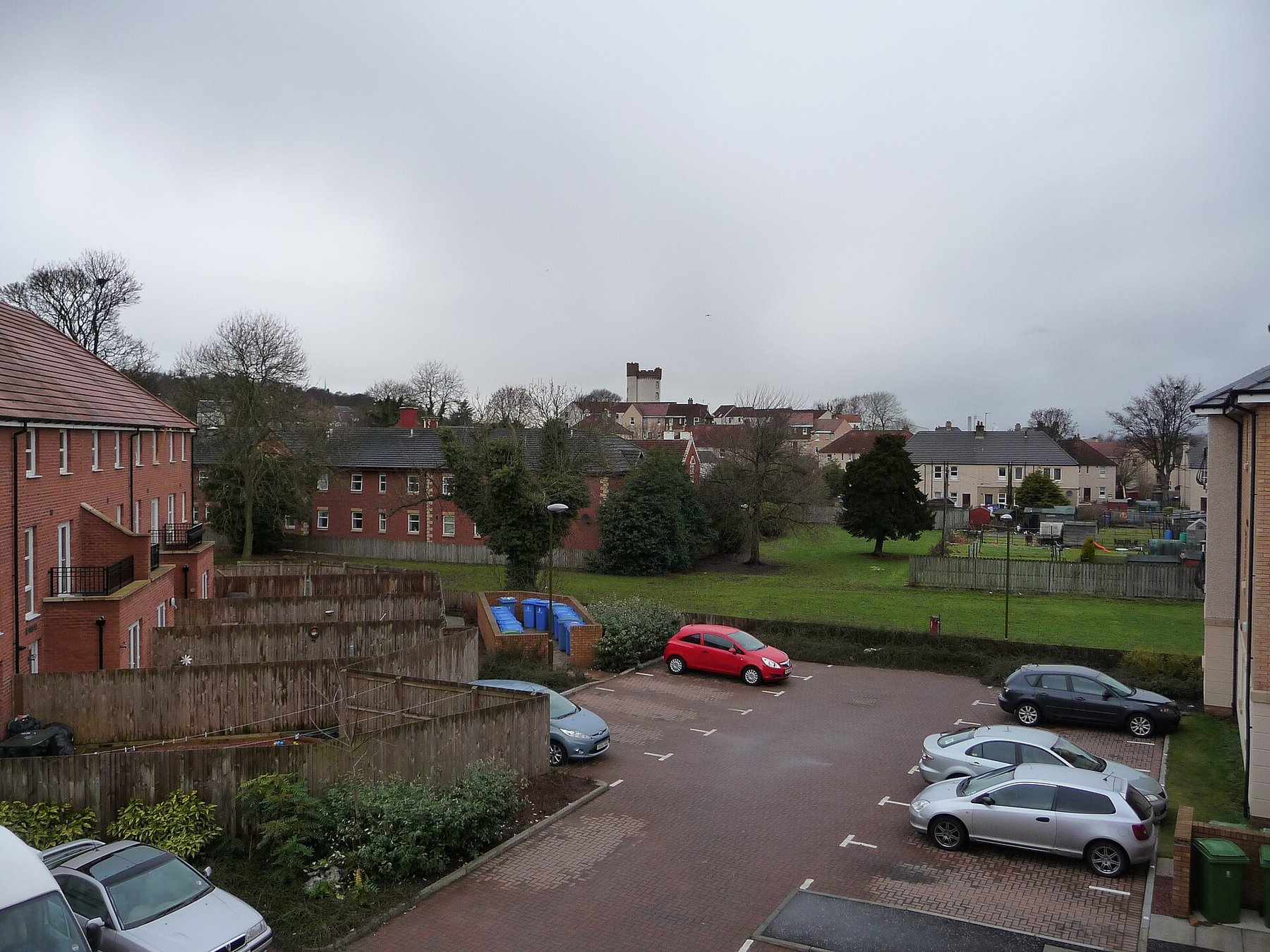
The engine house survives in Kinningars Park at Bridgeness, nine metres tall, roofless and partly ruinous, still holding some 415 brick nesting boxes from its years as a dovecot; it and the park were given to Falkirk Council in the 1970s, and in 1997 vandals burnt the wooden lintels carrying the nest boxes, which the parks department replaced in concrete. Bridgeness Tower, the windmill of 1750 that the 1777 engine was sited near, still stands above the town.
The engine house survives in Kinningars Park, nine metres tall, roofless and partly ruinous, with the nesting boxes from its years as a dovecot.
Related mines
- Carronhall Colliery — Bridgeness and Carronhall were two of the last four collieries the Carron Company operated, and went into public ownership together at nationalisation.
Nearby mines
- Carriden Colliery — 0.7 miles (1.1 km) W
- Kinneil Colliery — 2.3 miles (3.6 km) W
- Preston Island Colliery — 2.7 miles (4.3 km) N, Fife
- Valleyfield Colliery — 3.0 miles (4.9 km) N, Fife
- Charlestown Limeworks — 3.2 miles (5.2 km) NE, Fife
Straight-line distance, within 9 miles (15 km). Show on the map.
Disasters & major incidents
-
Bridgeness Colliery explosion, 1915
17 February 1915 · Explosion · 2 fatalities
A shot fired at the face set off an explosion of firedamp in a stone mine at Bridgeness No. 2 pit, Grangepans, on 17 February 1915, burning five men; the fireman died two days later and a miner with a broken spine seven months later.
What's uncertain
Points where sources disagree or the record could not be settled; both accounts are kept. All open questions in the archive.
- The BGS mine-plans catalogue holds a Mining Remediation Authority abandonment plan titled 'Bridgeness' (catalogue 12910, Six Feet, Main & Smithy, dated 1941); the catalogue gives no location and the plan's details do not clearly tie it to this working, so it may belong to another of the same name. (uncertain) 3
Recorded claims
Individual factual claims, each attached to the source(s) that support it below. Where sources disagree, both are kept.
- The Grange records show a resolution of 28 July 1777 to win the Smithy Coal by erecting a small fire engine near the windmill at Bridgeness, with a 32-inch cylinder bought from Sir Archibald Hope and seventeen fathoms of twelve-inch pipes. 1
- On 28 September 1778 the Nether Engine Pit was reported sunk three fathoms below the Main Coal and stopped by a feeder of water too strong to be drawn by a horse gin, until pipes were returned from Ayr. 1
- The Newcomen engine at the Doocot Pit was moved to No. 3 Pit in 1790 at a cost of £185, and the South Engine at Miller's Pit was stopped. 1
- The engine house stands in Kinningars Park at NT 0139 8129, nine metres tall, roofless and partly ruinous, with some 415 brick nesting boxes from its conversion to a dovecot about 1803. 1
- The Lists of Mines record 250 people at Bridgeness in 1894, 452 in 1910, 587 in 1923 and 285 in 1937. 2
- The colliery worked the Main, Red and Smithy coals, with the Six Feet and Navigation added by 1915, and raised ironstone alongside the coal that year. 2
- The BGS mine-plans catalogue holds a Mining Remediation Authority abandonment plan titled 'Bridgeness' (catalogue 12910, Six Feet, Main & Smithy, dated 1941); the catalogue gives no location and the plan's details do not clearly tie it to this working, so it may belong to another of the same name. (uncertain) 3
Photographs & further reading
A measured survey and history of the Newcomen engine house at Kinningars Park, with the Grange colliery records of the 1770s that explain why and where it was built.
View sourceOutput, employment and seams for each Lists of Mines year from 1894 to 1937.
View sourceSources
- (secondary) The Bridgeness Engine House — Falkirk Local History Society (read via a Wayback Machine capture)
- (primary) Durham Mining Museum: Bridgeness Colliery — Durham Mining Museum, from the Lists of Mines
- (primary) BGS / Mining Remediation Authority mine plans: BRIDGENESS — British Geological Survey / Mining Remediation Authority
- (observational) Bridgeness Tower and Grange nursing home (photographed 2011) — Geograph Britain and Ireland, Bob Simpson
Record created: 10 September 2026 · Last researched: 10 September 2026