 MineArchive
Whim
| Also known as | Whim engine, Horse whim, Gin, Horse whims |
|---|---|
| Category | Structures & Machinery |
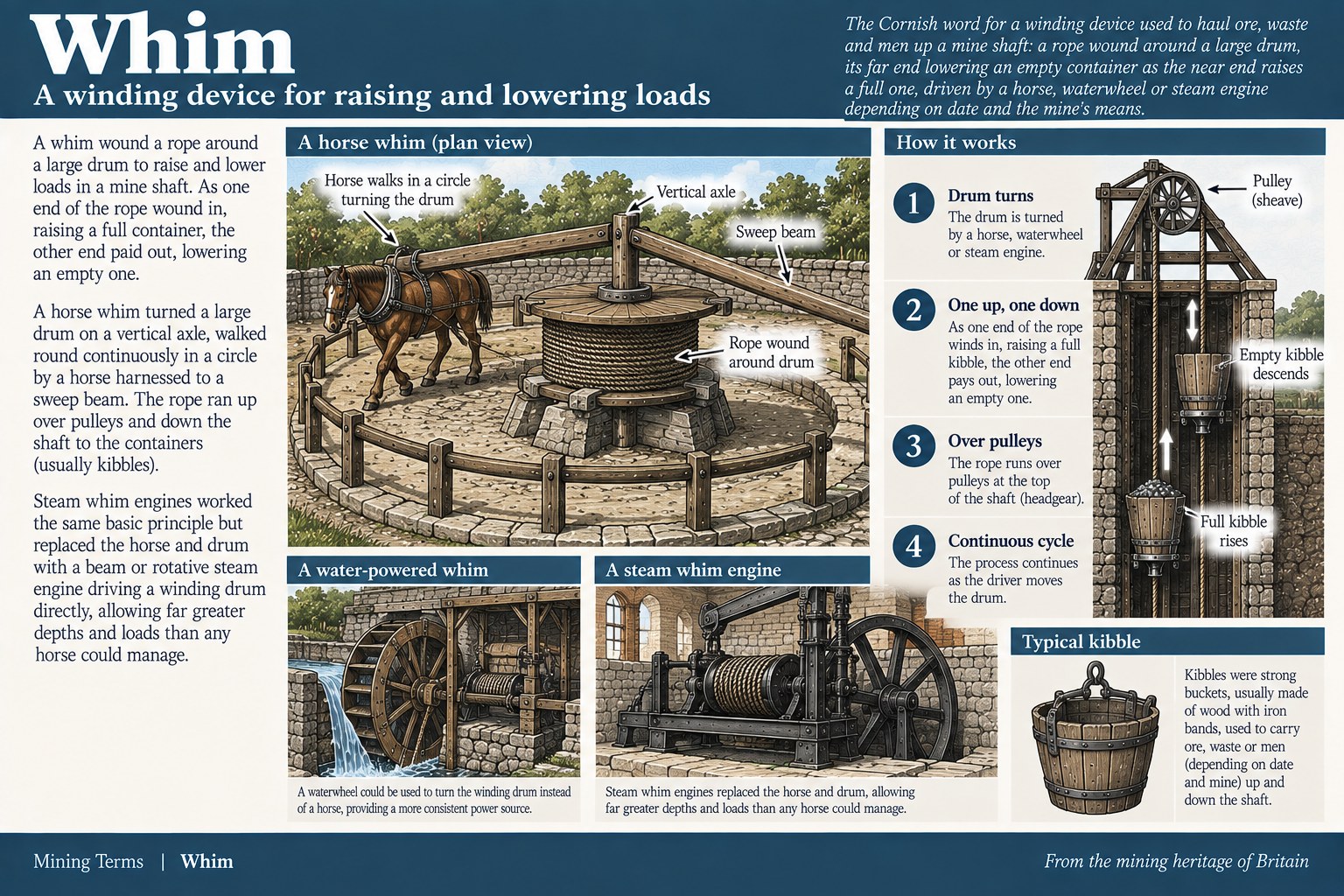
The Cornish word for a winding device used to haul ore, waste and men up a mine shaft: a rope wound around a large drum, its far end lowering an empty container as the near end raises a full one, driven by a horse, waterwheel or steam engine depending on date and the mine's means.
Historical usage
Whims were in everyday use across British metal and coal mines from around 1700 through to the late 19th century, gradually shifting in power source as mines grew deeper and cheaper prime movers became available: horse-powered whims (also called whim gins or horse gins) dominated shallow working from roughly 1700 to 1880, before steam winding engines — built specifically as 'whim engines' — became affordable even for smaller operators.
How it worked
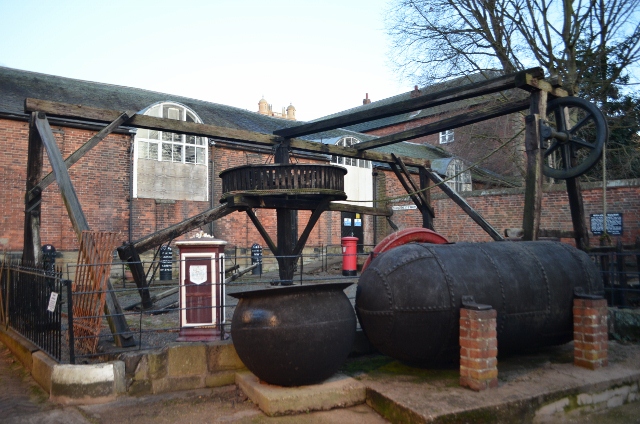
A horse whim turned a large drum on a vertical axle, walked round continuously in a circle by a horse harnessed to a sweep beam; the rope wound around the drum ran up over pulleys and down the shaft, so that as one end paid out carrying an empty kibble, the other end wound in, raising a full one. Steam whim engines worked the same basic winding principle but replaced the horse and drum with a beam or rotative steam engine driving a winding drum directly, allowing far greater depths and loads than any horse could manage.
Why it was used
Winding was one of the most constant, repetitive jobs on any working mine — ore, waste and often the miners themselves all had to be raised and lowered by whim, since before the man-engine and mechanised cages, it was frequently the only way in or out of a working shaft. A whim capable of reliable, continuous operation was therefore essential mine infrastructure, not a luxury, and the move from horse to steam power tracked the growing depth and scale of British mining directly.
Risks & limitations
A horse whim's capacity was fundamentally limited by animal endurance and shaft depth, which capped how deep a mine using only horse winding could practically be worked; steam whim engines removed that ceiling but represented a much larger capital outlay, which is part of why horse whims persisted at smaller and shallower mines long after steam winding had become standard elsewhere.
Regional variation
Cornwall in particular refined the steam whim into some of its most celebrated surviving engines: the 1840 whim engine at Levant Mine, designed by Francis Mitchell and built by Harvey's of Hayle, is the only steam winding engine in the world still working in its original position, and East Pool's 1887 Michell whim engine was the last such engine built at Holman Bros' Camborne foundry.
Related terminology
Capstan, Gin Circle, Water Balance, Whim Crane, Winding Engine, Windlass
Mines associated with this term
5 examples chosen from 66 linked records — the term page is not an index.
- Nenthead Mines — Cumbria (surviving physical example)
Horse whims were used to raise ore and materials at several of Nenthead's mine entrances, some of which remain accessible today. - Wheal Coates — Cornwall (surviving physical example)
Wheal Coates' surviving mine buildings include a separate winding ('whim') engine house alongside its pumping and stamping engine houses. - Gin Pit Colliery — Greater Manchester (well documented example)
Named in this record’s current condition: “Gin Pit Village, the small settlement built to house the colliery's…” - All Profit Colliery — Gloucestershire (well documented example)
Named in this record’s workings: “…size in the 1840s were worked by level or shallow shaft, wound by horse whim where they were wound at all, and sold their coal locally.” - Allenheads Mines — Northumberland (well documented example)
Named twice in this record, first in the history: “…was begun in Sir William Blackett's time and completed in 1776; the Gin Hill shaft was sunk by 1793. By the early 19th century Allenheads…”
Disasters associated with this term
Included only where MineArchive's own research gives a reasonable evidential basis, with the nature of the relationship stated — not every disaster where this term might plausibly apply.
- Felling Colliery explosion, 1812 (contextual relationship)
Named twice in this record, first in the summary: “…heard four miles off. Thirty-three men were brought out alive by a horse-whim worked by hand, three of whom later died; everyone else was left…” - Garden Pit Inundation, Landshipping, 1844 (contextual relationship)
Named 3 times in this record, first in the summary: “…up in the coal buckets by putting the horses to a gallop on the whim. It remains the worst loss of life in Pembrokeshire mining.” - Gin Pit explosion, 1863 (contextual relationship)
Named twice in this record, first in the summary: “A firedamp explosion at Gin Pit, Maesteg on the Saturday after Christmas Day 1863 killed…”
Sources
- (primary) The History of Winding - 2 — Durham Mining Museum
- (secondary) Cornish Engines — Cornwall Online / Trevithick Trust
- (secondary) Horse-power Hoisting Drum Mechanism — Firgelli Automations
- (secondary) Whim (mining) — Wikipedia
Record created: 20 August 2026 · Last researched: 20 August 2026