 MineArchive
Felling Colliery explosion, 1812
At about half past eleven on the morning of Monday 25 May 1812 a firedamp explosion tore through Felling Colliery near Gateshead, killing 92 men and boys of the 128 below ground. The ground shook for half a mile and the report was heard four miles off. Thirty-three men were brought out alive by a horse-whim worked by hand, three of whom later died; everyone else was left below. A second explosion drove back the one rescue party that got down, and the pit was sealed for six weeks to smother the fire. Recovery of the bodies took from July to September. The local curate's pamphlet on the disaster helped found the Sunderland Society, out of which came the Geordie and Davy safety lamps.
| Date | 25 May 1812 |
|---|---|
| Mine | Felling Colliery |
| Region | Tyne and Wear |
| Type | Explosion |
| Fatalities | 92 (The Durham Mining Museum and the Tyne and Wear HER both give 92; the contemporary account reproduced by the museum says ninety-one, and the obelisk at Heworth carries ninety-one names.) |
| Context | During active mining |
Cause
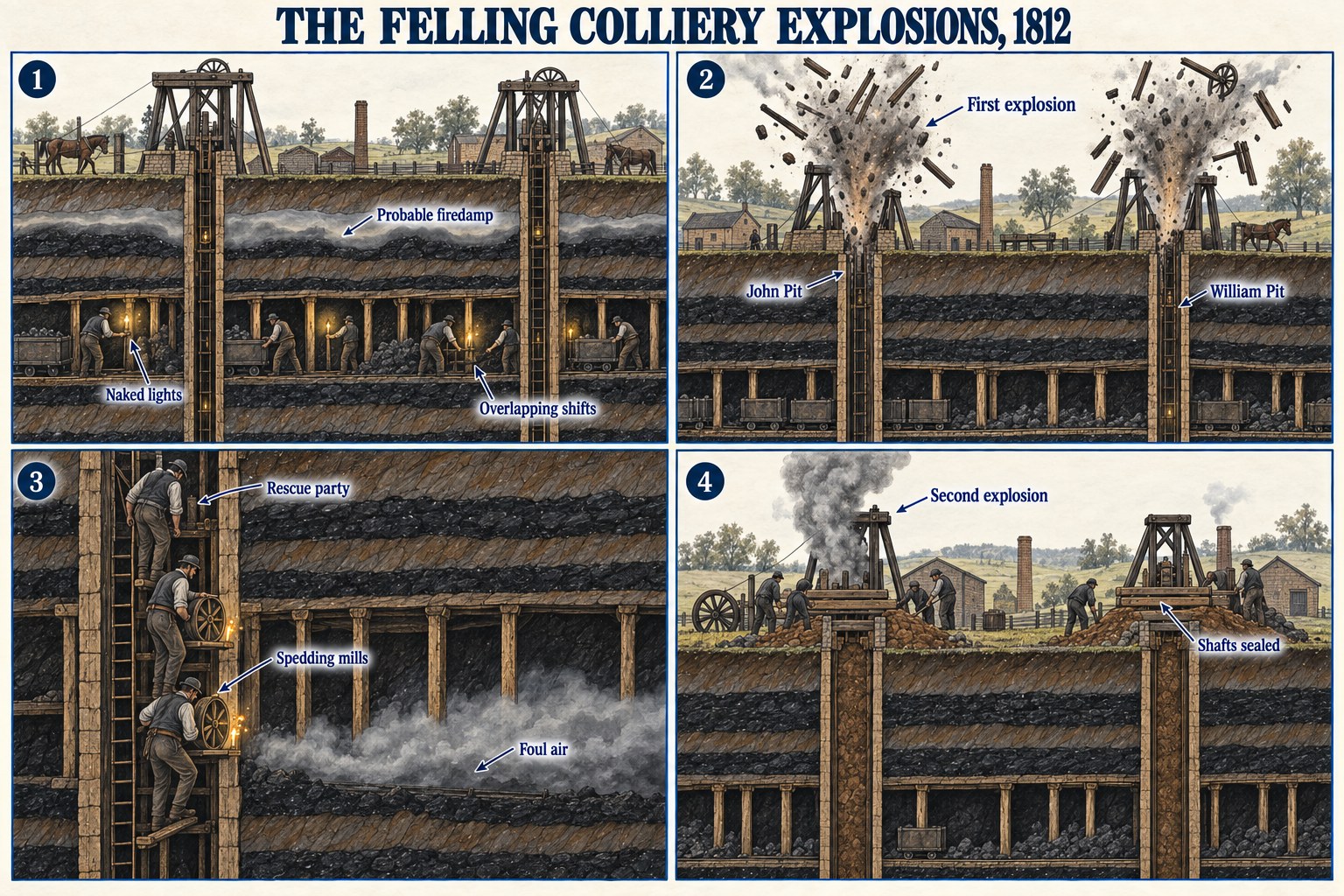
Firedamp ignited by a naked light. The cause of the first explosion has never been established with certainty, but firedamp is the probable one: there was no evidence of large quantities of coal dust in the air beforehand.
Contributing factors
The colliery was worked by candlelight, the safety lamp not yet existing; Spedding mills were used where gas was suspected, and had themselves caused an explosion at Wallsend in 1785. The two working shifts overlapped, so nearly the whole workforce was underground when the blast came.
What happened
The first explosion came at about 11:30. Dust and small coal were thrown up from both shafts in an inverted cone, corves and pieces of timber fell around the pit heads, and the dust drifted a mile and a half downwind, darkening Heworth village and lying thick enough in the roads to hold footprints. Both shaft frames were blown off, set alight and their pulleys shattered. Coal dust three inches thick in the horizontal flue from William Pit burnt to a light cinder.
The pulleys of the John Pit horse-whim were mounted on a crane swung clear of the shaft and so survived. Men on the surface took the place of the horses and wound up 33 survivors and two bodies; three of the survivors died afterwards. Eighty-seven men and boys remained below. Forty-five minutes later a rescue party went down with Spedding mills for light, the sparks falling, one of them said, like dark drops of blood in the foul air. They were forced back from two directions by the difficulty of breathing and retreated to the shaft bottom. While two were still below and two in the shaft, the second explosion came.
Rescue & recovery
The rescuers agreed that nobody left below could be alive: two explosions, blackdamp, fire and afterdamp made further descent impossible. When it was proposed to seal the pit to smother the fire, the crowd at the pit head shouted murder, remembering three men who had survived forty days in a pit near Byker. The owners promised that no expense would be spared on any workable rescue scheme but refused to offer a reward, saying they would be accessory to no man's death by persuasion or bribe. Two men descended on the Wednesday and were driven back by gas within a few yards of the shaft. Smoke rising from John Pit settled the argument, and both shafts were sealed with clay and planks.
The pit was cautiously reopened on 4 July, the escaping gas collected in bladders and tested against a candle until it no longer fired. On 8 July nine men went down William shaft and found the air cool and wholesome. Recovery took until 19 September, all of it by the light of Spedding mills, with the stoppings and traps repaired as the men advanced so that the air would circulate. The bodies had lain seven weeks and most could not be recognised; mothers and widows identified them by clothes, shoes and tobacco boxes. Coffins were filled underground. On 20 September, 117 days after the explosion, the pit was inspected by candle, the William Pit furnace relit and the colliery brought back into work. One body was never found.
Investigation & inquiry
There was no public inquiry of the kind a later century would have held. The analysis that mattered was made by the Reverend John Hodgson, curate of Jarrow and Heworth, who took the trouble to work out why the area near the downcast shaft was found wrecked when the men who escaped had reported it intact. He reasoned that the strong incoming air current had checked the first explosion there, and that afterdamp driven up from the seat of the fire had then pushed a pocket of firedamp into the burning coal and set off the second. Two paragraphs later he noted that the dust in the barrow-ways had burnt to a cinder, without drawing the conclusion: that coal dust raised by one explosion could cause the next was only beginning to be understood.
Changes to practice & legislation
Hodgson's sixteen-page pamphlet, written for the general reader rather than for practical miners and explaining the terms as it went, was one of the first attempts at a scientific account of a colliery explosion, and it turned the disaster into a public question. On 1 October 1812 the Sunderland Society was founded by clergymen, doctors, owners and managers to publicise accidents and their causes, study ventilation and develop a safe light. William Reid Clanny, who had already built an impractical lamp, was a member; so was George Stephenson, then enginewright at Killingworth. Stephenson produced the Geordie lamp, feeding air through tubes too narrow for flame to pass; Humphry Davy produced the Davy lamp, surrounding the flame with iron gauze fine enough to stop flame but open enough to admit methane, which then burned harmlessly inside and whose concentration could be read from the height of the cone above the flame.
Memorials & commemoration
The dead were buried together in Heworth chapel yard in a trench, side by side and two coffins deep, with brick and lime between every four coffins; four were buried in single graves. Hodgson persuaded the bereaved to accept a common and speedy burial after Dr Ramsay warned that returning the decayed bodies to their homes for wakes risked spreading putrid fever. A plain obelisk nine feet high stands over the trench, with brass plates on its four sides carrying the names and ages of the dead in alphabetical order.
What's uncertain
Points where sources disagree or the record could not be settled; both accounts are kept. All open questions in the archive.
- The Durham Mining Museum and the Tyne and Wear HER both give 92 dead. The contemporary account the museum reproduces says ninety-one perished, and the obelisk at Heworth carries ninety-one names; the difference is most likely the three men who were brought out alive and died afterwards. (disputed) 1,2,3
- The explosion is dated 25 May 1812 by the contemporary account and by the museum's own record; the Tyne and Wear HER gives 24 May. (disputed) 2,3
- No cause was ever established with certainty. Firedamp ignited by a naked light is the probable one, there being no evidence of large quantities of coal dust in the air before the blast. (uncertain) 4
Recorded claims
Individual factual claims, each attached to the source(s) that support it below. Where sources disagree, both are kept.
- The Durham Mining Museum and the Tyne and Wear HER both give 92 dead. The contemporary account the museum reproduces says ninety-one perished, and the obelisk at Heworth carries ninety-one names; the difference is most likely the three men who were brought out alive and died afterwards. (disputed) 1,2,3
- The explosion is dated 25 May 1812 by the contemporary account and by the museum's own record; the Tyne and Wear HER gives 24 May. (disputed) 2,3
- No cause was ever established with certainty. Firedamp ignited by a naked light is the probable one, there being no evidence of large quantities of coal dust in the air before the blast. (uncertain) 4
- The disaster prompted the Reverend John Hodgson's pamphlet and the founding of the Sunderland Society on 1 October 1812, from which came Stephenson's Geordie lamp and Davy's safety lamp. 4
Related terminology
Mining terms this disaster is structurally linked to, with the nature of the relationship.
- Afterdamp (contextual relationship)
Named twice in this record, first in the rescue and recovery: “…left below could be alive: two explosions, blackdamp, fire and afterdamp made further descent impossible. When it was proposed to seal the…” - Bad Air (contextual relationship)
Named in this record’s narrative: “…sparks falling, one of them said, like dark drops of blood in the foul air. They were forced back from two directions by the difficulty of…” - Chokedamp (contextual relationship)
Named in this record’s rescue and recovery: “…agreed that nobody left below could be alive: two explosions, blackdamp, fire and afterdamp made further descent impossible. When it was…” - Safety Lamp (contextual relationship)
Named 4 times in this record, first in the summary: “…found the Sunderland Society, out of which came the Geordie and Davy safety lamps.” - Whim (contextual relationship)
Named twice in this record, first in the summary: “…heard four miles off. Thirty-three men were brought out alive by a horse-whim worked by hand, three of whom later died; everyone else was left…”
Plans & documents
Sources
- (primary) Felling Colliery — Durham Mining Museum
- (primary) Felling Colliery (Brandling Main/John Pit), HER 3801 — Tyne and Wear Historic Environment Record
- (primary) Local Historian's Table Book: the Felling explosion of 1812, reproduced by the Durham Mining Museum — Durham Mining Museum
- (secondary) Felling mine disasters — Wikipedia
Record created: 9 September 2026 · Last researched: 9 September 2026