 MineArchive
Gin Circle
| Also known as | Gin Race (Another name for the same feature.), Winding Circle (The monument type used by the Historic Environment Records.), Horse Gin Circle (The fuller form, naming the power.) |
|---|---|
| Category | Mine Workings & Access |
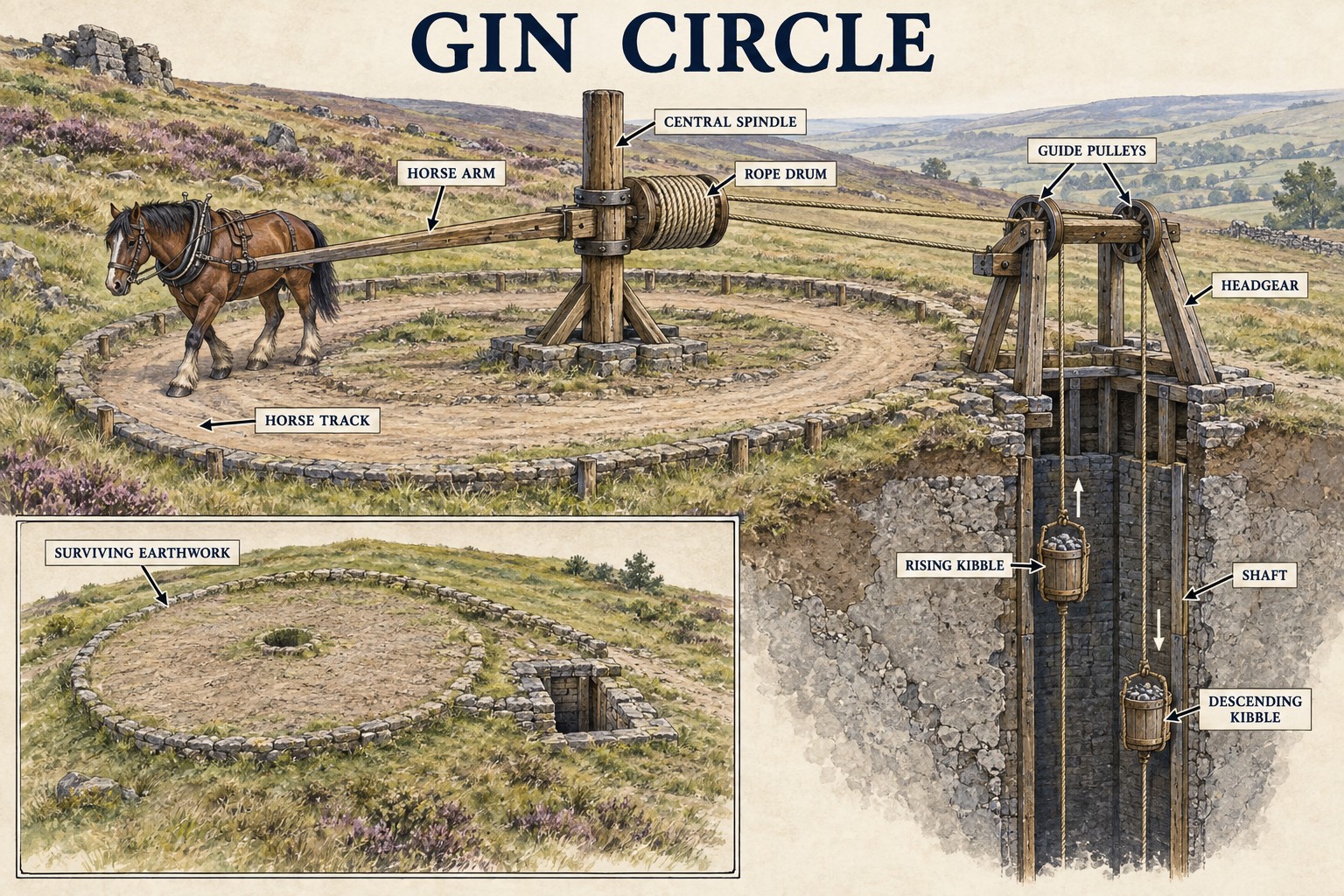
The circular track a horse walked to drive a winding gin, and the earthwork it left. The machine is a whim; the gin circle is the ring of ground it stood in — a levelled platform, the horse track worn or built around it, and a hollow at the centre where the bearing block for the vertical spindle sat.

Historical usage
The horse gin was the ordinary way of raising ore and water from a shallow shaft before steam, and on the Derbyshire lead field it stayed ordinary long after. Because the gin itself was timber and iron and went for scrap, the circle is usually all that survives, and the Historic Environment Record classes it as a monument type in its own right — 'winding circle' — dated post-medieval alongside the shaft it served.
This archive's own records find them at Hazard Mine on Dirtlow Rake, where a walled gin circle stands beside the grilled engine shaft with a fragment of the belland yard wall; at Faucet Rake; at Little Brookhead; and on the Dirtlow Rake record itself. The Derbyshire Historic Environment Record's entry for Old Twelve Meers at Eyam describes one exactly: a gin circle platform cut into the steep hillside, with horse track and a central hollow where the bearing block has been removed, and an adjacent open shaft on the downslope side.
How it worked
A horizontal drum turned on a vertical spindle set at the centre of the circle, away from the shaft mouth, with a horse harnessed to an arm and walking the ring. The rope coiled on the drum and ran out over pulleys on a simple headgear above the shaft, so that one container came up as the other went down. Everything about the arrangement that survives is negative: the platform levelled out of the slope, the ring of trodden or walled track, and the socket at the middle.
Why it was used
A horse was the cheapest power a small partnership could put on a shaft. It needed no boiler, no coal, no enginewright and no capital beyond the animal, and on the Derbyshire lead field, where mines were worked by small groups under the mineral custom rather than by companies, that was usually the only power available.
Risks & limitations
A gin can only wind from a shallow shaft, slowly, and it stops when the horse does. Its real limitation shows in the archaeology: the circles cluster on the small, short-lived workings, and the mines that went deep put up an engine house instead. As surviving features they are fragile — a levelled platform and a ring of stone are easily ploughed out, robbed for walling or lost to opencasting, which is what happened to most of the gin circle at Hazard Mine.
Regional variation
Recorded across the British orefields and coalfields, but conspicuous in the Derbyshire lead country, where the survival of shallow workings on limestone upland has left more of them than anywhere else. Gin race is another name for the same feature. The machine itself is held in this archive under Whim, which carries Gin and Horse whim as aliases; the North Staffordshire glossary distinguishes the earlier cog and rung gin from the horse whim that replaced it at the end of the seventeenth century.
Related terminology
Mines associated with this term
5 examples chosen from 34 linked records — the term page is not an index.
- Dirtlow Rake Mine — Derbyshire (surviving physical example)
Gin circles survive along the rake among the shafts and hillocks of the Castleton lead workings. - Hazard Mine — Derbyshire (surviving physical example)
A walled gin circle survives here beside the grilled engine shaft, badly reduced by the opencasting of the late 1990s but still readable on the ground with a fragment of the belland yard wall. - Hurst Mines — North Yorkshire (well documented example)
Named in this record’s current condition: “…The Grinding Mill Dam survives west of Hurst Hall with traces of gin circles on several shafts. Prys Level has the best-preserved features in the…” - Alnwick Moor Bell Pits — Northumberland (well documented example)
Named 3 times in this record, first in the workings: “…of spoil that form shaft mounds; between them are the remains of gin circles, the level tracks where a horse walked round to drive the winding or…” - Bentley Grange Ironstone Pits — West Yorkshire (well documented example)
Named twice in this record, first in the workings: “…to one side. A number have access ramps and platforms interpreted as gin circles. About five mounds in the western part of the area, south of…”
Sources
- (primary) Old Twelve Meers Lead Mine, Sir William Hill Road, Eyam — Derbyshire Historic Environment Record MDR14006 — Derbyshire Historic Environment Record
- (secondary) Glossary of mining terms — North Staffordshire Miners' Group, Apedale Heritage Centre — North Staffordshire Miners' Group
Record created: 10 September 2026 · Last researched: 10 September 2026