 MineArchive
Whim Crane
| Category | Structures & Machinery |
|---|
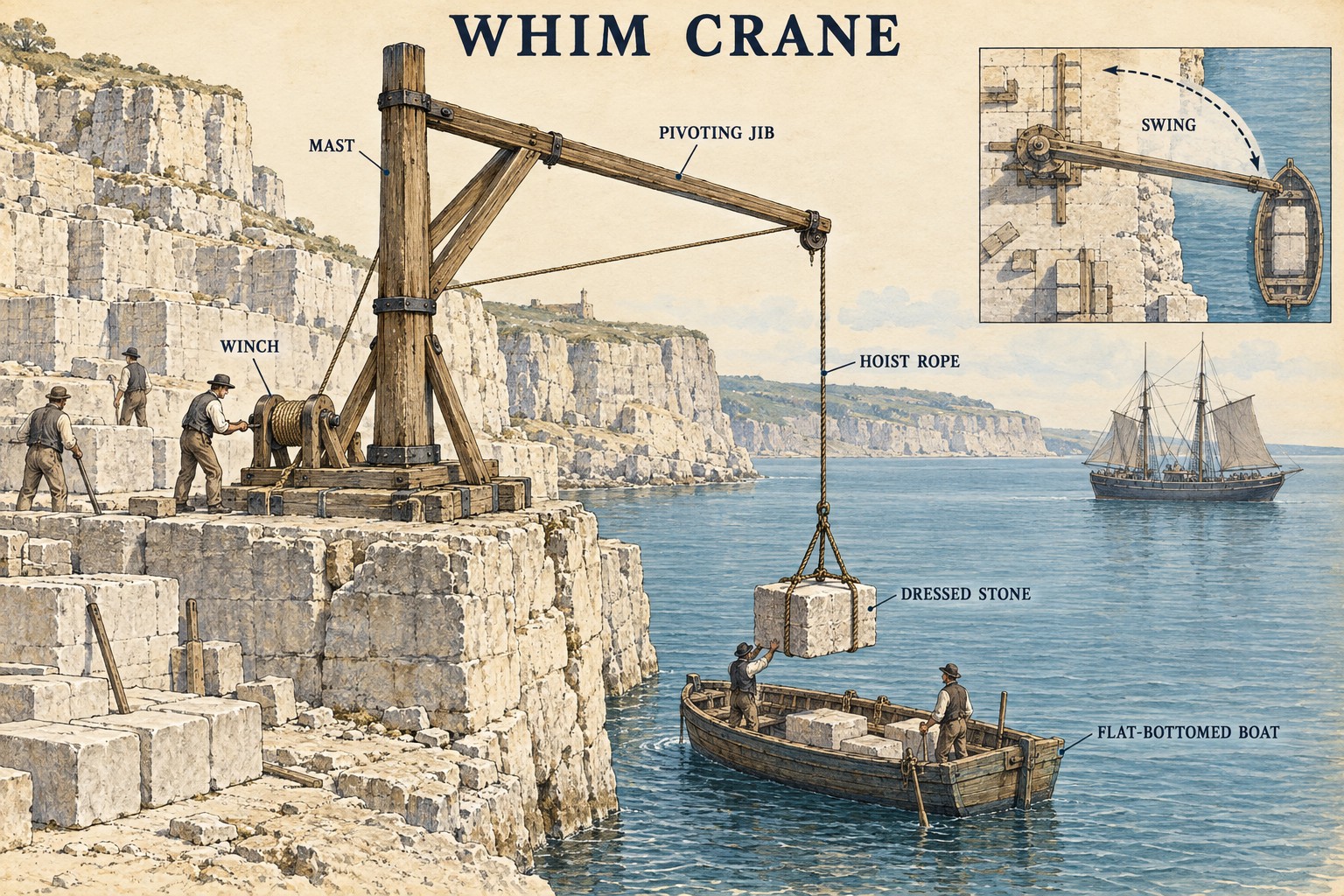
A simple wooden jib crane, or derrick, used at coastal stone quarries to swing and lower dressed blocks from the quarry ledge down to boats waiting below — a distinct device from the shaft-hoisting mine whim, despite sharing its name.
Historical usage
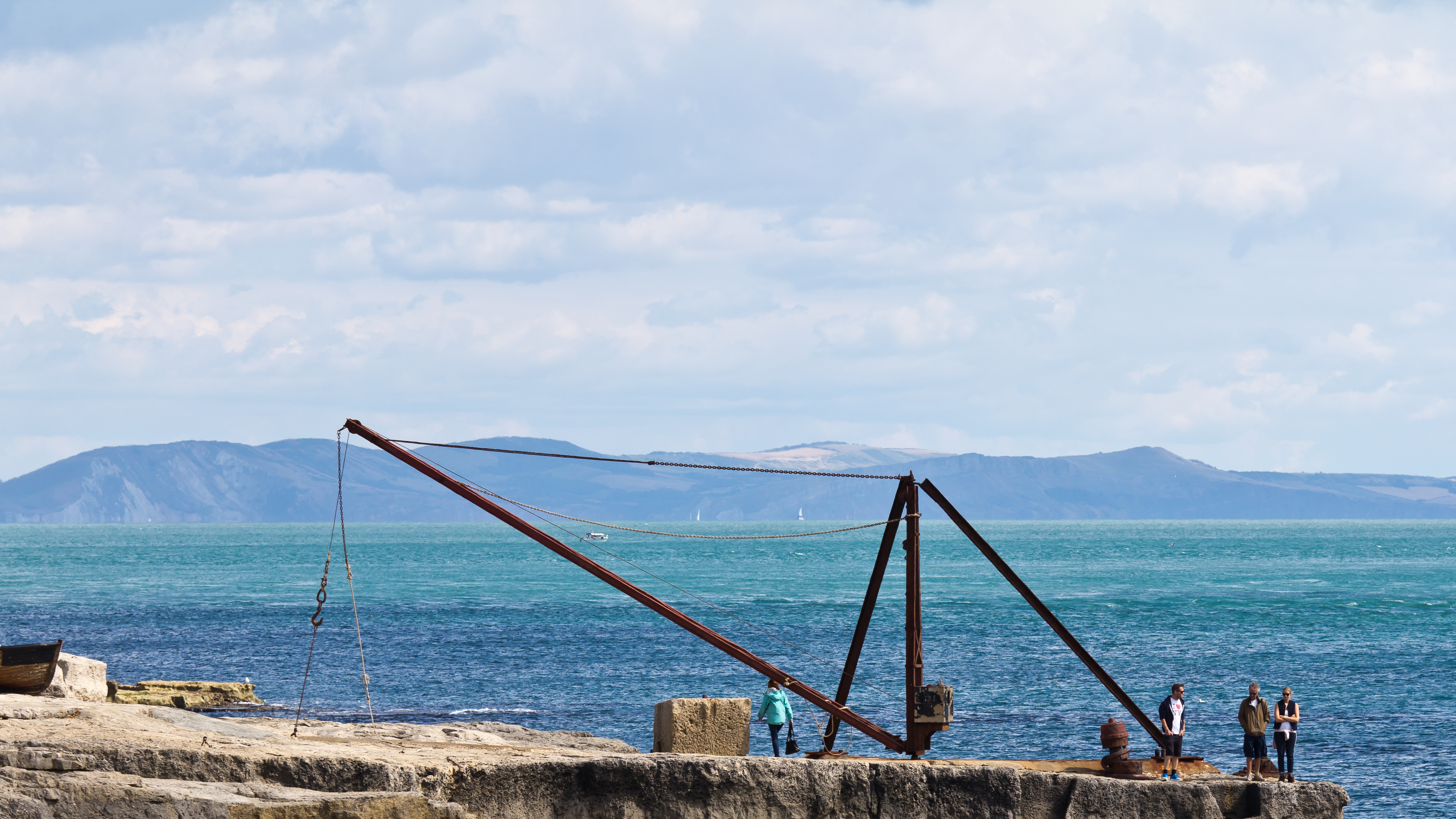
Whim cranes were the standard means of loading stone at Purbeck's coastal quarries, including Tilly Whim near Swanage — itself apparently named for the device, possibly combined with a quarryman called George Tilly — where stone cut from horizontal cliff-face galleries had no practical route to market except straight down to a waiting boat. The same basic device, often called a derrick, was used at stone quarries across the Isle of Purbeck and Portland wherever cut blocks needed to be lowered from a cliff-edge working directly onto shipping; a later ironwork example, the Red Crane at Portland Bill, still survives in place as a listed structure.
How it worked
A vertical mast, often built from reused ship's timber, carried a pivoting jib suspended from its top; mast and jib could swing together to move a load out over the cliff edge, while a winch — sometimes turned by hand, sometimes by a donkey harnessed to a capstan — lowered the stone on a rope to a flat-bottomed boat waiting below, which then rowed the load out to a larger barge or ketch anchored offshore.
Why it was used
Coastal quarries like Tilly Whim had no practical road access for the sheer weight of dressed stone they produced, and shipping was in any case far cheaper than land transport for bulk cargo over any real distance — the whim crane was the only workable link between a cliff-face quarry gallery and the sea lane that would actually carry its stone to market.
Risks & limitations
Loading only worked in calm summer weather, when boats could safely approach directly beneath the cliff face, meaning coastal quarries like Tilly Whim effectively had a working season rather than year-round production; the exposed cliff-edge working itself, with heavy stone swung out over open water on a simple wooden crane, was inherently hazardous.
Regional variation
Specific to Britain's coastal stone-quarrying districts — the Isle of Purbeck and Portland above all — rather than to mining generally; the mine whim used to wind ore and men up a vertical shaft is a related but mechanically distinct device that happens to share the same name.
Related terminology
Mines associated with this term
Included only where MineArchive's own research gives a reasonable evidential basis — not every mine where this might plausibly apply.
- Tilly Whim Caves — Dorset (well documented example)
The site's own name almost certainly commemorates this crane, used to lower finished stone from the quarry ledge to boats waiting below.
Sources
- (secondary) Purbeck - Into the Quarries — Dorset Ancestors
- (secondary) Purbeck Stone and Quarrying in the Isle of Purbeck — Virtual Swanage
- (secondary) Red Crane, Portland — Wikipedia
Record created: 22 August 2026 · Last researched: 22 August 2026