 MineArchive
Blondin
| Also known as | Blondin crane (Common alternative name) |
|---|---|
| Category | Structures & Machinery |
An aerial ropeway spanning a quarry pit, carrying a powered carriage that could travel along the cable and also raise and lower a load beneath it — so material could be lifted straight up out of the bottom and set down anywhere under the span.
Historical usage
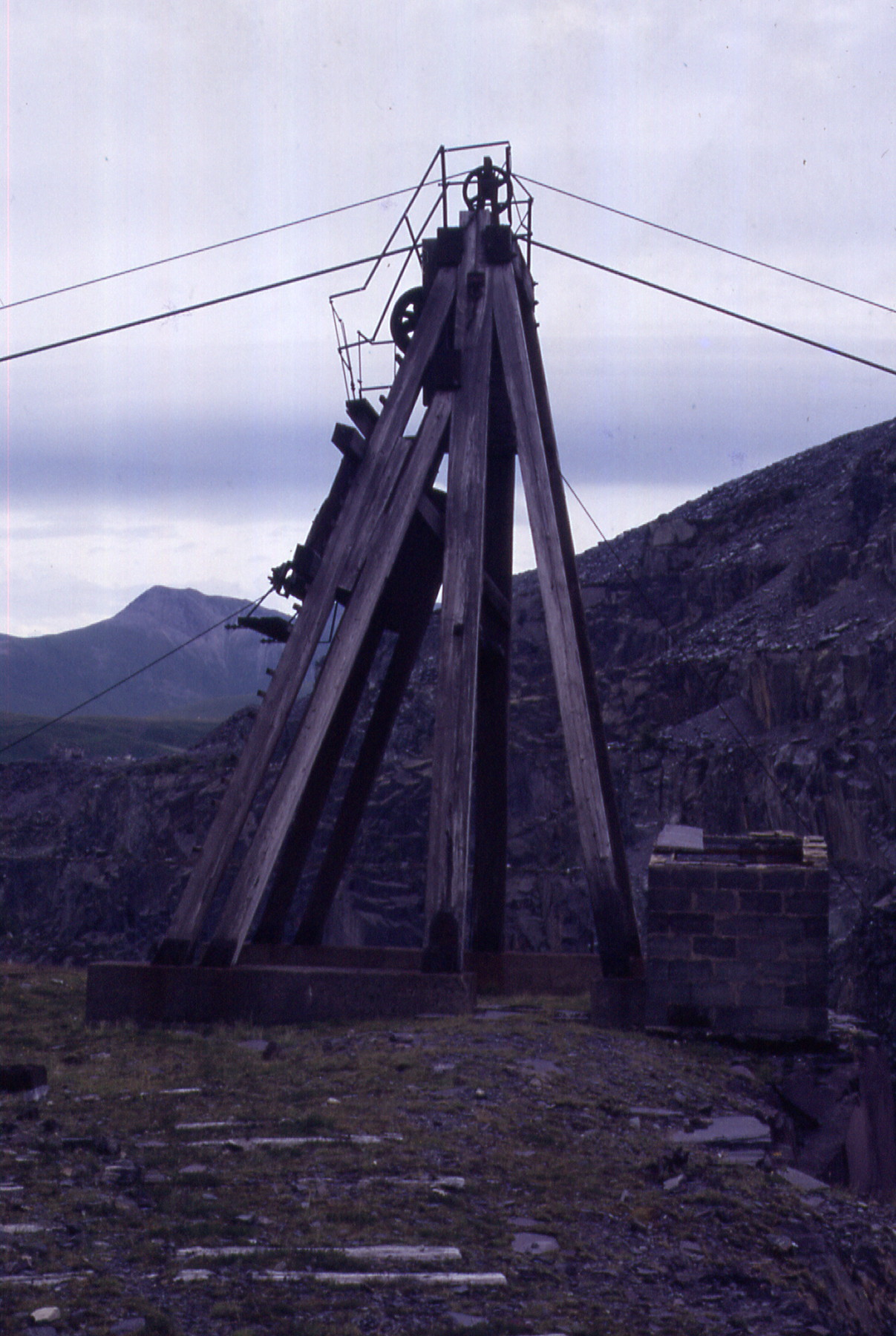
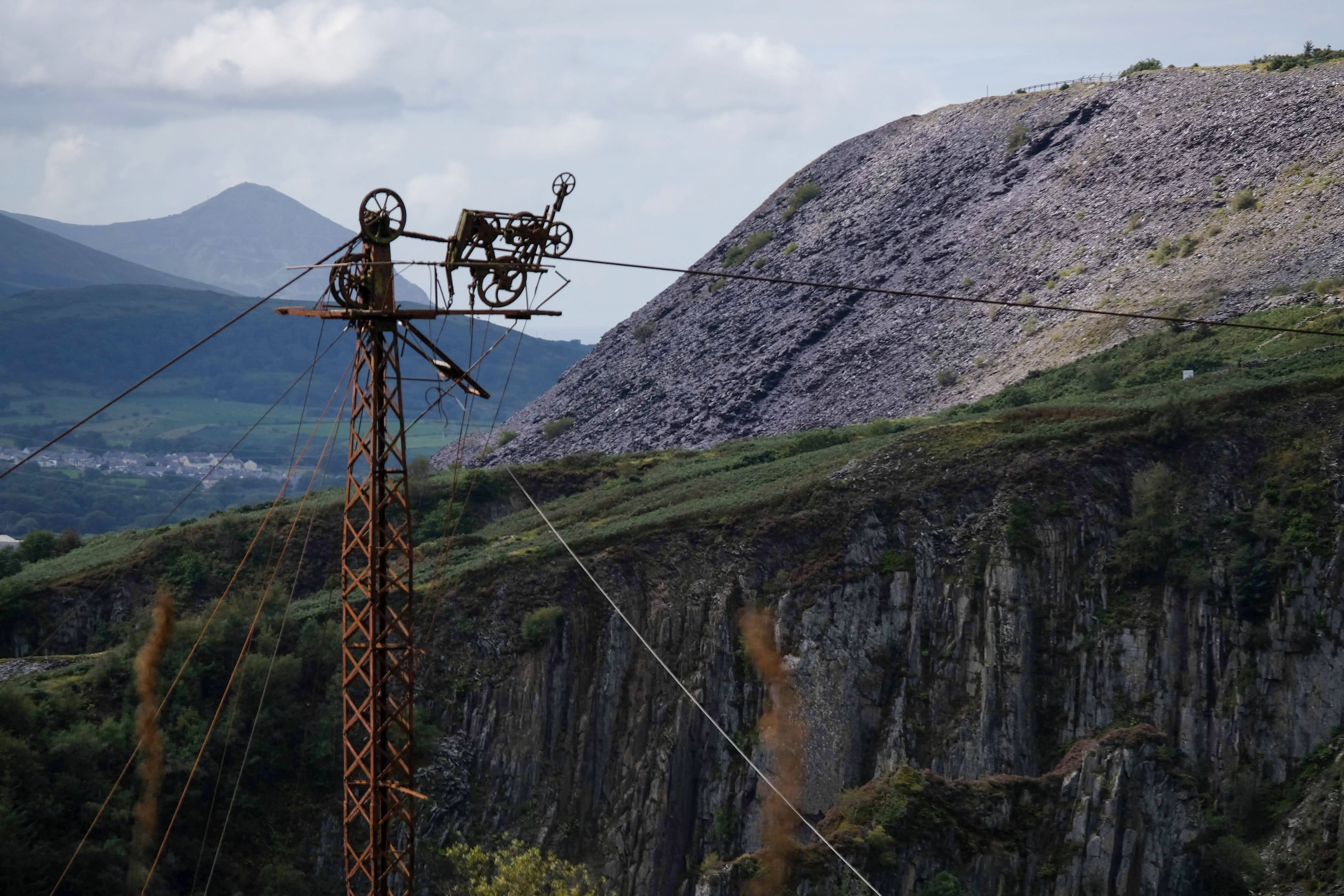
The Blondin was invented by John Fyfe, a Scottish quarry engineer, who installed the first one in 1872 at Kemnay granite quarry in Aberdeenshire. From 1896 John M. Henderson and Company produced them commercially, replacing the original iron ropes with steel, and the type spread through the granite quarries of Scotland and the slate quarries of North Wales, as well as into bridge building in Britain and the United States. Pen-yr-Orsedd in the Nantlle valley had four of them, installed in 1906 with Bruce Peebles electrical gear, and it was there that the last working examples ran until 1979.
How it worked
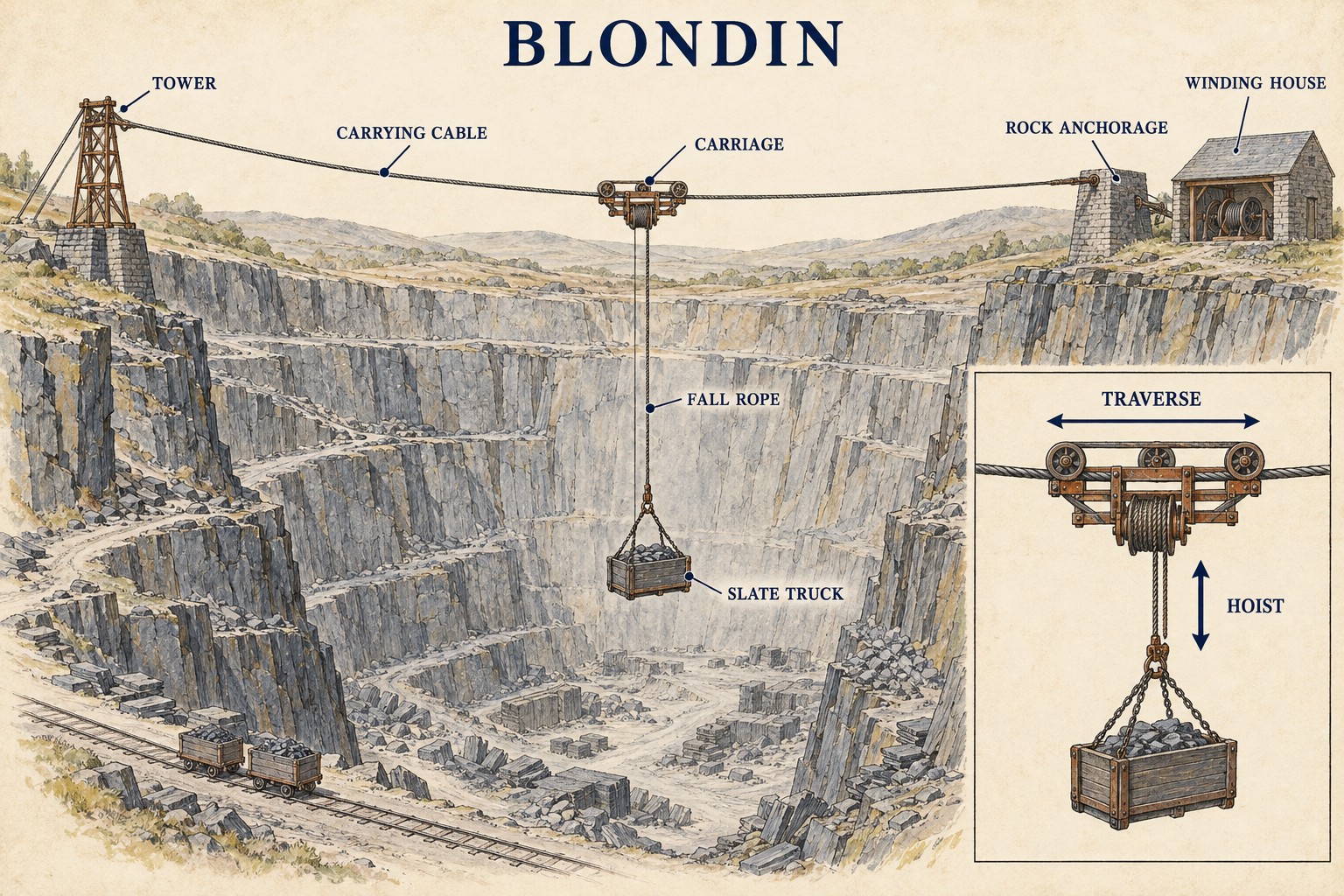
Cables were strung across the pit between towers, or a tower and a rock anchorage, on opposite sides. A carriage ran along the cable, and a fall rope through the carriage lifted and lowered the load beneath it, so the operator controlled two motions at once — traverse and hoist. Power came from a steam or, later, an electric hoist in a winding house at one end. A loaded truck of slate blocks could be picked up off the quarry floor, carried out over the rim and set down on a mill bank without ever touching an incline.
Why it was used
A deep pit is the hard case in quarry haulage. An incline needs a formed trackbed and can only ever serve the fixed points it was built to reach, so every time the pit went deeper the haulage had to be rebuilt to follow it. A Blondin reaches anywhere beneath its span and lifts vertically, which means the pit can be deepened almost indefinitely without touching the transport at all — the single most useful property it has. The name is borrowed from Charles Blondin, the tightrope walker who crossed Niagara, for reasons anyone who has seen a load travelling a slack cable over a quarry will recognise.
Risks & limitations
The towers and anchorages have to be substantial enough to carry both the load and the tension of a long span, and a single cableway is a single point of failure for an entire pit — if it is down, nothing comes out. Operating one well took real skill, since traverse and hoist had to be judged together over a swinging load. The toppled towers still lying at Pen-yr-Orsedd give a fair idea of the forces involved.
Regional variation
Most strongly associated with Aberdeenshire granite, where it was invented, and with the slate quarries of Gwynedd — Penrhyn, Dinorwig and above all Pen-yr-Orsedd. The Nantlle valley also developed its own alternative for the same problem, the locally invented chain incline, so the two solutions can be found within a few miles of each other.
Related terminology
Aerial Ropeway, Headgear, Incline, Waggonway, Whim Crane
Mines associated with this term
5 examples chosen from 7 linked records — the term page is not an index.
- Pen-yr-Orsedd Quarry — Gwynedd (surviving physical example)
The last four working Blondins in Britain ran here until 1979, and one still hangs in place on its cable — the only one of its kind left standing. - Alexandra Quarry — Gwynedd (well documented example)
Named twice in this record, first in the history: “…in 1888, a water-balanced shaft was working by 1893, and two Blondin aerial cableways were installed in 1901 with more added in 1909. In…” - Kemnay Quarry — Aberdeenshire (well documented example)
The blondin aerial ropeway system was developed here by John Fyfe, and went on to be used at deep-pit quarries across Britain — Kemnay is where it started. - Blaenycae Quarry — Gwynedd (well documented example)
Named 4 times in this record, first in the summary: “…around 1830 to the 1930s, using first a chain incline and later a Blondin cableway to lift slate from the pit, before eventually becoming part…” - Tymawr East Quarry — Gwynedd (well documented example)
Named in this record’s surface remains: “…an earlier engine and winder, now quarried away), the bases of a Blondin aerial cableway system, and a well-engineered access road.”
Sources
- (primary) Nantlle Valley Slate Quarry Landscape — 'Blondin' ropeway, Pen yr Orsedd Slate Quarry — UNESCO World Heritage Centre
- (primary) Pen-yr-Orsedd Slate Quarry — Coflein (Royal Commission on the Ancient and Historical Monuments of Wales)
- (secondary) Blondin (quarry equipment) — Wikipedia
Record created: 24 August 2026 · Last researched: 24 August 2026