 MineArchive
Dinorwig Slate Quarry
| Location | Between Llanberis and Dinorwig, Gwynedd — 53.1261, -4.0981 (approximate) |
|---|---|
| Commodity | Slate |
| Type | Slate |
| Worked | 1787–1969 |
| Operators | Assheton Smith (1787–1969) |
Overview
Dinorwig, between Llanberis and Dinorwig in Snowdonia, was once the second-largest slate quarry in the world after neighbouring Penrhyn — a 700-acre working employing over 3,000 men at its peak, closed abruptly in 1969 and now the site of the National Slate Museum.
History
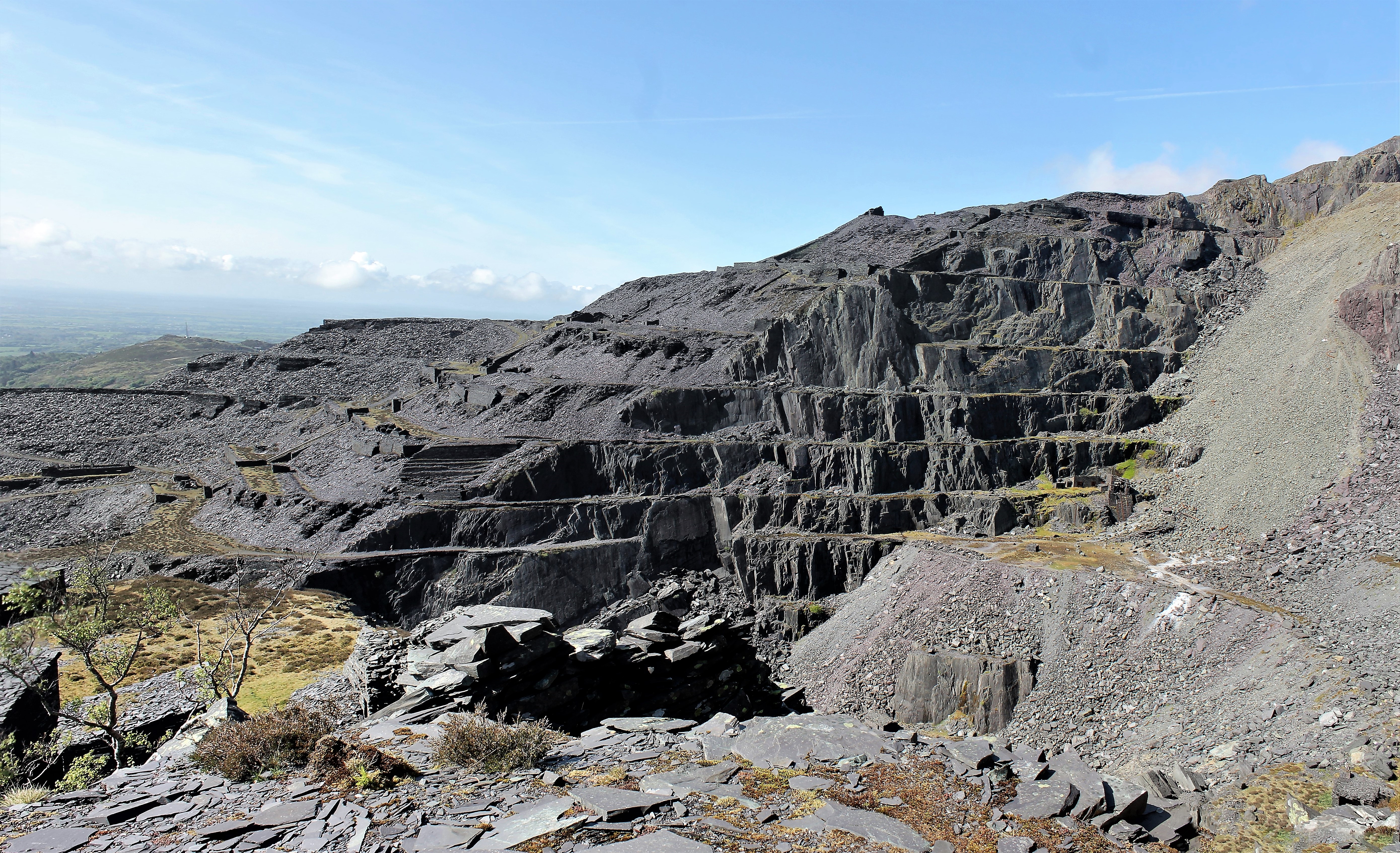
Small-scale slate extraction was first attempted at Dinorwic in 1787 under a private partnership leasing the site from the landowner Assheton Smith, but progress was slow in the face of wartime conditions, taxation and high transport costs. A new partnership, again led by Assheton Smith, took over on expiry of the lease in 1809, and the opening of a horse-drawn tramway to Port Dinorwic in 1824 finally solved the transport problem, triggering rapid expansion. By its late 19th-century peak the quarry produced around 100,000 tonnes of slate a year and employed over 3,000 men, worked across roughly 700 acres in galleries stepped up the near-vertical slate vein — the second-largest slate producer in the world after Penrhyn. Employment had fallen to around 2,000 by 1930. Decades of unsystematically placed waste tips began collapsing into the main workings during the 1950s and 60s, and a major rockfall in the Garret area in 1966 effectively ended large-scale production; after a period of limited salvage work, Dinorwig finally closed on 4 July 1969. Conditions could be dangerous: a parliamentary return for 1909 recorded four men killed and 332 seriously injured among 1,017 men working inside the quarry that year alone, and in June 1910 the Liberal MP Ellis Davies told the Commons that one in three of the men working inside Dinorwig had been injured in each of the previous two years. Home Secretary Winston Churchill confirmed that a Royal Commission then sitting would take evidence on safety conditions in the North Wales slate industry as a result.
Geology
Slate of the Llanberis belt, worked across roughly 700 acres in galleries stepped up the mountainside above Llyn Peris.
Workings
The quarry's near-vertical slate vein allowed it to be worked through galleries stepped up the mountainside — around 20 galleries in each of its two main sections — connected by an extensive internal tramway network on 1ft 10¾in gauge track and by inclines, including the Vivian Transporter Incline of 1873 (restored in 1998). Early De Winton steam locomotives were succeeded mainly by Hunslet engines from 1870, and 22 internal-combustion rail tractors were acquired between 1935 and 1949, of which only three survived to closure.
Closure
Closed on 4 July 1969 after a period of limited salvage work.
What remains
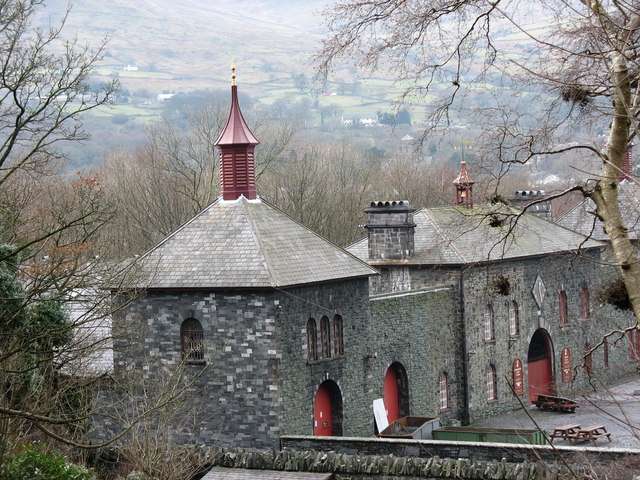
The quarry workshops at Gilfach Ddu, built in the 1870s, now house the National Slate Museum, under lease to National Museum Wales; equipment from the internal railway was reused to build the Llanberis Lake Railway over part of the old trackbed. Since 1974 much of the mountain behind the quarry has been hollowed out further for the Dinorwig pumped-storage power station, 'Electric Mountain', opened in 1984, and the site was inscribed as part of the Slate Landscape of Northwest Wales UNESCO World Heritage Site in 2021.
Related mines
- Marchlyn Quarry — Marchlyn is one of Dinorwic's outlying pits, worked upslope of the main galleries alongside Wellington and Hafod Owen, and closed with the quarry in 1969.
- Vivian Quarry — Vivian Quarry was a self-contained department within the wider Dinorwig slate quarry complex.
Nearby mines
- Vivian Quarry — 0.7 miles (1.1 km) W
- Marchlyn Quarry — 1.2 miles (2.0 km) N
- Glynrhonwy Quarry — 1.7 miles (2.7 km) W
- Penrhyn Quarry — 3.1 miles (5.0 km) NE
- Coetmor Quarry — 4.1 miles (6.6 km) N
Straight-line distance, within 9 miles (15 km). Show on the map.
What's uncertain
Points where sources disagree or the record could not be settled; both accounts are kept. All open questions in the archive.
- A 2023 report describes the quarry's upper levels, including the Australia Mill and its compressor house, as remaining in 'remarkable condition, with many of the buildings and artifacts remaining in place', preserved by minimal disturbance since closure. (uncertain) 2
Recorded claims
Individual factual claims, each attached to the source(s) that support it below. Where sources disagree, both are kept.
- At its late 19th-century peak, Dinorwig produced around 100,000 tonnes of slate a year and employed over 3,000 men across roughly 700 acres — the second-largest slate quarry in the world after neighbouring Penrhyn. 1
- Decades of unsystematically placed waste tips began collapsing into the workings during the 1950s and 60s, and a major 1966 rockfall in the Garret area effectively ended large-scale production before the quarry finally closed on 4 July 1969. 1
- Since 1974, much of the mountain behind the old quarry has been hollowed out further for the Dinorwig pumped-storage power station, 'Electric Mountain', which opened in 1984. 1
- A 2023 report describes the quarry's upper levels, including the Australia Mill and its compressor house, as remaining in 'remarkable condition, with many of the buildings and artifacts remaining in place', preserved by minimal disturbance since closure. (uncertain) 2
- A parliamentary return for 1909 recorded four men killed and 332 seriously injured among 1,017 men working inside the quarry that year; in 1910 it was stated that one in three men working inside Dinorwic had been injured in each of the previous two years. 3,4
- Home Secretary Winston Churchill confirmed in June 1910 that a Royal Commission then sitting would take evidence on safety conditions in the North Wales slate industry. 4
Photographs & further reading
A report on the quarry's upper levels, including the Australia Mill and compressor house.
View sourceSources
- (secondary) Dinorwic quarry — Wikipedia
- (observational) Dinorwic Slate Quarry, Llanberis — 2023 — 28DaysLater
- (primary) Dinorwic Slate Quarries (Accidents) — Hansard, House of Commons, 9 March 1910
- (primary) Dinorwic Slate Quarry Accident — Hansard, House of Commons, 22 June 1910
Record created: 20 August 2026 · Last researched: 24 August 2026