 MineArchive
Vivian Quarry
| Location | Llanberis, Gwynedd — 53.1231, -4.1145 (exact) |
|---|---|
| Commodity | Slate |
| Type | Slate |
| Worked | 1870s–1960 |
| Maximum depth | Worked on seven levels; the flooded former pit now reaches roughly 18 metres in depth. |
Overview
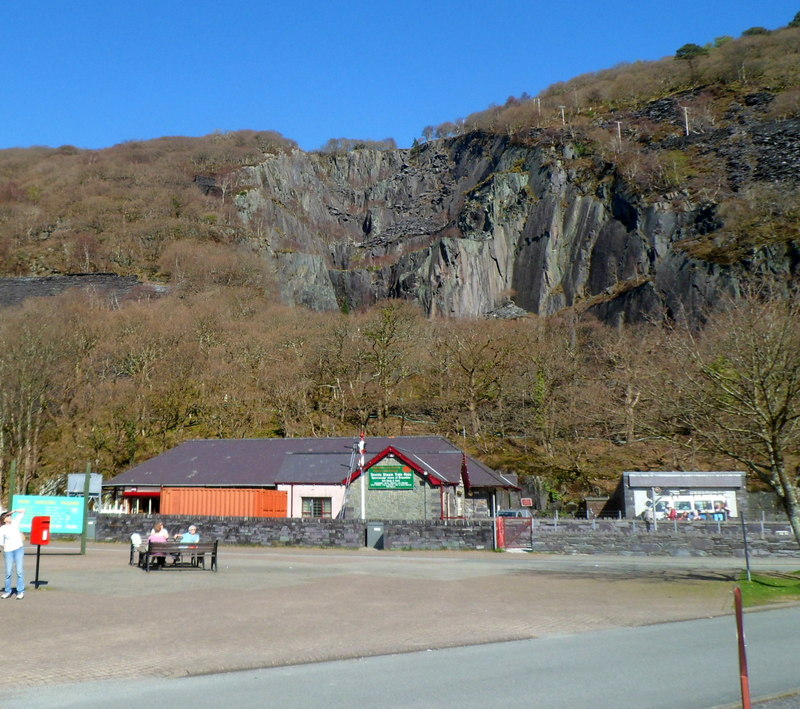
A self-contained department of the vast Dinorwig slate quarry at Llanberis, worked on seven levels from the 1870s until 1960 and named after its manager, the Hon. Walter Warwick Vivian -- its flooded former pit is now the Vivian Diving Centre, a popular site for exploring a submerged quarry landscape.
History
Vivian Quarry formed a self-contained part of the wider Dinorwig slate quarry complex, named after Walter Warwick Vivian, appointed manager of Dinorwig at the age of 28 in 1884 -- the son of the 2nd Baron Vivian and a considerable social step up from the quarrymen he managed. Initial quarrying from the 1870s worked downward, with the visible galleries later formed as extraction proceeded back upward through seven working levels. Slate cut in the galleries travelled by small railway wagon to inclines that lowered it down the quarry face, while waste rock was hauled across the hillside, over a bridge crossing the Padarn Railway (now the Llanberis Lake Railway), to be tipped at the lake shore. An aerial ropeway fitted with a 'Blondin' device -- named after the tightrope walker Charles Blondin, who performed in Caernarfon in 1878 -- raised slate from the lower levels; one of its wagons is still displayed outside a shop in Llanberis. Quarrying finished in 1960, after which run-off and underground springs flooded the worked-out pit to a depth of around 18 metres, creating the lagoon used today by the Vivian Diving Centre.
Geology
Slate of the Llanberis belt, a self-contained department of the Dinorwig quarry worked on seven levels.
Workings
Worked on seven levels via galleries linked by inclines; waste rock was hauled across the hillside for tipping at the lake shore, and an aerial 'Blondin' ropeway raised slate from the lowest levels.
Closure
Quarrying ended in 1960; the site was never reworked afterward.
What remains
Flooded to a depth of about 18 metres since quarrying ended in 1960, now run as the Vivian Diving Centre; divers can see surviving quarry buildings, equipment and vehicles on the submerged quarry floor. One incline, V2, was restored to working order in 1998 by the National Museum of Wales. The quarry's dry upper rock faces also became a significant British rock-climbing venue from the early 1980s, most famously the site of Stevie Haston's 1981 route Comes the Dervish on the Dervish Slab -- widely credited with triggering the wider Llanberis slate-climbing boom of that decade. Climbing access has since been restricted in favour of the diving centre, which is now the site's primary recreational use.
A restored incline (V2) with its distinctive traveller-carriage design, preserved in 1998 by the National Museum of Wales, together with quarry buildings visible both above and below the waterline. The dry rock faces above the flooded floor, including the Dervish Slab, remain physically in place from the quarry's brief but influential era as a climbing venue.
Related mines
- Dinorwig Slate Quarry — Vivian Quarry was a self-contained department within the wider Dinorwig slate quarry complex.
Nearby mines
- Dinorwig Slate Quarry — 0.7 miles (1.1 km) E
- Glynrhonwy Quarry — 1.0 miles (1.7 km) W
- Marchlyn Quarry — 1.6 miles (2.7 km) NE
- Penrhyn Quarry — 3.6 miles (5.8 km) NE
- Coetmor Quarry — 4.5 miles (7.3 km) NE
Straight-line distance, within 9 miles (15 km). Show on the map.
Recorded claims
Individual factual claims, each attached to the source(s) that support it below. Where sources disagree, both are kept.
- Vivian Quarry was worked on seven levels and named after Walter Warwick Vivian, appointed manager of the wider Dinorwig quarry in 1884 at the age of 28. 1
- Slate working at Vivian Quarry finished in 1960; the flooded former pit, up to 18 metres deep, is now used by the Vivian Diving Centre, with surviving quarry huts and equipment visible underwater. 1
- One incline, V2, was restored to working order in 1998 by the National Museum of Wales; it uses a distinctive design in which quarry trucks are carried on traveller carriages. 1
- The quarry's dry upper rock faces became a significant British rock-climbing venue from the early 1980s, most famously the site of Stevie Haston's 1981 route Comes the Dervish on the Dervish Slab, widely credited with triggering the wider Llanberis slate-climbing boom of that decade; climbing access has since been restricted in favour of the Vivian Diving Centre, now the site's primary recreational use. 2
Photographs & further reading
A detailed account of the quarry's working levels, its manager Walter Warwick Vivian, and its afterlife as a diving centre.
View sourceSources
- (secondary) Former Vivian slate quarry, Llanberis — History Points
- (secondary) DESTINATION GUIDE: Llanberis Slate - The Full Tour — UKClimbing
- (observational) Vivian Quarry near Llanberis — Geograph Britain and Ireland (Jaggery)
Record created: 30 August 2026 · Last researched: 30 August 2026