 MineArchive
Penrhyn Quarry
| Location | Bethesda, Gwynedd — 53.1670, -4.0670 (exact) |
|---|---|
| Commodity | Slate |
| Type | Slate |
| Worked | 1770s–Still active |
| Maximum depth | Main pit nearly 1 mile long, up to 1,200 ft (370 m) deep |
| Operators | Pennant / Penrhyn Estate (1765–1965) |
Overview
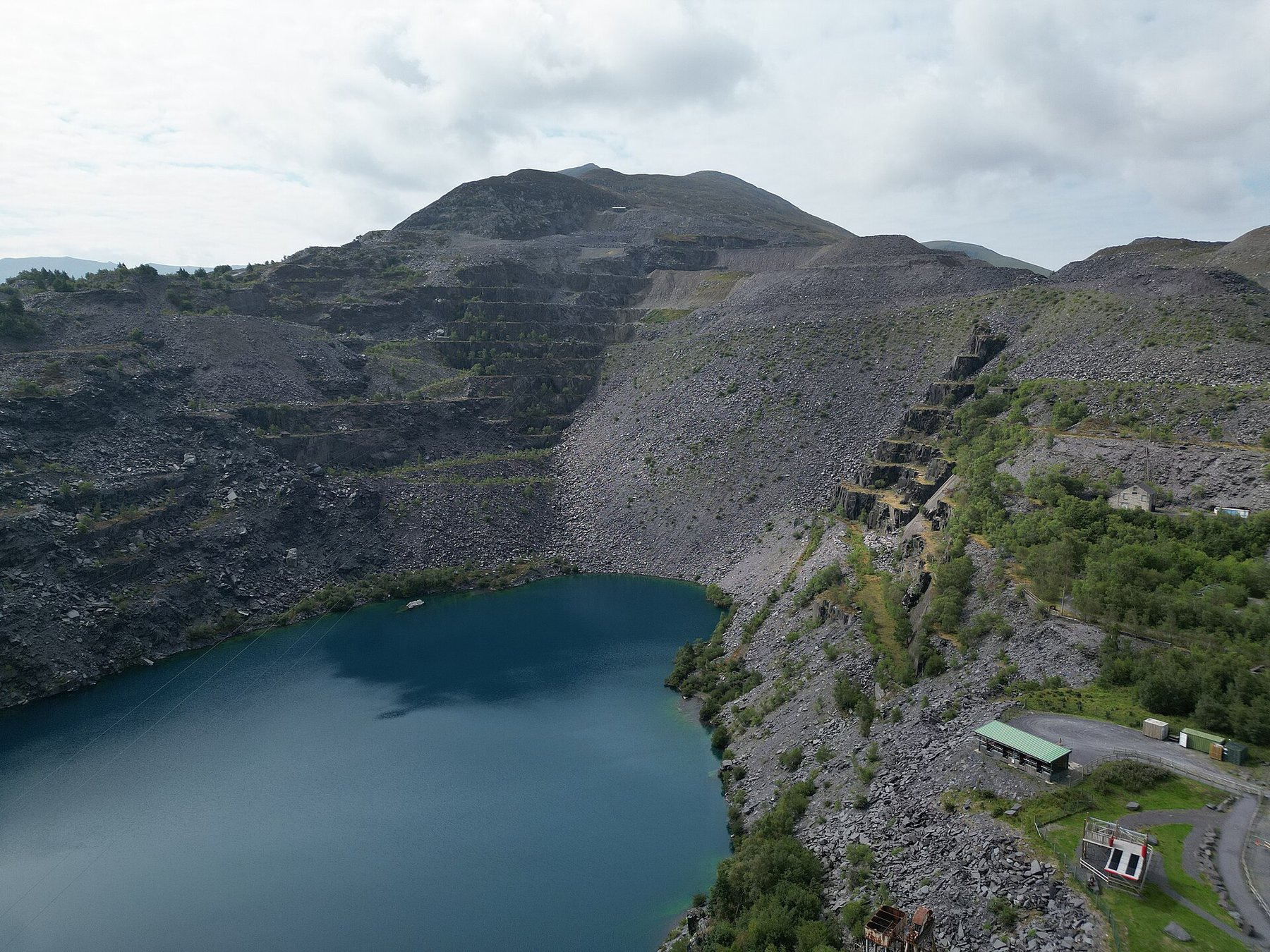
Penrhyn Quarry, above Bethesda in Gwynedd, was the world's largest slate quarry at its 19th-century peak, and remains Britain's largest today. It is also the site of the Great Penrhyn Strike of 1900-1903, Britain's longest-running industrial dispute, which locked nearly 3,000 men out of work for three years and left the community of Bethesda permanently changed.

History
Slate extraction at Penrhyn is first recorded in a Welsh poem of 1570, but the modern quarry dates from the 1770s, when Richard Pennant began developing it on land his marriage had brought into the family. Ownership passed down through the Pennant/Douglas-Pennant family, who became Barons Penrhyn, for the next two centuries. The quarry grew to be the world's largest slate quarry through the 19th century, employing close to 3,000 men and producing around 112,000 tonnes of slate a year by 1881. On 22 November 1900, nearly 3,000 quarrymen walked out after Lord Penrhyn and quarry manager Emilieus Young moved to break the North Wales Quarrymen's Union's influence at the site, beginning what became a three-year lockout — the Great Penrhyn Strike — over union rights, pay and working conditions. The dispute ended in 1903 with the union defeated and the Bethesda community, in the words of historians of the dispute, never fully recovering.
Geology
The quarry works a major deposit of Cambrian slate on the northern edge of Snowdonia, extracted as a vast open-cast pit rather than underground workings.
Geological setting: Slate and Regional Metamorphism (well documented example)
Workings
Extraction proceeds as a single enormous open pit, now nearly a mile long and up to 1,200 feet deep, worked in stepped galleries; accidents were a serious and recurring hazard throughout the quarry's history — across the wider Carnarvonshire slate quarries, 110 fatal accidents were recorded in the decade 1883-1892 alone. Much of the quarry's plant was water-powered: water-balance lifts raised slate from the underground workings, water drove an air compressor for pneumatic tools, and the Felin Fawr slate works below the quarry carried two water wheels, the older of about 1846 thought to have driven sawing and dressing machines and a second of about 1907 powering foundry bellows and a machine shop.
Closure
Still active. The associated National Slate Museum at Llanberis, a separate site, closed in November 2024 for redevelopment.
What remains
Penrhyn Quarry remains a working slate quarry today, now under Welsh Slate/Breedon ownership, and forms part of the Slate Landscape of Northwest Wales UNESCO World Heritage Site. The associated National Slate Museum at nearby Llanberis (not this site itself) closed in November 2024 for a major £21m redevelopment, expected to reopen in 2026. A 2022 report records both Felin Fawr wheels still in place, largely below ground in deep pits: the older has lost most of its wheelhouse and its pit is sheeted over, while the 1907 wheel retains its house. Felin Fawr itself has been redeveloped as an industrial estate, so the surviving structures now stand among working businesses.
Related mines
- Blaen y Cwm Quarry — William Griffiths, formerly of Penrhyn quarry, was brought in as Blaen y Cwm's manager.
- Pantdreiniog Quarry — Pantdreiniog was purchased specifically to give employment to strikers locked out of Penrhyn during the Great Strike of 1900-03.
Nearby mines
- Coetmor Quarry — 1.1 miles (1.7 km) N
- Pantdreiniog Quarry — 1.2 miles (1.9 km) N
- Marchlyn Quarry — 2.0 miles (3.2 km) SW
- Dinorwig Slate Quarry — 3.1 miles (5.0 km) SW
- Vivian Quarry — 3.6 miles (5.8 km) SW
Straight-line distance, within 9 miles (15 km). Show on the map.
Culture
- The Pantdreiniog Co-operative Quarry (Labour)
The Penrhyn lockout of 1896 and Great Strike of 1900-03 were the reason for the co-operative.
Recorded claims
Individual factual claims, each attached to the source(s) that support it below. Where sources disagree, both are kept.
- By 1881 Penrhyn Quarry produced around 112,000 tonnes of slate a year, employing close to 3,000 men at its peak. 1
- The Great Penrhyn Strike began on 22 November 1900, when nearly 3,000 quarrymen walked out after the owner and manager moved to break the North Wales Quarrymen's Union's influence at the site; the three-year lockout ended in 1903 with the union defeated. 1,2
- Across the Carnarvonshire slate quarries as a whole, 110 fatal accidents were recorded between 1883 and 1892; individual recorded deaths at Penrhyn include a worker killed by a falling five-ton boulder in 1861 and Richard Hughes, killed on one of the inclines in 1882. 3,4
- Penrhyn was still producing slate in 2022, and its operator describes the quarry as having been in commercial production for over seven centuries and as having employed more than 2,500 people at its 19th-century peak. 5,6
- Located at about 53.167 N, 4.067 W. 1
Photographs & further reading
The present operator's own page on the quarry, giving its production history and current commercial status.
View sourceSources
- (secondary) Penrhyn quarry — Wikipedia
- (secondary) The great Penrhyn quarry strike — TUC 150 Stories
- (secondary) Penrhyn slate quarry — History Points
- (primary) Penrhyn Quarry (Wales) -- Accidents — National Library of Wales Archives and Manuscripts
- (observational) Water Turbines 4 — Penrhyn Quarry Turbine House and Felin Fawr Water Wheel — 28DaysLater
- (secondary) Penrhyn Slate Quarry — Welsh Slate
Record created: 20 August 2026 · Last researched: 9 September 2026